
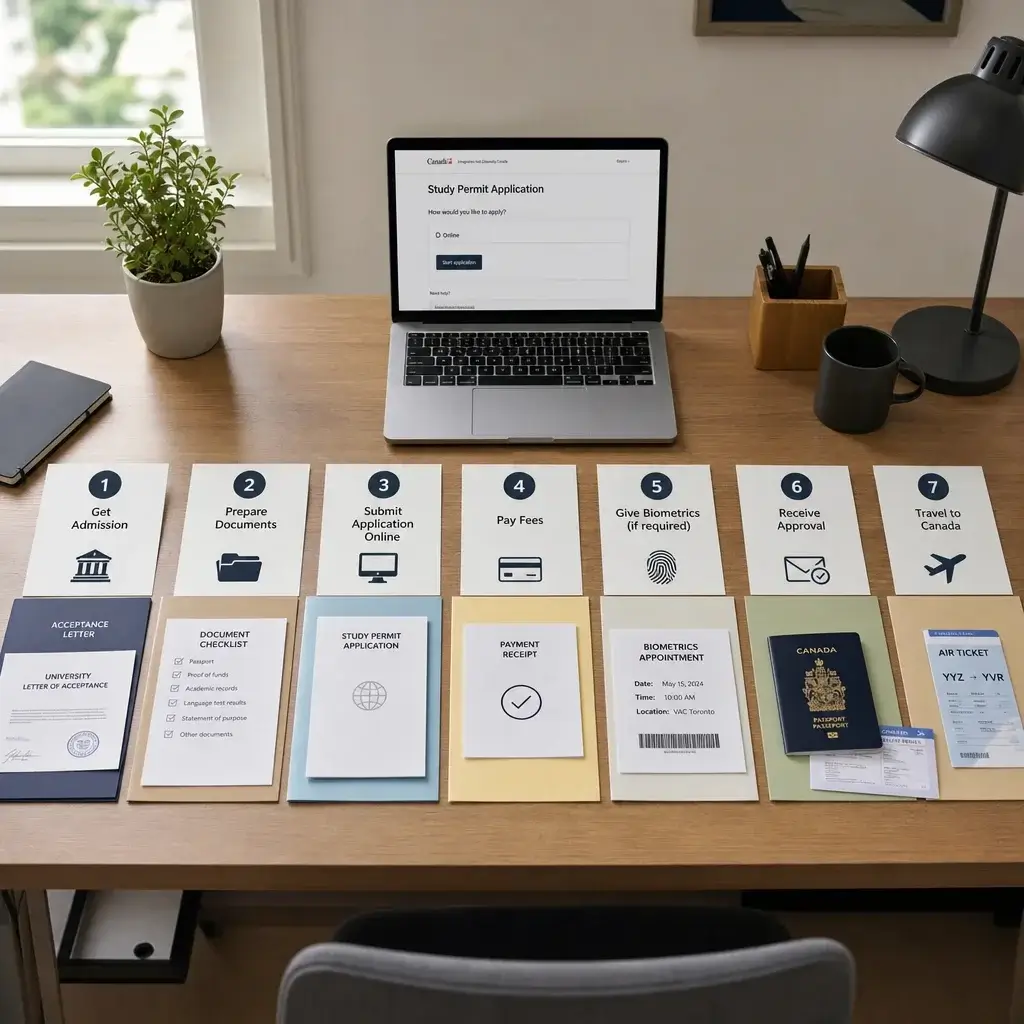
Many applicants treat the study permit process like a form-filling job. That is a mistake. A Canada study permit file is really a credibility file. IRCC checks whether the school, the money, the purpose, and the timeline all fit together.
I work from a practical rule. Build the file in the same order an officer will read it. That cuts confusion fast. Rules change. IRCC updates forms, document triggers, and travel instructions. Check current official guidance before you submit.
Canada study permit process at a glance
The Canada study permit process usually runs in 7 steps: get accepted by a designated learning institution, confirm whether you need a PAL or TAL or a CAQ, gather your documents, apply online, complete biometrics or a medical exam if required, answer IRCC follow-up requests, then travel to Canada after approval with the right entry documents and receive the actual permit at the port of entry.
A Canadian study permit is permission to study in Canada for an approved program at an eligible school. It is not the same thing as a visa. A study permit allows study inside Canada, while a TRV or an eTA is travel authorization used to board a plane and seek entry.
The admission-to-arrival timeline has clear stages. After acceptance, confirm your school is a DLI and check province-specific requirements. Before submitting, gather identity, school, and financial documents. After submitting, watch for biometric and medical instructions. After approval, review your Letter of Introduction and travel documents. On arrival, check every condition printed on the permit before you leave the inspection area.
Applying early is safer because Study permit processing time and IRCC study permit processing time vary by country, season, biometrics timing, medical screening, and file completeness. I would not plan around one internet estimate. I would plan around your program start date and the current IRCC tool.
Who needs a study permit in Canada, and who may be exempt?
Most foreign nationals need a study permit if the program in Canada is longer than 6 months. That is the basic threshold people miss. If your course or program will go past that point, study permit requirements Canada usually apply before you begin.
A designated learning institution, or DLI, is a school approved by a province or territory to host international students. Admission to a DLI is the starting gate. Without a valid letter of acceptance from an eligible school, the Canada study permit application usually fails on eligibility.
Some people may study without a permit in narrow situations, but exemptions are fact-specific and should not be stretched. The common variables are program length, the person’s status in Canada, and the legal category they fall under. For special cases, I would verify the exact IRCC exemption page instead of relying on forum advice.
Decision tree: do you need a PAL/TAL, CAQ, biometrics, medical exam, TRV or eTA?
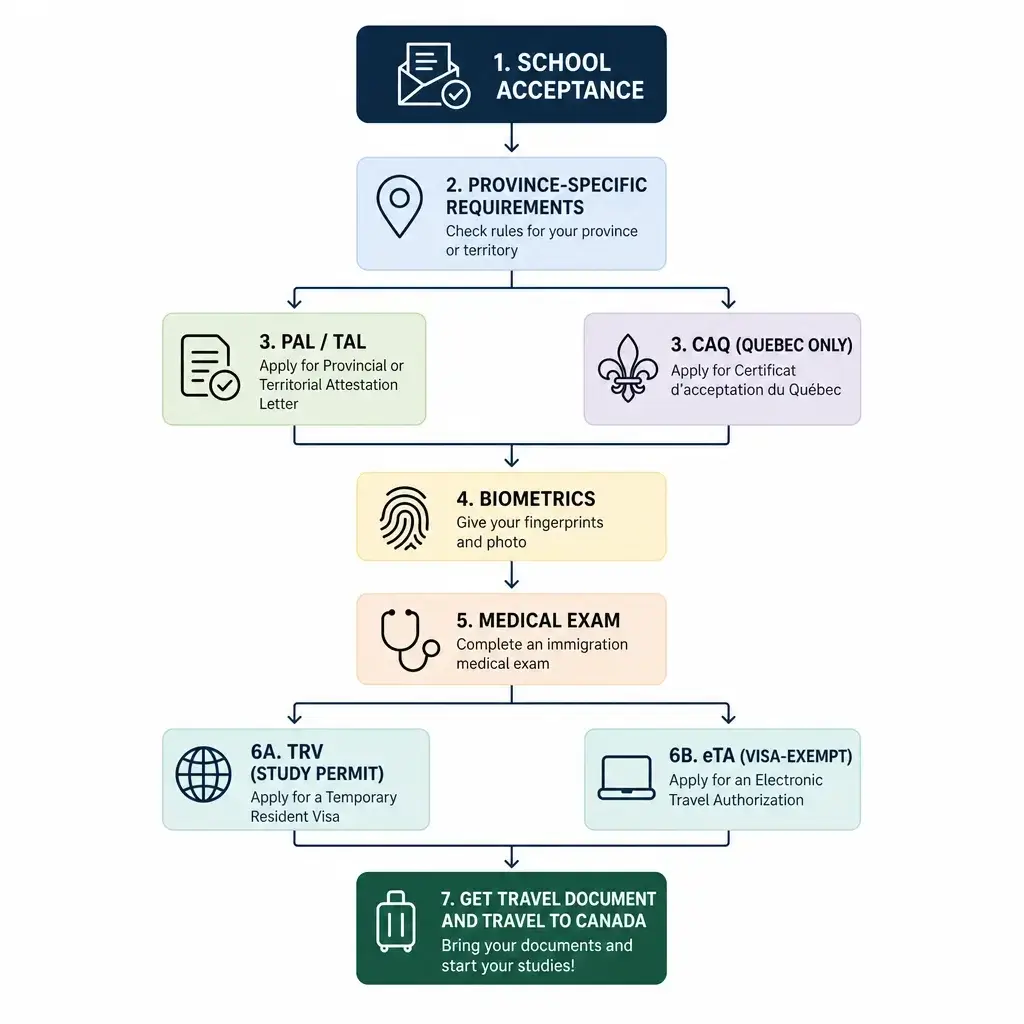
The fastest way to avoid filing the wrong package is to split the requirements into 5 separate checks: school acceptance, provincial letter needs, Quebec rules, travel document needs, and identity or health screening.
A PAL or TAL is a provincial or territorial attestation letter used in some study permit cases under newer IRCC controls for international students. Whether you need one depends on factors like the province, school type, and level of study. Because IRCC new rules for international students study permit files have changed over time, you must check the current exemption and requirement list for your exact category.
A CAQ is Quebec’s own acceptance document for many students planning to study in Quebec. If your program is in Quebec, PAL TAL CAQ study permit analysis starts with the school and province, not with the federal form alone.
Biometrics are fingerprints and a photo collected to confirm identity. Medical exams are immigration health exams done by approved panel physicians. Whether IRCC study permit requirements include biometrics or a medical often turns on your country of residence, travel history, length of stay, and the type of work or study environment connected to your program.
A TRV or eTA is separate from permission to study. TRV eTA study permit questions cause confusion because applicants mix entry documents with study authorization. If you are visa-required, you generally need a TRV to travel. If you are eTA-required, you need an eTA instead. The study permit does not replace that boarding and entry document.
Paper filing and border applications are not the standard path for most applicants. Online filing is the normal route. Any exception should be checked against current IRCC instructions before you depend on it.
Step-by-step: how to apply for a study permit
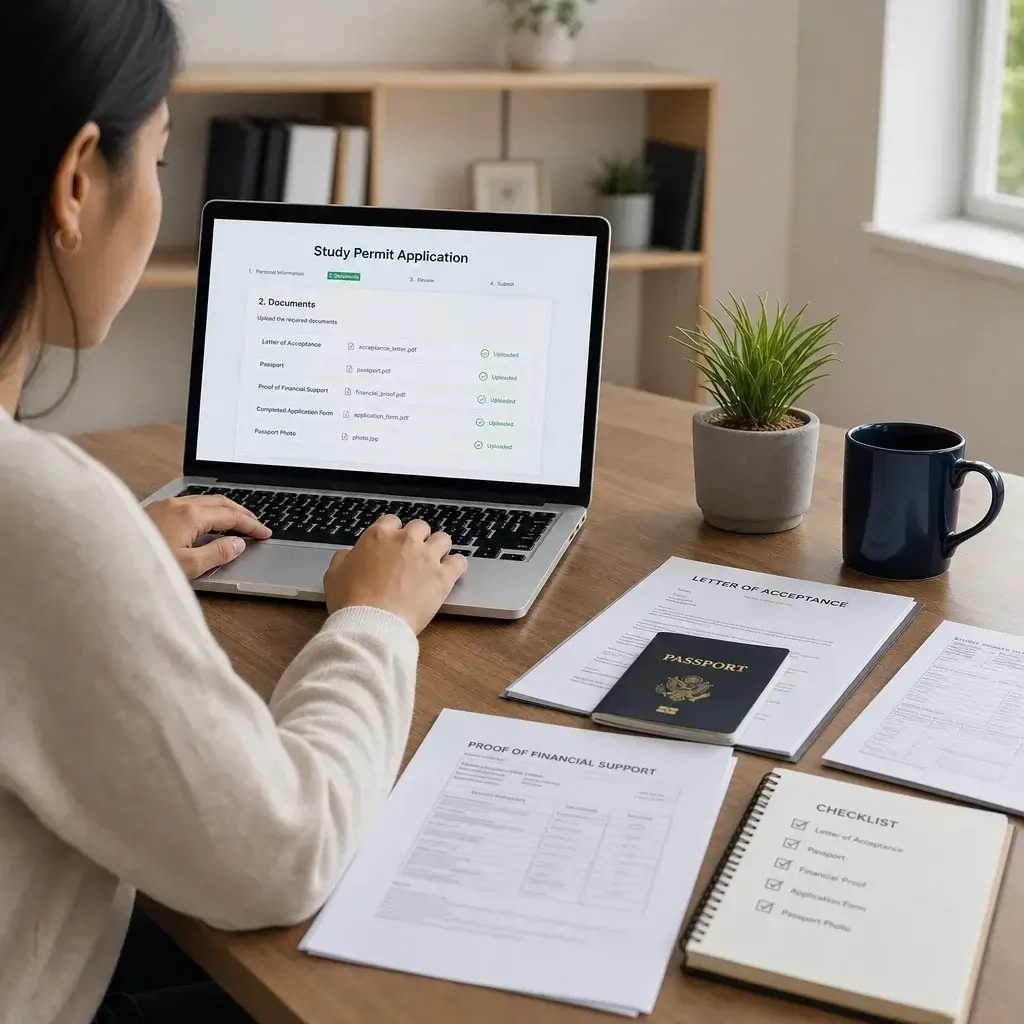
The safest filing order is 8 steps. First, secure admission from a DLI and keep the final letter of acceptance exactly as issued. Second, confirm whether your case needs a PAL, TAL, or CAQ. Third, prepare the passport, school records, financial evidence, family documents if relevant, and any explanation letter needed to connect your background to the program.
Fourth, create or sign into your IRCC account and answer the eligibility questions carefully. The system generates a personalized study permit documents checklist based on the answers you enter. If you answer a status question wrong at this stage, the checklist itself can go wrong.
Fifth, complete the forms and upload clean, readable copies of every required document. The file should read like one story. The program should fit your education or work history. The money should match the tuition and living plan. The sponsor, if any, should be clearly connected to the applicant.
Sixth, pay the government fees shown in the portal and submit the full package. I am not listing the fee amounts here because fees can change and the brief requires current verification for exact figures. Check the current IRCC fee page for the application fee and the biometrics fee before payment.
Seventh, watch the account after filing. After submission, IRCC may issue a biometrics instruction letter, a medical request, or an additional document request. Delays often begin when applicants stop checking the portal for 1 to 2 weeks during a busy season.
Eighth, respond fast and in full, then wait for the final decision. A good file does not end at submission. It stays alive until approval or refusal. If the case is urgent, delayed, or already refused, this is the stage where legal review can save time and prevent a second weak filing.
Before you submit
A strong study permit process check takes 4 points. Confirm the school and program details match every form. Confirm the funds cover tuition, living costs, and the travel plan. Confirm all translations are complete and readable. Confirm the explanation letter resolves any gap, career change, or sponsorship question before the officer has to guess.
Study permit document checklist
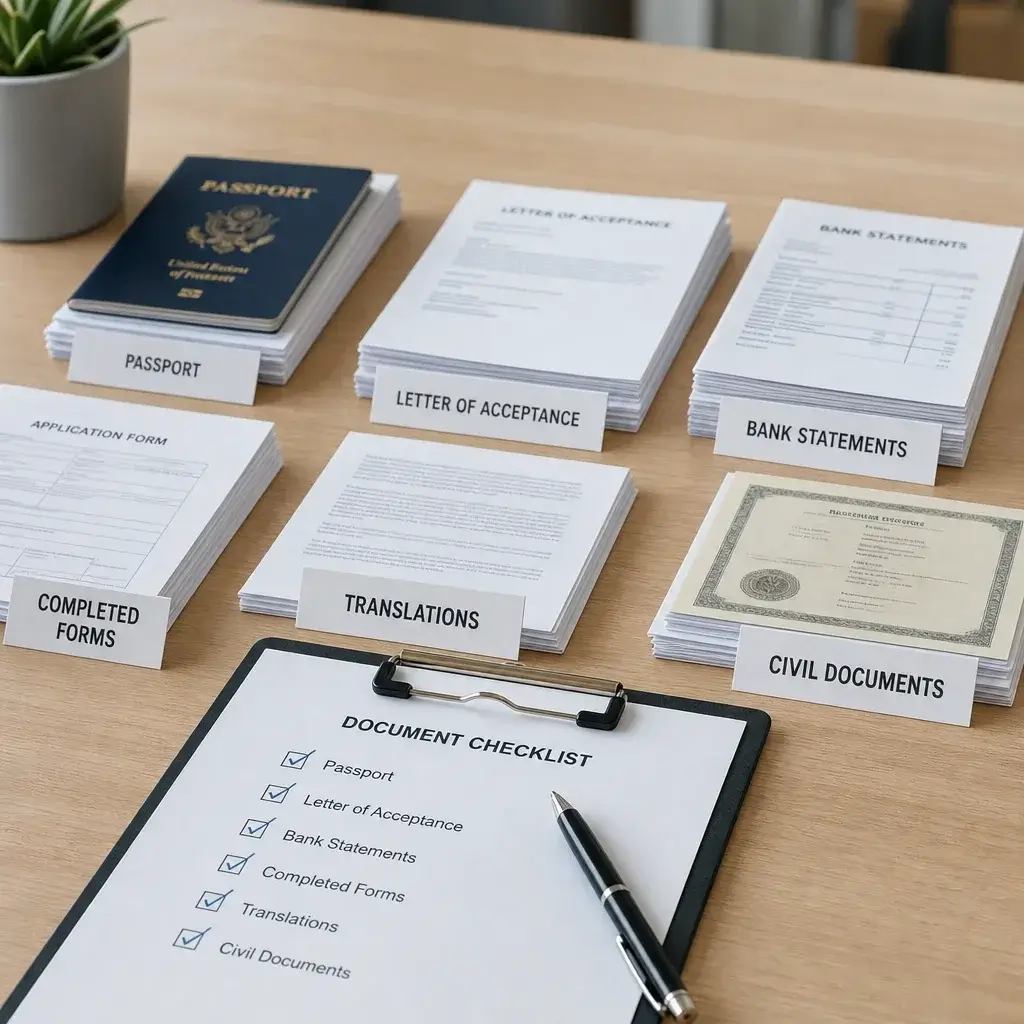
The core study permit documents checklist usually starts with the passport, letter of acceptance, financial evidence, completed IRCC forms, and photographs if requested in the system. If family members are included, civil status documents such as marriage certificates or birth certificates may also be required.
The letter of acceptance proves the school has admitted you to a specific program. The passport proves identity and travel document validity. Financial records prove you can cover tuition and living costs. Family documents prove relationships where a spouse or child is part of the file. PAL, TAL, or CAQ documents prove provincial compliance where they apply.
Country-specific checklists matter because IRCC can ask applicants in different regions for different supporting records. That is why a generic internet list fails so often. The personalized checklist in the portal is stronger than any blog post, including this one.
Translations must be complete, not selective. If a document is not in English or French, the translated version should follow current IRCC translation rules. A half-translated bank record or a cropped civil certificate is a classic refusal trigger because the officer cannot rely on it.
A coherent package beats a thick package. I would rather see 1 clean financial story than 12 random documents with conflicting names, dates, or balances. Officers do not reward volume. They reward clarity.
Proof of funds: how much money you may need and what documents help
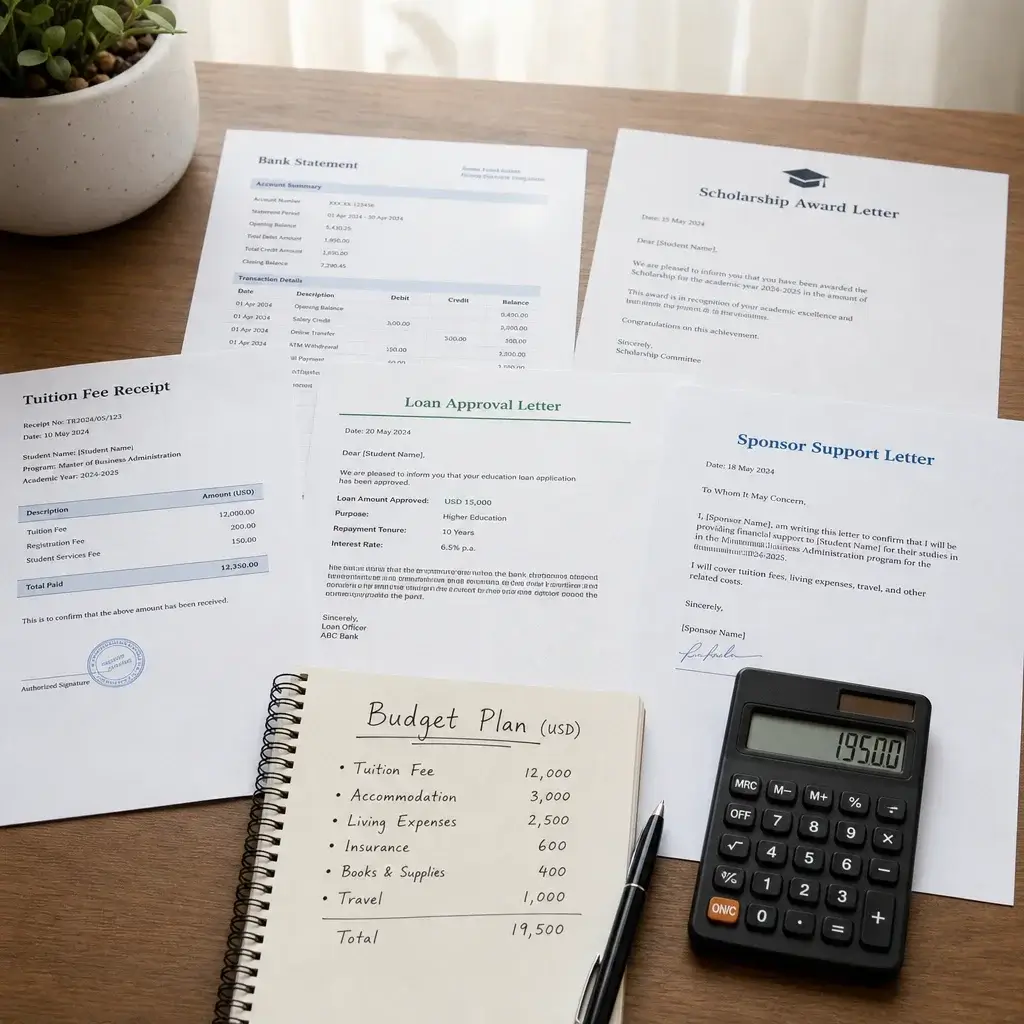
Proof of funds study permit Canada analysis starts with 3 cost buckets: tuition, living expenses, and travel or return transportation where IRCC expects that to be shown. The exact minimum amount changes over time and can differ by location and family size, so you should check the current IRCC table before you file.
What counts as proof of financial support for a study permit usually includes bank statements, proof of tuition payment, scholarship or bursary letters, education loan documents, and sponsor support records with evidence of the sponsor’s income and relationship to you. A sponsor letter alone is weak. A sponsor letter backed by tax, employment, and bank evidence is far stronger.
Here is the practical proof-of-funds table most applicants need:
| Evidence type | What it proves | What can go wrong |
|---|---|---|
| Bank statements | Current cash available and account history | Sudden large deposits with no source explanation |
| Tuition receipt | Money already paid to the school | Receipt does not match the school or student |
| Scholarship letter | Third-party funding committed to study | Letter is conditional or unclear on amount |
| Education loan approval | Approved borrowed funds for studies | Loan is not finalized or terms are missing |
| Sponsor package | Family or other support | Income does not support the promised amount |
| GIC or similar program-linked evidence | Structured student support where applicable | Applicants rely on outdated routes without checking current rules |
The strongest financial package is consistent across 4 points: source of funds, account history, sponsor identity, and total budget. If your bank balance rose sharply 2 weeks before filing, explain the source with sale records, salary records, loan papers, or gift documentation. Unexplained money is one of the easiest ways to trigger credibility concerns.
A realistic budget helps more than a polished letter. If the tuition is high, the living plan must still make sense. If the sponsor supports other dependants, that should be visible in the evidence. If the applicant has already paid a deposit, include the receipt because it shows commitment and reduces doubt.
Study permit processing time, fees and what happens after you apply
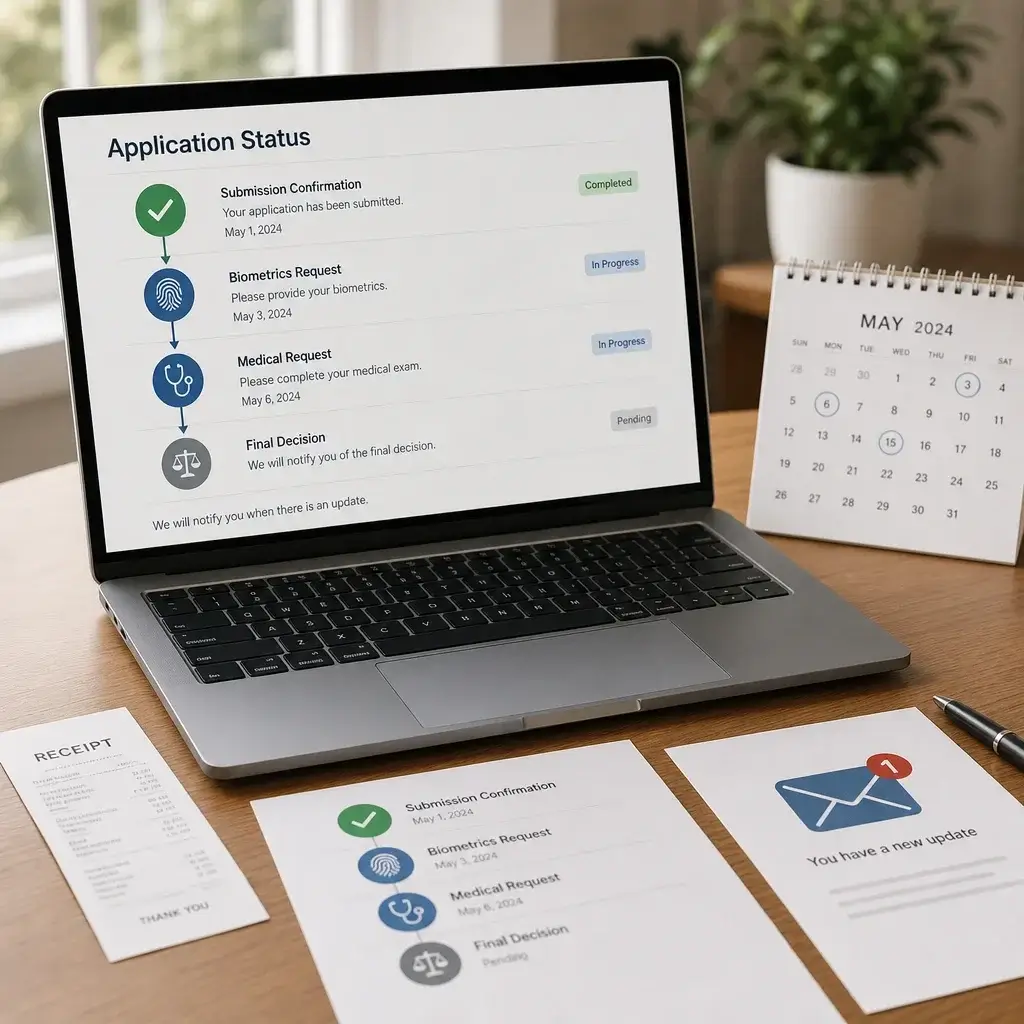
Study permit processing time is variable, not fixed. IRCC study permit processing time changes by country, application volume, biometrics speed, medical screening, security checks, and file completeness. The official IRCC processing tool is the right place to check the current estimate for your location.
The main government charges usually include the study permit application fee and, for many applicants, the biometrics fee. I am not putting exact numbers here because current verification matters and fees can change. Check the current fee schedule on IRCC before you submit or before you refile a returned application.
After you apply, the normal milestones are straightforward. First comes the submission confirmation in your account. Then biometrics instructions may issue. Then medical requests or additional document requests may follow if needed. Then the file moves through background and eligibility review before the final decision.
The best way to check status is through the same IRCC account used to submit the file, along with any official case-specific update tools IRCC currently provides. If IRCC asks for a document, answer exactly what was asked for and upload it in one organized response. Drip-feeding evidence can make a weak impression.
Approval rates are not the most useful metric for this page. Public approval numbers can vary by year and country, and they do not tell you whether your own file is credible. Stronger application factors are clearer: eligible school, logical program choice, complete documents, reliable funds, and a purpose statement that fits the record.
After approval: Letter of Introduction, travel documents and arrival in Canada
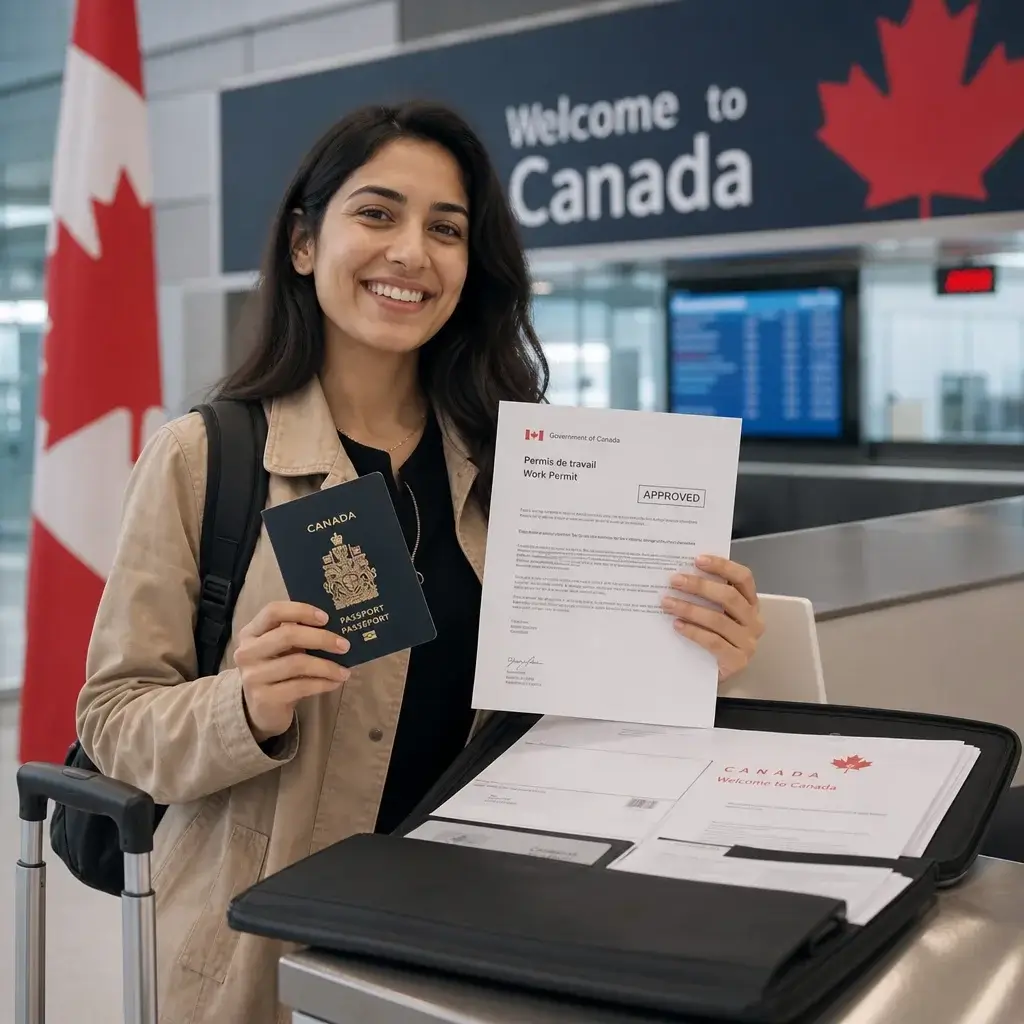
Approval from outside Canada often means you receive a Letter of Introduction, not the final study permit itself. The Letter of Introduction tells border officials that the application was approved and that the permit can be issued on entry after final examination.
You should travel with the passport, the Letter of Introduction, the school letter of acceptance, proof of funds, and copies of any key supporting documents used in the application. If the officer asks a simple question about the school, program, or funding, you should be able to answer it in 30 seconds without searching through your phone.
You may also need a valid TRV or eTA to travel, depending on your nationality and the way IRCC processes your approval documents. Do I need a separate TRV or eTA application after approval is not a small detail. It is a boarding detail. Check the current IRCC instruction page attached to your approval before booking travel.
The actual permit is generally issued at the port of entry for outside-Canada approvals. Before leaving the border area, review the permit line by line. Check your name, the school condition if listed, work conditions, and the expiry date. Errors are easier to fix on the spot than after you leave the airport.
Arrival checklist
The arrival checklist has 5 items: passport, Letter of Introduction, acceptance letter, financial proof, and travel-entry document if required. Then read the permit before you walk away.
Can you work while studying in Canada?
You may be allowed to work while studying in Canada if your study permit conditions authorize it and your program and institution meet the current legal rules. Work permission is condition-based. It does not exist just because you hold a permit with the word student on it.
Off-campus work rules can change, including temporary public policies. Because the brief requires current verification, I am not stating a fixed hour cap here. Check the current IRCC page on off-campus work for the present limit during regular academic sessions and any breaks. Outdated numbers spread fast and hurt students.
On-campus work, off-campus work, and program-required work placement are 3 different categories. They should not be mixed. The rule for one category does not automatically cover the others.
A Social Insurance Number, or SIN, is required for lawful work in Canada. If the permit conditions do not authorize work, a SIN does not fix that problem. The permit wording comes first.
Remote work is not a loophole I would assume is safe. Whether remote work counts toward student work limits depends on the current IRCC position and the nature of the work. If your hours or status are close to a limit, verify the latest official guidance before you accept the job.
Co-op work permits, spouse options and bringing children
A co-op work permit Canada application may be required if a work placement, internship, or practicum is an essential part of the academic program. If the program requires work experience for graduation, the study permit alone may not be enough.
Spouses, common-law partners, and children may be able to come with a student, but each family member usually needs their own immigration document. One family can involve a study permit, an open work permit question, and one or more visitor or study documents for children.
Spouse eligibility is an area where rules have changed over time, so I would not rely on old blog posts. Current eligibility can depend on the student’s program level and other verified criteria. This is one area where a rushed filing causes avoidable refusals.
Children may need visitor status or their own study authorization depending on age, planned schooling, and the current rules. The key point is that family options should be planned as one strategy, not as 3 separate last-minute applications.
If your family file is time-sensitive or one member has a status problem, Sutton Law can review the strategy and deadlines through a free assessment. That is most useful when the file involves mixed statuses, travel timing, or changing rules for spouse eligibility.
Maintaining status during studies: changing schools, extending your permit and restoration
A student must keep meeting the conditions of the permit after arrival, including remaining enrolled and actively pursuing studies under the current IRCC framework. A Canada study permit is not a one-time entry stamp. It carries ongoing obligations.
Changing schools, programs, or levels of study can trigger reporting duties or other compliance steps. Do I need a new study permit if I change schools or programs cannot be answered with one sentence for every case. The real factors are your current level of study, your new institution, and the latest IRCC rules on updates and permits.
Study permit extension Canada filings should be prepared before the current permit expires. I would not wait for the last week. Extension work often takes longer than expected because transcripts, enrollment letters, and passport renewals can collide at the same time.
Apply for study permit within Canada situations are possible in some categories, but the exact route depends on your current status and the current rules. Apply for study permit within Canada does not mean every person physically present in Canada can file that way. Status category matters.
Applying for study permit within Canada as a visitor is especially sensitive because visitor eligibility to apply from inside Canada has changed through public policies and rule updates. That means this pathway must be checked against the latest IRCC instructions on the day you plan to file, not from an article saved 6 months ago.
Maintained status means a person who applied to extend status before expiry can usually remain in Canada under the previous conditions until IRCC decides the extension, subject to the exact rules for that status and application type. It is a timing protection, not a cure for every status problem.
Restoration is a last-resort process after status has been lost, and it carries tighter limits than a normal extension. Because the current restoration deadline and permissions must be verified, I am not giving a fixed number here. If your permit has expired, act fast and get case-specific advice before working, studying, or traveling on assumptions.
If your permit is expiring, you changed schools, or you may have fallen out of status, Sutton Law can assess the deadlines and next steps through a free assessment. That is often where early legal help costs less than fixing a refused restoration later.
Common study permit refusal reasons and how to avoid them
Study permit refusal Canada decisions usually turn on credibility, not one missing page alone. The common refusal themes are weak purpose of study, poor financial evidence, mismatch between past education or work and the new program, missing or inconsistent documents, and concerns about whether the plan is genuine and temporary under the law.
A weak purpose of study hurts because the officer cannot see why this program, at this school, in Canada, makes sense now. The fix is specific. Show the academic or career logic in plain language. Connect the chosen program to your prior record and future plan with documents, not slogans.
Financial refusals happen when the money does not look available, legal, stable, or sufficient. The prevention method is evidence quality. Give bank history, source documents, sponsor proof, and a budget that matches the real costs.
Mismatch refusals happen when the new program looks random. If you are changing fields, explain the bridge. If you had a long study gap, explain what happened during that period with work records or other evidence. Silence invites doubt.
Document inconsistency is one of the easiest refusal triggers to avoid. If one form says single and another document suggests marriage, the officer notices. If one bank letter gives one balance and another file gives a different number from the same date, the officer notices that too.
How can I avoid a study permit refusal has one practical answer: make the file easy to believe. Every document should support the same story. If the case has prior refusals, unusual funding, a career pivot, or urgent timing, legal review before filing is often worth it.
A refusal does not always end the road. Depending on the reason, the next step may be a stronger reapplication, a request for deeper file records, or legal advice on whether another remedy makes sense. The right choice depends on the actual refusal basis, not on panic.
Troubleshooting delays, missing documents, IRCC update requests and refusals
If IRCC asks for more documents, respond completely and on time through the official channel named in the request. A partial response can be worse than a careful full response because it signals that the original weakness still exists.
If biometrics, medicals, or document collection are delayed, keep records of appointments, receipts, and attempts to comply. Those records matter because they show the delay came from logistics rather than neglect.
IRCC study permit update requests should be answered in the structure the officer can follow fast: cover note, requested document, source explanation, and any translation or supporting proof. I would not upload a jumble of screenshots and hope the officer sorts it out.
Case-specific follow-up tools can change over time, including the naming and use of the IRCC webform or its successor channels. The safe move is to use the method currently listed in your account or on the official IRCC contact page for study permit files.
If the file is delayed well past the normal published range for your location, review whether biometrics, medicals, passport validity, or unreadable uploads may be holding it back. Delay analysis should start with the file history, not with guesses from social media.
If your study permit is refused, read the refusal reasons carefully before you reapply. The first job is diagnosis. The second is correction. Reusing the same package with one new letter is how applicants collect a second refusal.
For refused, delayed, or document-heavy files, Sutton Law offers a free assessment to help identify the real issue and the deadline pressure. That is especially useful where the semester start date, family travel, or status expiry leaves little room for another mistake.
What happens after graduation: PGWP and staying in Canada
PGWP after study permit planning should begin before the program ends, not after graduation day. Some graduates may qualify for a Post-graduation Work Permit, or PGWP, if the school and program meet the current rules.
PGWP eligibility changes from time to time, so I will not give a sweeping rule here. The key factors usually include the institution, the program, proof of completion, and whether the graduate still has valid status or a compliant next-step filing strategy.
The timing documents that matter most are usually the completion letter, transcript, passport validity, and the date status expires. A student who ignores those dates can lose a clean transition even after finishing the program successfully.
Graduation can also open the door to work permit and permanent residence planning. If you want to stay in Canada after studies, it helps to map the route early rather than reacting after the permit window gets tight.
If you are moving from student status to a PGWP or another work pathway, Sutton Law can review the transition through a free assessment. That can be useful where timing, travel, previous refusals, or family status changes make the next step less straightforward.
FAQ: quick answers on approval rates, travel, visitors, remote work and 2026 rule changes
Approval rates exist in public discussions, but they are not a reliable shortcut for personal decision-making. What is the approval rate for the IRCC study permit is less useful than whether your own file proves school eligibility, funds, purpose, and document consistency.
Canada student visa requirements 2026 may change again because IRCC can revise forms, attestation letter rules, work rules, or family eligibility settings. The safest habit is simple: verify the latest official instructions right before you submit, right before you travel, and right before you extend.
Can I travel during my studies and re-enter Canada depends on 3 live conditions: valid status in Canada, valid passport, and the correct travel document for re-entry such as a TRV or eTA where required. A valid study permit alone may not be enough for boarding.
Applying for study permit within Canada as a visitor is not a universal option. It depends on the current public policy or regulatory route available to visitors at the time of filing. That is why older articles on this point age badly.
Does remote work count toward work limits should be checked against current IRCC guidance and your permit conditions before you rely on it. If the work is being done while you are in Canada and your study authorization has limits, do not assume the internet-based nature of the job makes those limits disappear.
Do you need a new TRV or eTA after study permit approval is a travel-document question, not a study-permission question. Follow the approval instructions issued in your own file. IRCC’s process for issuing or linking travel documents can change.
If you want someone to review your study permit process before you file, after a refusal, or when a permit is close to expiry, Sutton Law offers a free assessment. Use it when the timeline is tight, the file is unusual, or the stakes are too high to guess.
The short takeaway is this. A strong file is clear, complete, and current. Build it in order. Check every condition. And if the facts are messy, fix the strategy before you file.