

Getting married while your PR application is in process is allowed. The dangerous mistake is treating the wedding as unrelated to your immigration file.
The direct answer: Yes, you can marry while waiting for Canadian permanent residence. You must report the marriage to Immigration, Refugees and Citizenship Canada (IRCC) before becoming a permanent resident. Your spouse may need to be added or examined, even if they will not immigrate with you.
Getting Married While Your PR Application Is in Process: The Main Rule
Marriage does not automatically cause a permanent residence refusal. It changes your family composition, which IRCC must assess before granting PR. The consequences depend on your program, application stage, and spouse’s immigration history.
Marriage also does not guarantee PR, including marriage to a Canadian citizen. A qualifying relationship can support sponsorship, but the sponsor and applicant must satisfy the applicable requirements. An existing economic application and a sponsorship application are different routes.
I separate the wedding date from the immigration milestone. Receiving an approval letter or Confirmation of Permanent Residence (COPR) is not necessarily the same as becoming a permanent resident. A marriage before landing or electronic confirmation of PR still requires disclosure.
Why You Must Tell IRCC About the Marriage
You must disclose a new spouse even when they remain abroad. Calling someone “non-accompanying” describes their immigration plans; it does not remove them from your family information. Non-accompanying spouses generally still require examination.
Failing to disclose material information can lead to refusal and misrepresentation proceedings. A finding of misrepresentation carries a five-year inadmissibility period. An omission is not automatically a finding of misrepresentation, but an inaccurate marital history is a serious problem.
An undeclared, unexamined spouse can also face exclusion from later family sponsorship. Exceptions exist, but later sponsorship is not a dependable way to repair non-disclosure. I tell clients to document the relationship now, rather than build a future application around an avoidable omission.
Common-law status matters before the wedding, too. For immigration purposes, a common-law relationship generally requires at least 12 consecutive months of conjugal cohabitation. If you already met that definition, the file may have required an update before you married.
Step-by-Step: How to Notify IRCC After Marriage
The update should identify your file, disclose the marriage, and explain whether your spouse seeks PR with you. IRCC’s webform is a standard channel for reporting application changes; an account upload or processing-office instruction may provide another submission route.
- Identify your program and stage. Record your application number, unique client identifier (UCI), and submission date. Note any pending document deadline, passport request, or COPR.
- Gather the marriage evidence. Prepare the marriage certificate and your spouse’s passport details. If the certificate has not arrived, report the marriage immediately and explain when you expect it. Do not wait silently for the document.
- Submit the change through the applicable channel. Use the IRCC webform or the upload or office channel identified for your file. Save the submission and acknowledgement.
- State your spouse’s immigration plans. Explain whether they are accompanying, non-accompanying, or already a Canadian citizen or permanent resident.
- Complete the requested update package. Submit updated forms, supporting documents, and applicable fee receipts. A spouse seeking PR normally needs their own admissibility assessment.
- Track outstanding requests. Record deadlines for police certificates, medical examinations, biometrics, and additional relationship evidence. If a document is delayed, explain the obstacle before the deadline and provide evidence of your efforts.
Sample Marriage Update Message
A useful update gives the officer enough information to locate the application and understand the change. It should not claim that your spouse has already been added merely because you submitted a webform.
Subject: Change in marital status, PR application [application number]
I am the principal applicant, [full name], UCI [number]. I married [spouse’s full name] on [date] in [location]. My spouse is currently in [country] and is [accompanying/non-accompanying/already a Canadian citizen or permanent resident].
I have attached [marriage certificate/passport details/available supporting documents]. Please provide instructions for updating my application and completing any required family-member assessment.
My application is currently at [stage]. I have received [any passport request or COPR], with a deadline or expiry date of [date].
If COPR has already been issued, identify that fact prominently. IRCC needs to address the changed family composition before you proceed with becoming a permanent resident.
Document Checklist for Adding or Declaring Your Spouse
The document package depends on whether your spouse seeks PR and on your application stream. A marriage certificate proves the legal marriage; it does not replace identity documents, background information, or admissibility screening.
| Document category | Usually relevant | Requested according to the case |
|---|---|---|
| Marriage evidence | Marriage certificate and marriage date | Ceremony records or an explanation while the certificate is pending |
| Identity | Spouse’s passport details | Birth certificate, photographs, previous names |
| Updated application information | Corrected marital status and family composition | Updated application, family information, and background declaration forms |
| Relationship history | Accurate dates and prior marital status | Cohabitation evidence, photographs, communications, divorce documents |
| Admissibility | Information needed to assess the spouse | Police certificates, medical examination, biometrics, further background records |
| Canadian status | Status information if the spouse is in Canada | Work permit, study permit, visitor record, or proof of Canadian citizenship or PR |
| Children | Disclosure of relevant dependent children | Birth certificates, custody records, consent documents, examinations |
| Fees and language | Receipts where additional fees apply | Required translations and supporting translator documentation |
IRCC can request forms such as Additional Family Information and a background declaration when adding a spouse. The package must match the stream and the request. Sending unrelated forms does not correct inconsistent dates elsewhere in the application.
Non-English or non-French documents need translations that meet IRCC’s requirements. Names, dates, and previous marriages must remain consistent across the certificate, passport, forms, and relationship history.
Express Entry: When Marriage Changes Your CRS Score
The timing of marriage matters for Express Entry. A change before submitting the electronic PR application is treated differently from a genuine family change after submission. Confusing those stages leads to bad advice about losing points.
The Comprehensive Ranking System (CRS) ranks Express Entry candidates. An accompanying spouse changes the scoring structure: some principal-applicant factors have lower maximums, while eligible spouse factors can contribute points.
| Relationship situation | General CRS treatment | Practical issue |
|---|---|---|
| Single applicant | Scored without spouse factors | Profile must accurately reflect any existing common-law relationship |
| Married, accompanying spouse | Scored using the accompanying-spouse structure | Spouse’s education, language results, and Canadian work experience can contribute |
| Married, non-accompanying spouse | Generally scored without accompanying-spouse factors | The spouse must still be disclosed; the stated plans must be truthful |
| Spouse is a Canadian citizen or PR | Generally scored without accompanying-spouse factors | Disclose the marriage and spouse’s status |
These are Express Entry scoring distinctions, not exemptions from disclosure. Provincial Nominee Program conditions, settlement funds, and the underlying economic program can create separate requirements.
Before an Invitation or Before Submitting the PR Application
Marriage while you are in the pool requires an accurate profile update. Your recalculated score determines where you stand for future invitations. A spouse’s language results or educational credential assessment can matter if you seek points for those factors.
Marriage after an Invitation to Apply (ITA), but before submitting the electronic application, requires reassessment. Your updated circumstances must support the invitation and program eligibility. If the recalculated score falls below the relevant invitation threshold, proceeding on the original score can lead to refusal.
After Submitting the Electronic PR Application
A genuine marriage after submitting the electronic application does not ordinarily trigger CRS reassessment under the invitation-stage assessment. IRCC’s approach to post-submission family changes differs from its treatment of changes before submission. You must still report the marriage and complete the spouse-related requirements.
That distinction does not protect an inaccurate original application. If you were already married or common-law when you applied, describing the relationship as newly created does not fix the earlier omission.
A CRS score of 470 is not universally sufficient or insufficient. Its usefulness depends on the invitation round, category, program, and whether you qualify for that round. A score alone cannot establish eligibility or predict an invitation.
Accompanying Versus Non-Accompanying Spouse
An accompanying spouse seeks permanent residence through your application. A non-accompanying spouse is declared but does not seek PR through that application at that time. Their physical location does not decide the category.
| Issue | Accompanying spouse | Non-accompanying spouse |
|---|---|---|
| Included in family information | Yes | Yes |
| Seeks PR through this application | Yes | No |
| Examination | Required as applicable | Generally required despite not immigrating |
| Fees | Applicable spouse processing and PR fees | No PR processing fee merely for declaration; examination costs can still arise |
| Later immigration | Assessed within the current application | Usually needs a separate future immigration route |
| Express Entry scoring before submission | Accompanying-spouse structure | Generally without accompanying-spouse factors |
These distinctions do not make non-accompanying status a workaround for inadmissibility. A spouse’s inadmissibility can affect the principal applicant even when the spouse will not immigrate, subject to the applicable legal exceptions.
A delayed police certificate does not justify hiding a spouse. Report the marriage, identify the missing certificate, and document the request. IRCC decides whether to allow additional time; the applicant cannot remove a family member from scrutiny by leaving them off the forms.
What Changes at Each PR Processing Stage
After AOR, Biometrics, or Background Checks
An Acknowledgement of Receipt (AOR) confirms receipt of the application, not approval of future family changes. Marriage after AOR still requires disclosure and any necessary spouse assessment.
Completed biometrics or background checks for you do not clear your new spouse. IRCC may require their medical examination, police certificates, biometrics, and background review. The file can remain open while those requirements are completed.
After a Passport Request or COPR, Before Landing
Adding a spouse after COPR requires action before landing or electronic PR confirmation. Report the marriage and do not use the existing documents to complete the process as though your family composition were unchanged.
IRCC may need to reopen the assessment and replace immigration documents. Travel bookings and an approaching COPR expiry do not remove the spouse-examination requirements. Include document expiry dates in the update rather than assuming the original travel plan remains workable.
After You Have Become a Permanent Resident
A marriage that genuinely begins after you become a permanent resident does not add your spouse retroactively to the completed application. Sponsorship or another immigration pathway becomes the relevant route.
Waiting until after landing does not erase an existing common-law relationship. If you already qualified as common-law before PR, that relationship belonged in the original application even if the wedding happened later.
Decision Tree: Marry Now or Wait Until After PR
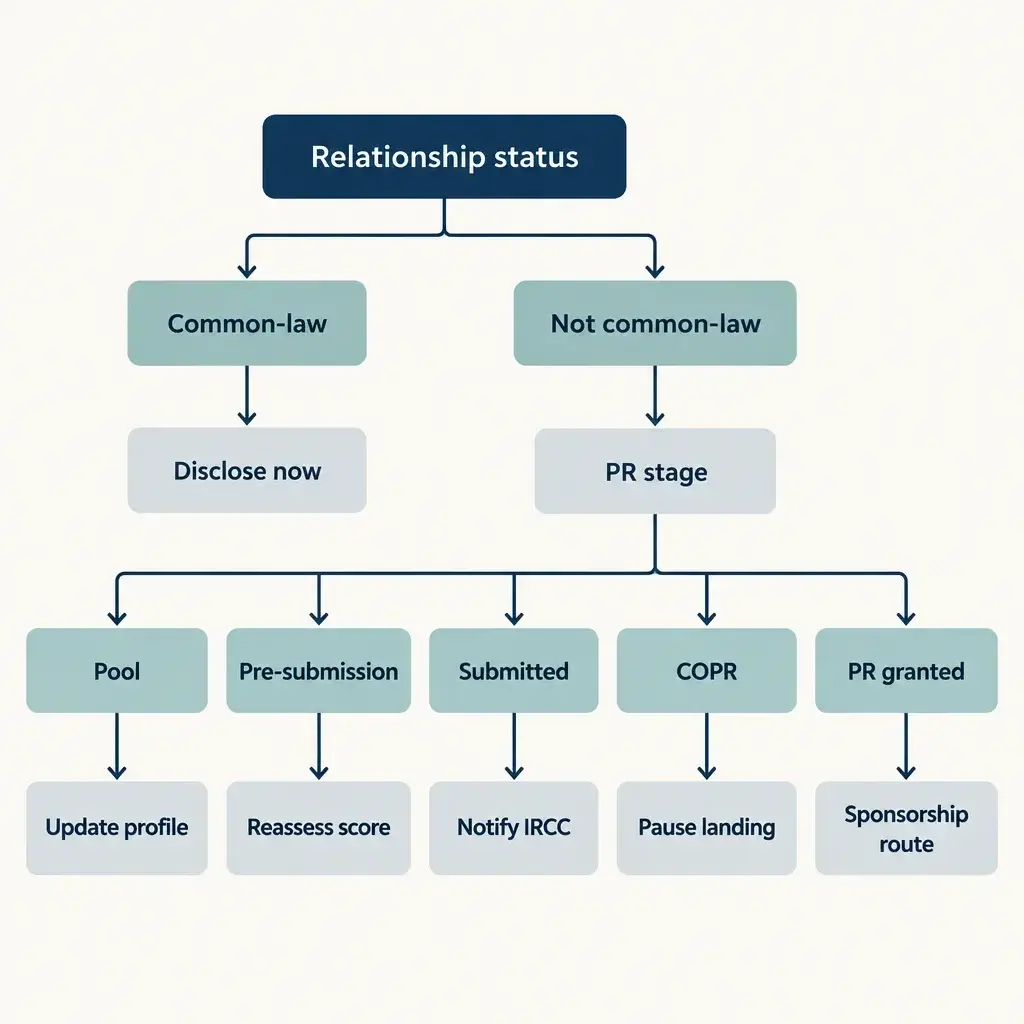
The useful decision is not simply “before or after approval.” It is whether your existing relationship has already created disclosure duties, and which immigration route fits your plans. I do not recommend delaying disclosure to protect a travel date.
- Already common-law? Disclose that status now. Postponing the wedding does not preserve a truthful “single” declaration.
- In the Express Entry pool? Assess the married profile, accompanying plans, language evidence, and settlement funds before relying on the current score.
- Invited but not yet submitted? Reassess the invitation threshold and program eligibility before filing.
- Application already submitted? Marriage can allow an eligible spouse to be assessed within the pending economic application, but adds documents and screening.
- COPR issued but PR not yet granted? Report the marriage and pause completion of the landing process until IRCC addresses the change.
- Already a permanent resident? Assess sponsorship or another route for a spouse whose relationship arose after PR.
Marrying now can make sense when you want your spouse assessed within an eligible pending application. Waiting can make sense when you are not ready to marry and understand that a later spouse may need a separate application. Neither choice permits a false marital or common-law declaration.
Delays, Refusals, Fees, and Withdrawal
Marriage can extend processing because IRCC must assess additional family information. The length of that extension turns on the stream, document readiness, police-certificate availability, medical follow-up, and background screening. There is no universal marriage-related delay to add to your original estimate.
There is also no single “spouse PR processing time in 2026.” Adding a spouse to an economic application and filing a new sponsorship application are different processes. The application class, processing office, Quebec involvement, and outstanding examinations determine which timeline applies.
A stalled file does not necessarily mean Canada is delaying your application without reason. Missing civil documents, unresolved background information, medical follow-up, and conflicting relationship dates can prevent finalization. A completed principal-applicant assessment does not eliminate those spouse-related steps.
Common refusal risks include program ineligibility, material non-disclosure, inadmissibility, and inadequate evidence. Before electronic submission, an Express Entry score change can also undermine the invitation. In sponsorship cases, IRCC assesses whether the relationship is genuine and meets the legal requirements.
A single Canada-wide PR rejection rate would not answer your case-specific risk. Economic programs and family sponsorship assess different requirements, and refusal statistics need a defined stream, period, and applicant group. I focus on the actual weakness: missing proof, incorrect eligibility, inconsistent forms, or an unresolved admissibility issue.
Adding an accompanying spouse normally brings additional government processing fees and a right of permanent residence fee. Medical examinations, translations, and document collection can also create expenses. Legal work depends on the stream, file stage, prior omissions, and whether inadmissibility or a provincial nomination needs attention.
Withdrawing a current application to pursue sponsorship can sacrifice completed work. Processing fees are generally not refundable once processing has begun; an unused right of permanent residence fee is refundable if PR is not granted. Switching routes should solve a real eligibility problem, not merely follow an assumption that marriage is faster.
Marrying a Canadian Citizen or Permanent Resident
Marriage to a Canadian citizen or permanent resident can create a spousal sponsorship pathway. The sponsor must qualify, the relationship must meet the legal test, and the applicant must satisfy the applicable admissibility requirements. Marriage alone grants neither PR nor permission to work.
A sponsor must be at least 18. A Canadian citizen living abroad can sponsor if they demonstrate plans to live in Canada when the sponsored person becomes a permanent resident. A permanent resident must live in Canada to sponsor.
Inland Versus Outland Spousal Sponsorship
“Inland” commonly describes the Spouse or Common-Law Partner in Canada Class. “Outland” commonly describes Family Class sponsorship, which can also be used for some applicants living in Canada. The labels are not simply descriptions of where a form is submitted.
| Issue | Inland class | Family Class, commonly called outland |
|---|---|---|
| Typical fit | Couple living together in Canada | Spouse abroad, or a suitable Family Class applicant in Canada |
| Residence requirement | Applicant must meet the in-Canada class requirements | Applicant does not have to remain in Canada throughout processing |
| Travel | Inability to return can undermine the in-Canada application | Travel still requires appropriate entry documents and admissibility |
| Work permission | An eligible applicant may qualify for a separate open work permit | Some eligible in-Canada applicants can also qualify under applicable measures |
| Refusal route | Generally judicial review rather than a sponsorship appeal | Sponsor generally has an Immigration Appeal Division appeal, subject to exceptions |
These class differences affect strategy, but neither route is automatically faster. Continuing a sound economic application may be preferable to replacing it with sponsorship. Sponsorship can be the better route when the economic pathway no longer fits the applicant’s circumstances.
A sponsorship undertaking is the sponsor’s financial support commitment. For a spouse outside Quebec, it lasts three years from the day the sponsored spouse becomes a permanent resident, and divorce does not end it.
Spouses in Canada, Abroad, or With Admissibility Concerns
A spouse already in Canada does not receive work permission or temporary status just by being added to your PR file. Their visitor, student, or worker status must be handled separately under the applicable rules. A pending PR application is not a substitute for a permit extension.
A spouse abroad can be added to an eligible pending application. Police certificates, identity records, translations, and access to a panel physician can affect document readiness. Location changes the logistics, not the duty to disclose.
Criminality, previous misrepresentation, and certain medical findings can affect the application. Non-accompanying status does not automatically protect the principal applicant from a spouse’s inadmissibility. A previous visa refusal is not itself proof of inadmissibility, but the refusal and its underlying facts must be accurately addressed.
Medical rules also differ by immigration category. Spouses sponsored in the family class are exempt from the excessive-demand ground of medical inadmissibility, but that exemption does not remove every medical admissibility requirement.
Common-Law Partners, Children, Separation, and Divorce
A fiancé is not a spouse merely because a wedding is planned. A fiancé can nevertheless already qualify as a common-law partner through the required cohabitation. Relationship labels must follow the facts, not the wording used in everyday conversation.
Children must be considered when a new spouse joins the family. Eligible dependent children, including relevant children from previous relationships, need accurate disclosure and any required assessment. Custody arrangements do not automatically remove a child from immigration family information.
Separation or divorce during processing must be reported when it changes the application’s relationship basis or family composition. A spousal sponsorship application can lose its qualifying relationship; an economic application may instead require revised spouse information and documents.
Divorce after becoming a permanent resident does not automatically cancel PR. It also does not erase previous fraud or misrepresentation. A genuine relationship ending after immigration is different from a relationship that was falsely presented during the application.
Getting Married in Toronto or Elsewhere in Ontario
Canadian immigration status and permission to marry are separate issues. Ontario does not require Canadian citizenship or permanent residence to marry. The marriage still must satisfy the legal requirements for a valid ceremony.
An Ontario marriage licence application requires identity documentation and information about previous marriages. A previous divorce requires supporting proof; a divorce granted outside Canada can require additional authorization and legal documentation. Foreign-language records can also require translation.
The ceremony record is not the same as the provincial marriage certificate. In Ontario, the marriage must be registered before the certificate can be issued. That distinction trips people up: report the marriage to IRCC while the certificate is pending, then provide it when available.
Marriage licensing and registration procedures differ across provinces and territories. Immigration recognition also requires a legally valid marriage; a ceremony abroad must satisfy the relevant recognition requirements. A wedding celebration without a legally valid marriage does not establish spousal status.
Frequently Asked Questions
Can I get married while waiting for PR in Canada?
Yes. Marriage during processing is allowed, but you must update IRCC before becoming a permanent resident. Your spouse may need to be assessed within the application.
Do I need to tell IRCC after submitting my PR application?
Yes. Submission does not freeze your family information. Report the marriage through the applicable update channel and retain proof of submission.
Can I add my spouse after AOR?
Yes, in an eligible pending application. IRCC will require the spouse-related documents and assessments applicable to your stream; AOR does not prevent a family update.
What if my spouse is non-accompanying?
You must still declare them. Non-accompanying spouses generally require examination, and failing to complete that process can create later sponsorship problems.
Does getting married lower my CRS score?
It can change the score before electronic application submission, particularly with an accompanying spouse. A genuine marriage after submission does not ordinarily trigger the same invitation-stage CRS reassessment.
What if I marry after COPR but before landing?
Report the marriage before completing landing or electronic PR confirmation. IRCC must address the new family composition and may need to replace the documents.
Does marriage guarantee PR in Canada?
No. Sponsorship requires an eligible sponsor, a qualifying relationship, and an applicant who meets the applicable immigration requirements.
How long will marriage delay my application?
There is no fixed extension. Spouse documents, medical follow-up, police certificates, background screening, and the processing stage determine the additional work.
Can I sponsor my spouse later instead?
Potentially, if you qualify as a sponsor and properly disclosed and completed any required examination of the spouse before your own PR. Leaving a spouse undeclared is not a safe route to later sponsorship.
What happens if we divorce during processing?
Report the relationship change. A sponsorship application depends on the qualifying relationship; an economic application requires reassessment of the relevant family information and requirements.
Can divorce cause me to lose PR afterward?
Divorce alone does not cancel permanent resident status. Fraud or misrepresentation remains a separate issue, and an existing sponsorship undertaking does not end because of divorce.
Which documents do I need to update IRCC?
Start with your application identifiers, marriage details, certificate if available, and spouse’s identity information. Updated forms, police certificates, medical examinations, biometrics, and fee receipts follow according to the stream and IRCC’s request.
Talk to Sutton Law About Marriage During PR Processing
Contact Alex Sutton and the Sutton Law team if you are planning a marriage or need to update a pending PR application. We can prepare the marital-status update and assess how to add your spouse, including after COPR. Sutton Law offers a free initial assessment.