
Most refusals are not about one missing paper. They come from a weak file story. This super visa document checklist is built to help parents, grandparents, and hosts in Canada prepare one coherent application, not just upload random PDFs.
I see the same problem in immigration files that I see in family law motions. People collect documents, but they do not prove the point each document is supposed to prove. IRCC looks at eligibility, relationship, financial support, insurance, admissibility, and whether the visit makes sense. A complete super visa application checklist helps, but it does not guarantee approval.
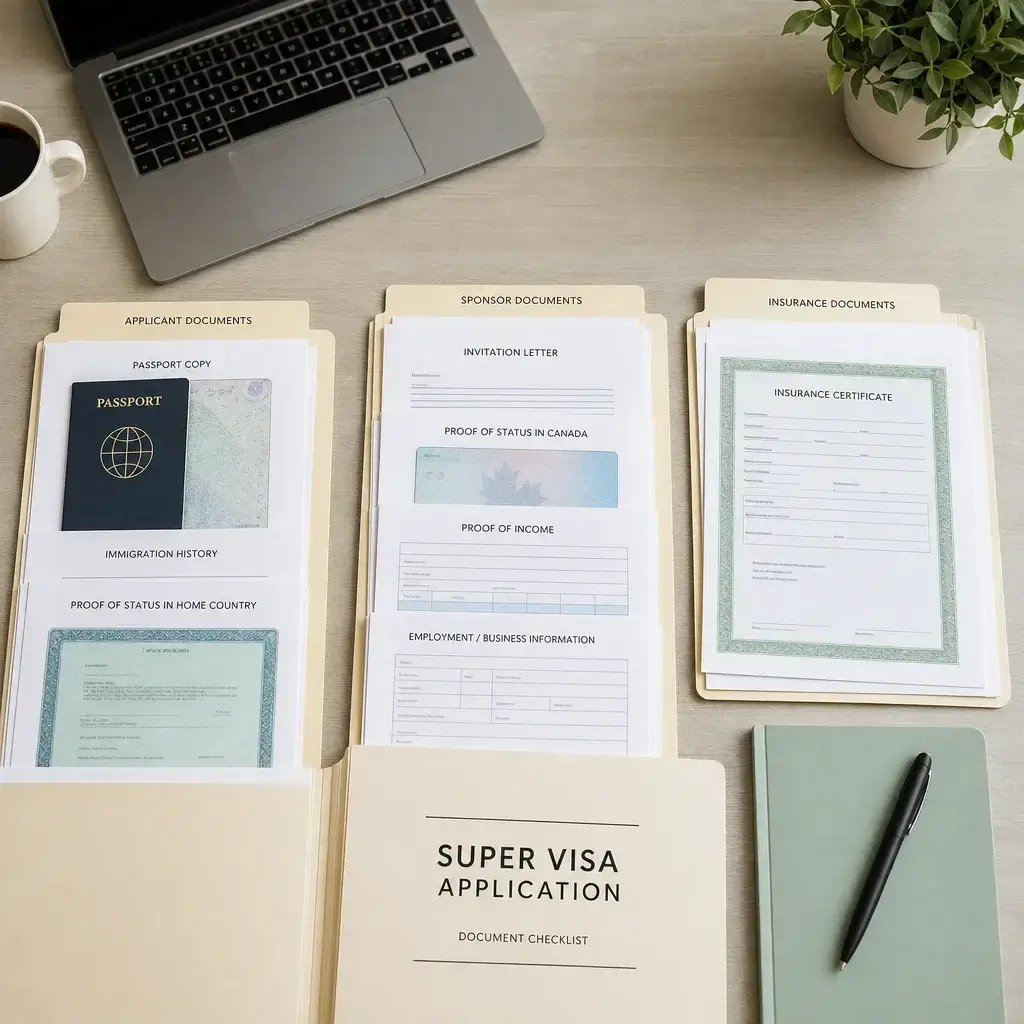
Super Visa checklist at a glance: who needs to provide what
This is the core file structure for a Super Visa application . The exact portal checklist can change by country, travel history, and the answers you give in the application .
| Document | Who provides it | Why IRCC asks for it | Common mistake / refusal risk |
|---|---|---|---|
| Valid passport copy | Applicant | Proves identity and travel document validity | Uploading only the bio page when other stamped pages help explain travel history |
| Application forms generated by the IRCC system | Applicant | Starts the actual Super Visa application and captures declarations | Using old PDFs from third-party sites or leaving answers inconsistent |
| Digital photo | Applicant | Identity and visa printing requirements | Wrong size, poor quality, or outdated photo |
| Proof of relationship | Applicant + Sponsor | Connects the parent or grandparent to the child or grandchild in Canada | Names do not match across birth, marriage, or passport documents |
| Invitation letter | Sponsor / host in Canada | Explains purpose of visit, support, and accommodation | Letter says one thing, forms and insurance say another |
| Proof of status in Canada | Sponsor / host in Canada | Shows the inviter is a Canadian citizen or permanent resident | Uploading expired or unclear status records |
| Income proof | Sponsor / host in Canada | Shows financial ability to support the visit and meet current income rules | Relying on one document instead of a consistent income package |
| Medical insurance proof | Applicant or Sponsor, depending on who purchased it | Shows the visitor has qualifying emergency medical coverage | Quote instead of policy, weak proof of payment, or dates that do not line up |
| Marriage certificate or civil status records | Applicant, if relevant | Explains spouse, name changes, or family composition | Skipping divorce or remarriage records in blended families |
| Translations | Applicant or Sponsor | Makes foreign-language records usable in the application | Translation uploaded without the original document |
| Prior refusal records or immigration history support | Applicant | Helps explain past visa refusals or prior applications honestly | Failing to disclose a past refusal or giving partial history |
| Home-country ties evidence | Applicant | Helps show the visit is temporary and credible | No evidence of residence, family, pension, work, or property abroad |
This side-by-side super visa for parents document checklist works best when you separate files into three folders: applicant, sponsor, and insurance . In practice, that cuts down upload mistakes 7 or 8 times out of 10 .
Who is eligible for a Super Visa?
A Super Visa is for the parents and grandparents of Canadian citizens and permanent residents . The host in Canada must be at least 18 years old and living in Canada .
That basic rule matters because people often confuse this with general family sponsorship. It is not for dependent children. It is not for siblings. It is not a shortcut for every relative. If the family relationship does not fit the parent-or-grandparent line, the application will fail on eligibility, not paperwork.
Spouses or common-law partners of an eligible parent or grandparent can be part of the plan in some cases, but I would not treat that as a casual assumption without checking the current IRCC instructions for your exact facts. Every family structure is different on the documents. Divorced parents, step-parents, and remarried families need a cleaner proof chain.
Admissibility still matters even with a perfect checklist . Medical issues, criminal history, prior misrepresentation, and inconsistent immigration history can all affect the result .
Super Visa vs visitor visa: which one fits better?
A Super Visa is usually the better fit when a parent or grandparent wants longer stays and can meet the insurance and income rules . A regular visitor visa is often simpler when the visit is short and the Super Visa requirements are hard to meet.
The practical difference is not just the label. A Super Visa has an income component for the host and a medical insurance requirement for the applicant . A regular visitor visa does not use that same structure . If your parent plans to stay for a short family event, a normal visitor visa may be enough. If the real plan is repeated or longer family stays, Super Visa Canada may make more sense.
Choose a Super Visa if:
- the applicant is a parent or grandparent of a Canadian citizen or permanent resident
- the host can show qualifying income under current IRCC rules
- the applicant can get compliant medical insurance
- the family wants a stronger long-stay visitor option than a standard TRV
Choose a visitor visa if:
- the visit is short and specific
- insurance cost is a problem
- income proof is too weak or too recent
- the relationship does not fit the Super Visa class
Applicant documents: what the parent or grandparent must prepare
The applicant usually needs identity records, civil status records, relationship proof, forms, photo, and supporting evidence that the visit is temporary and genuine . The exact forms can vary with the portal prompts and country-specific instructions .
A good applicant package usually includes a full passport scan, not just the identity page . I prefer full-page copies when there are entry stamps, prior visas, name variations, or old refusal issues. That gives the officer more context and avoids the impression that pages were selected too tightly.
The applicant should also gather civil records that explain family status . That can include marriage certificates, divorce certificates, death certificates of a spouse, adoption records, or legal name-change documents. These are not filler documents. They close gaps in the family chain.
Home-country ties can make the file stronger when the case needs it . Common examples are employment letters, pension proof, proof of residence, property records, business ownership, family responsibilities, or financial ties abroad. A weak temporary-visit story is a common refusal point in visitor cases, including Super Visa cases.
Prior refusals must be disclosed accurately . I have seen files unravel because an earlier U.S., U.K., Schengen, or Canadian refusal was omitted when the officer could see it in the applicant’s immigration history.
Proof of relationship: what documents actually work
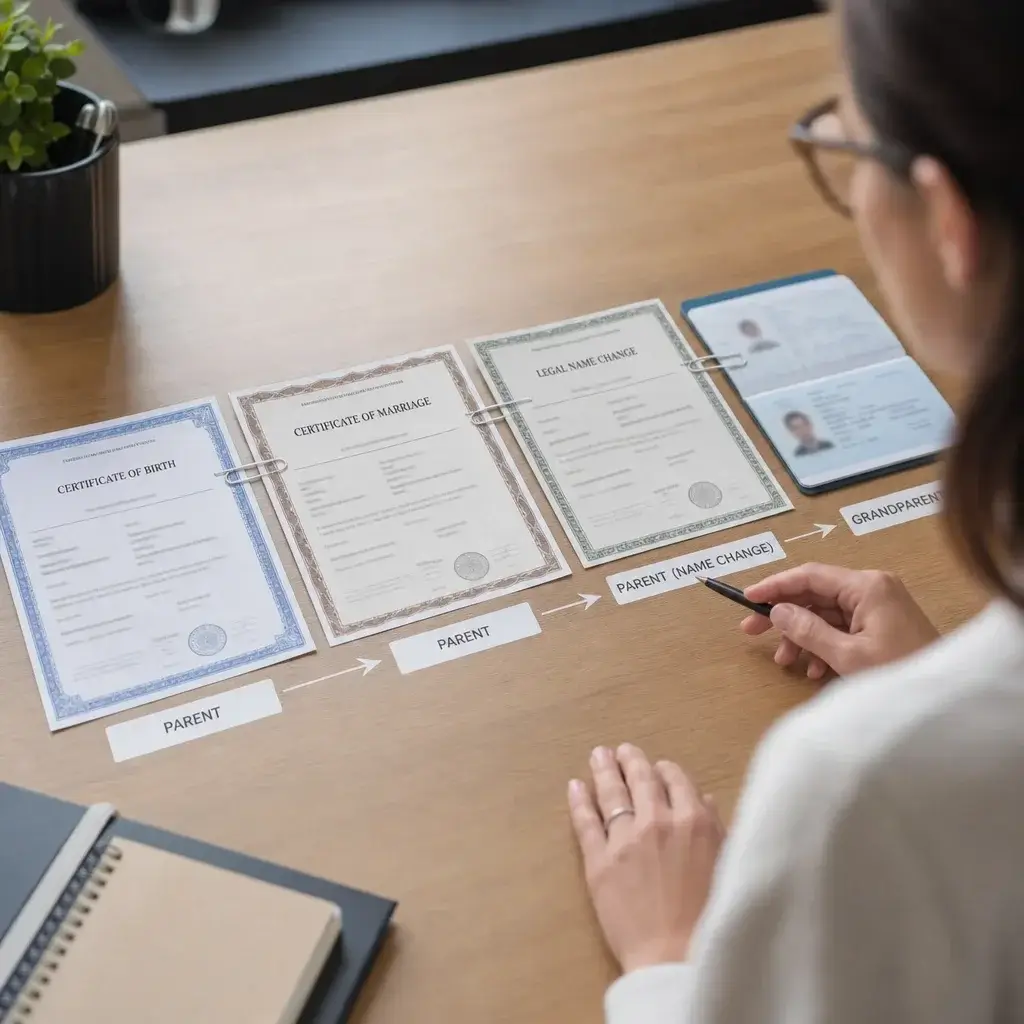
The best proof of relationship is the document chain that links the applicant to the host in Canada from start to finish . Birth certificates are often the primary record, but they are not always enough by themselves.
If the host is inviting a parent, the usual starting point is the host’s birth certificate naming that parent . If the host is inviting a grandparent, the chain often needs at least 2 links : the host’s birth certificate and the parent’s birth certificate or other civil record connecting the grandparent.
Name differences need to be explained with documents, not guesses . Marriage certificates, divorce judgments, legal change-of-name records, and translated civil records are often what saves a file from looking inconsistent.
Step-parents and blended families need extra care because the relationship is not always obvious from one document . In those cases, I usually look for a clean sequence of birth records, marriage records, custody or adoption documents where relevant, and a short explanation letter that maps the family relationship in plain English.
Affidavits can help, but they are usually supplementary, not primary proof . If a civil record exists, use it first. If it does not exist or was never issued, the file should explain that gap and support it with the best alternative records available.
| Relationship document | When to use it | Common problem | Better support |
|---|---|---|---|
| Birth certificate | Direct parent-child link | Parent name missing or spelled differently | Passport, school record, translation, name-change records |
| Marriage certificate | Explains surname change or spouse relationship | Wrong date or inconsistent names | Passport history, legal name-change proof |
| Divorce certificate / judgment | Explains family structure after separation | Old spouse still appears in other records | Updated civil records and explanation letter |
| Adoption order | Proves legal adoptive relationship | Informal family care mistaken for legal adoption | Court or government adoption record |
| Household register or civil registry extract | Common in some countries | Partial family details only | Birth records plus translation |
| Affidavit | Supports gaps or unavailable records | Used as sole proof when stronger records exist | Add civil records or official certificates |
Sponsor documents: income, status in Canada, and financial support proof

The sponsor has to prove 2 separate things: legal status in Canada and financial ability to support the visit . A lot of weak files prove one but not the other.
Proof of status in Canada is usually straightforward . Canadian citizens often use a passport, citizenship certificate, or birth certificate, depending on the facts. Permanent residents usually use a PR card or record confirming status. The point is to show the inviter is legally in the class allowed to invite under the program.
Income proof works best when it tells one consistent story across tax, work, and banking records . A Notice of Assessment, T4s, recent pay stubs, and an employment letter often fit together well for salaried employees. Self-employed sponsors usually need a broader package because one document rarely explains current income clearly.
A sponsor with variable income should not rely on a single high bank balance . Better evidence often includes tax filings, business income records, contracts, invoices, accountant material, and a short explanation of seasonality or recent changes. I have seen perfectly decent earners refused because the package looked random.
The support promise in the invitation letter should match the documents behind it . If the letter says the parent will stay at the sponsor’s home, the address and household details should be consistent across IDs, tax records, and other uploaded material.
Super Visa income requirement table and household size
The income threshold is one of the most important Super visa requirements, but I am not going to publish an unverified 2026 LICO table here. Use the current IRCC Super visa income requirements and the latest low-income cut-off figures before filing. That is an accuracy point, not a drafting choice.
Household size usually drives the calculation . In practice, you need to count the host in Canada, the host’s spouse or common-law partner if applicable, dependent children if applicable, and the parent or grandparent applicants the host wants to invite. If 2 parents are applying together, that can change the family size count by 2, not 1.
A common mistake is undercounting the household when there are children in Canada or 2 visiting parents in the same file . Another is overconfidence after using an online Super visa income calculator that does not explain who must be counted. Calculators can help. They do not replace the rule.
A sponsor who is close to the line should build a stronger file, not a thinner one . If income only barely meets the requirement, I would usually want cleaner tax evidence, clearer employment continuity, and a careful household-size explanation. Borderline files are where small errors hurt the most.
Can a co-signer help meet the income requirement?
I would not give you a yes-or-no answer on co-signers here without checking the current IRCC rule and your exact family structure. This is one of those points where old internet advice goes stale fast.
What I can say safely is this: informal help from relatives is not a substitute for whatever official financial rule IRCC is applying now . If the main host’s income is weak, the better approach is usually to confirm the current co-signer policy, count household size properly, and make sure the income evidence is complete before filing.
Invitation letter checklist: what the host must include
The invitation letter should tie the whole file together in one place . It is not just a polite note.
A strong invitation letter usually includes:
- the host’s full name, address, phone number, and email
- the host’s status in Canada
- the applicant’s full name and date of birth
- the exact relationship between host and applicant
- who is being invited, especially if 2 parents apply together
- the purpose of the visit
- where the parent or grandparent will stay
- how long the intended stay is expected to be
- who will pay for travel, living costs, and medical insurance if relevant
- the host’s household details if they matter to the income analysis
Consistency matters more than fancy wording . I would rather see a plain, accurate letter than a dramatic template copied from the internet. If the letter says the visit is for 6 months and the rest of the file points to a very different plan, the officer will notice.
Medical insurance requirements: what policy proof is acceptable
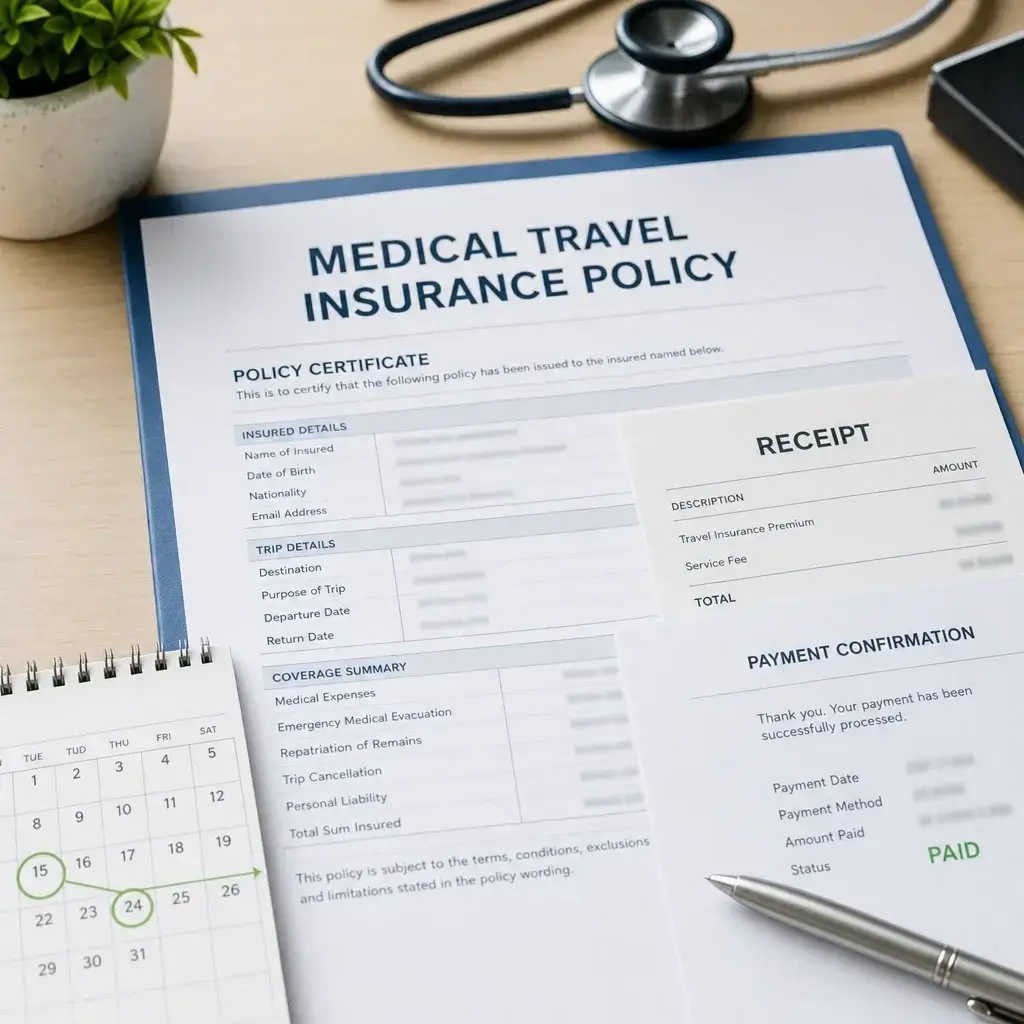
Medical insurance is a core part of a Super Visa application, and weak insurance proof sinks otherwise decent files . This is one of the first things I check when someone comes in after a refusal.
I am not going to publish an unverified minimum coverage amount, insurer rule, or payment rule here because those details are accuracy-sensitive and do change. Before buying any policy, confirm the current IRCC wording on coverage, insurer eligibility, validity period, and proof of payment.
The practical comparison checklist is still useful even without quoting a stale number . Look at the coverage amount, policy dates, whether the insurer is acceptable under current rules, refund terms if the visa is refused, deductible, exclusions, and pre-existing condition wording.
Pre-existing condition clauses matter more than people think . In the real world, I see applicants buy the cheapest policy and only later notice the policy excludes the exact condition that could trigger a claim. That may not always produce a refusal by itself, but it can make the application weaker and the trip riskier.
The proof uploaded should usually be stronger than a simple quote . A better insurance package often includes the policy or certificate, receipt, payment confirmation, and any insurer letter that clarifies the coverage terms.
Forms list for a Super Visa application
The form set usually includes a core application form plus conditional forms based on the applicant’s answers, country, travel history, and family situation . That is why static blog lists go out of date.
One commonly used form in temporary resident applications is IMM 5257 . Other forms may be requested depending on the file, such as background or family-related forms, a common-law declaration where relevant, or a use-of-representative form if someone is acting for the applicant. The exact list should come from the current IRCC system and country-specific instructions, not an old PDF folder.
Do not rely on unofficial downloads for a Super visa application form pdf . I have seen applications delayed because the applicant used an outdated version or completed a form that did not match the portal-generated checklist.
How to organize documents for online upload or paper submission

Online organization can reduce delay risk because officers can actually find what you meant to submit . Sloppy uploads create their own problems.
For online filing, combine related records into logical PDFs . Good file names do real work. I like simple labels such as Applicant-Passport, Relationship-BirthCertificates, Sponsor-NOA-T4-Paystubs, and Insurance-Policy-Receipt. That naming system makes the file readable in seconds.
Translations should stay with the original-language document they translate . If you split them into separate uploads without a clear link, the officer may treat the record as incomplete.
A submission-ready order helps whether you file online or through any paper or VAC-assisted pathway that may be available for your situation . I would usually organize it this way:
Applicant order
- Passport
- Forms
- Photo
- Civil status documents
- Relationship proof
- Home-country ties evidence
- Prior refusal or immigration-history support
- Translations attached to each underlying record
Sponsor order
- Status in Canada proof
- Invitation letter
- Notice of Assessment and tax proof
- Employment letter
- Pay stubs
- Bank or business support documents if relevant
- Household-size explanation if needed
Insurance order
- Policy or certificate
- Receipt
- Payment confirmation
- Any clarifying insurer letter
Translations, certified copies, and document formatting rules
Foreign-language documents generally need a proper translation package before they are useful to IRCC . Uploading only the original document is usually not enough.
A clean translation package usually contains the original-language document copy, the translation, and whatever certification or affidavit is required under the current IRCC instructions . I would not over-notarize the file. Not every page needs a stamp. Overdoing it wastes money and can still miss the real requirement.
Name spelling must be consistent across translated civil records . If one record says the mother’s name one way and another record uses a different transliteration, the package should explain that. Small spelling issues become big credibility issues when nobody addresses them.
Step-by-step: how to apply for a Super Visa for parents

The safest way to apply is in a fixed order that builds the file before you start uploading forms . That is how you avoid contradictions.
A practical sequence looks like this:
- confirm basic eligibility for the parent or grandparent and the host in Canada
- calculate household size carefully
- check the current income threshold on the official source
- gather proof of relationship
- collect sponsor status and income documents
- buy insurance that matches current IRCC requirements
- draft the invitation letter
- complete the online application and forms
- upload documents in a clean structure
- pay the current application fees shown by IRCC
- complete biometrics, medical steps, or passport submission if later requested
- monitor portal messages and respond by the deadline
Biometrics, medical exams, and passport requests do not always happen at the same stage . The process depends on the applicant’s country, prior biometrics history, and the officer’s review path.
Processing times, refusal risk, and what causes rejection
Super visa processing time is not one national number. It depends on country of residence, season, biometrics, medical review, security screening, and whether the file is complete .
I am not going to print a 2026 timeline range without a current source because processing times move. The right approach is to check the current IRCC estimate for the applicant’s country on the day you apply, then build in extra time for biometrics, medicals, and passport handling.
Yes, a Super Visa can be rejected . In my experience, the common refusal themes are missing relationship proof, weak or inconsistent income records, household-size mistakes, insurance problems, poor translations, unclear travel purpose, weak home-country ties, and undisclosed refusal history.
A complete checklist reduces preventable refusals, but officers still assess the whole story . They look beyond documents to credibility, admissibility, and whether the visit appears temporary and genuine.
Special cases: divorced parents, step-parents, multiple applicants, and variable income
Special family situations usually need more explanation, not more guesswork . This is where a standard Canada Super visa checklist PDF often stops being enough.
Divorced or separated parents may apply separately or together depending on the facts, but the documents should clearly explain the family structure . If one parent uses a former married surname and the other uses a current legal name, the file should connect those identities cleanly.
Step-parents need a stronger documentary chain because the relationship is less obvious on the face of one birth certificate . Marriage records, earlier civil status records, and a short family-tree style explanation can help the officer follow the file.
Multiple applicants often mean separate forms and separate supporting records even when the upload package overlaps . People get into trouble when they assume one invitation letter or one identity set covers everybody without naming each person clearly.
Variable-income sponsors should build consistency across months, not just show one good week or one good deposit . If income rises and falls, explain why. Self-employed files especially need that context.
Common mistakes checklist before you submit
The best final review is a blunt yes-or-no audit . If any answer is no, fix it before filing.
- Are names spelled consistently across passports, birth records, marriage records, and translations?
- Are dates of birth the same everywhere?
- Is the relationship chain obvious from the documents alone?
- Did you count household size correctly?
- Does the income evidence match the invitation letter story?
- Does the insurance proof show a real policy or acceptable proof, not just a quote?
- Are all scans complete, legible, and properly labelled?
- Are translations attached to the original-language records?
- Did you disclose prior refusals and immigration history accurately?
- Did you include each applicant separately where required?
- Do the invitation letter, forms, and supporting records all describe the same visit plan?
VFS or a VAC cannot guarantee approval . They may help with collection or transmission steps depending on the process, but they do not decide the application.
If your case involves prior refusals, missing civil records, a medical issue, criminal history, income close to the threshold, or urgent travel, lawyer review is usually money well spent. A free assessment is a sensible next step when the checklist is no longer straightforward.
FAQ
What documents are needed for a super visa?
The usual core documents are passport, forms, photo, proof of relationship, invitation letter, sponsor status in Canada proof, sponsor income evidence, and compliant medical insurance proof . Many files also need civil status records, translations, and home-country ties evidence.
What documents are needed for proof of relationship for super visa?
Birth certificates are often the main document, but marriage certificates, divorce records, legal name-change records, adoption papers, and registry extracts may also be needed to complete the family chain .
How to apply for a super visa for parents in Canada?
Start by confirming eligibility, then calculate household size, verify the current income rule, collect relationship proof, buy compliant insurance, prepare the invitation letter, complete the forms, upload a clean document set, and follow later biometrics or medical instructions if issued .
What are the eligibility requirements for a supervisa?
The applicant must be the parent or grandparent of a Canadian citizen or permanent resident, and the host in Canada must meet the current status, age, residence, and financial support requirements under IRCC’s rules .
How much money do I need to sponsor parents?
The required income depends on household size under the current low-income cut-off framework used for Super Visa cases . Because that table is updated, use the latest IRCC figures before you apply.
Can a co-signer help meet the income requirement?
Do not assume yes. Check the current IRCC rule first. If your income is close to the threshold, get the rule confirmed and make sure the household count and supporting documents are solid.
What should a Super Visa invitation letter include?
It should identify the host and applicant, explain the relationship, say why the visit is happening, state where the applicant will stay, outline expected duration, and confirm financial support and host status in Canada .
What medical insurance is required for a Super Visa?
The policy must meet the current IRCC requirements on coverage, insurer eligibility, validity, and proof of payment . Check the official rule before purchase because this area changes.
How long does it take to get a super visa in 2026?
There is no safe single timeline for every country. Check the current IRCC country-specific estimate and expect timing to be affected by biometrics, medical review, and overall file completeness.
Can a super visa be rejected?
Yes . Common reasons are weak relationship proof, income problems, insurance defects, poor translations, credibility concerns, undisclosed refusal history, or admissibility issues.
Do visa-exempt applicants follow the same Super Visa process?
The eligibility logic is the same, but the travel document mechanics can differ. You should follow the current IRCC instructions for the applicant’s nationality and travel document type.
Can VFS guarantee my visa approval?
No . VFS or another visa application centre may handle service steps, but approval is decided by the government officer reviewing the case.
When to get help from an immigration lawyer
Some Super Visa files are document-gathering jobs. Others are legal-risk files. Prior refusals, missing birth records, blended families, income close to the threshold, translation problems, medical concerns, or urgent travel plans usually deserve a closer look before you submit.
At my office, that usually means reviewing the relationship chain, checking whether the financial package actually proves what it needs to prove, and fixing contradictions before they turn into a refusal. If you are not sure your file is strong enough, book a free assessment and get the checklist reviewed before you hit submit.