

Many applicants treat a refusal like the end of the road. That is a mistake. A request for reconsideration IRCC can work in narrow cases, but only when you attack a real error in the original file, not when you simply hope for mercy.
I come at this like I used to read crop trials. First I check the record. Then I check where the decision went wrong. If the problem is weak evidence, I do not dress it up as reconsideration. I say reapply or review the court option.
What an IRCC reconsideration request is, and what it is not
An IRCC reconsideration request is a post-refusal request asking IRCC to revisit a decision because the original file was allegedly assessed in error. It is not the same as an appeal, and it is not the same as answering a procedural fairness letter before a final refusal.
A proper IRCC refusal reconsideration argument usually points to one of four things: overlooked evidence already submitted, a factual mistake, a misunderstanding of the record, or reasons that do not address material evidence. Those are record-based errors. A stronger new story, new finances, or a new travel plan is usually a reapplication issue, not a reconsideration issue.
Reconsideration is generally treated as discretionary in practice, which means IRCC may choose whether to revisit the file at all. Because the exact framework can vary by stream and office, this guide stays practical and cautious rather than promising that every refusal can be reopened.
When reconsideration may be appropriate after a refusal
Reconsideration fits best when the IRCC refusal letter can be matched to a clear error in the original record. If the officer wrote that bank evidence was missing, and your original submission receipt shows that the bank letter was uploaded, that is a classic overlooked-document scenario.
Reconsideration is weaker when the real problem is that the original application was thin, inconsistent, or missing key proof. If you now want to add new employment letters, new travel history, new tuition funding, or a new explanation that did not exist in the original file, reapply after IRCC refusal is often the cleaner path.
Credibility concerns usually make reconsideration harder because the officer’s concern may rest on interpretation rather than a simple factual mistake. In that type of file, GCMS notes and the exact wording of the refusal reasons matter more than emotion.
Inadmissibility and misrepresentation refusals need a more careful strategy because those cases can trigger broader legal consequences than an ordinary visitor visa or work permit refusal. In that category, individualized legal review is often more useful than a quick template letter.
A quick decision tree by refusal type and problem type

Use reconsideration when the refusal rests on an error in the original record. Use reapplication when the file needs stronger evidence. Use judicial review when the decision may be unreasonable or procedurally unfair and deadlines are running.
- Visitor visa refusal + overlooked document already submitted: reconsideration may fit.
- Visitor visa refusal + weak ties evidence: reapplication is often stronger.
- Study permit refusal + officer misread tuition payment proof already filed: reconsideration may fit.
- Study permit refusal + new sponsor funds obtained after refusal: reapplication usually fits better.
- Work permit refusal + wrong NOC or employer document was misread: reconsideration may fit.
- Work permit refusal + eligibility genuinely not established in the original file: reapplication may fit better.
- Permanent residence refusal + legal or procedural defect: reconsideration may be possible, but judicial review or an appeal right may matter more.
- Misrepresentation or inadmissibility refusal: do not rely on a generic letter; get the record reviewed first.
Reconsideration vs reapplication vs appeal vs judicial review vs procedural fairness
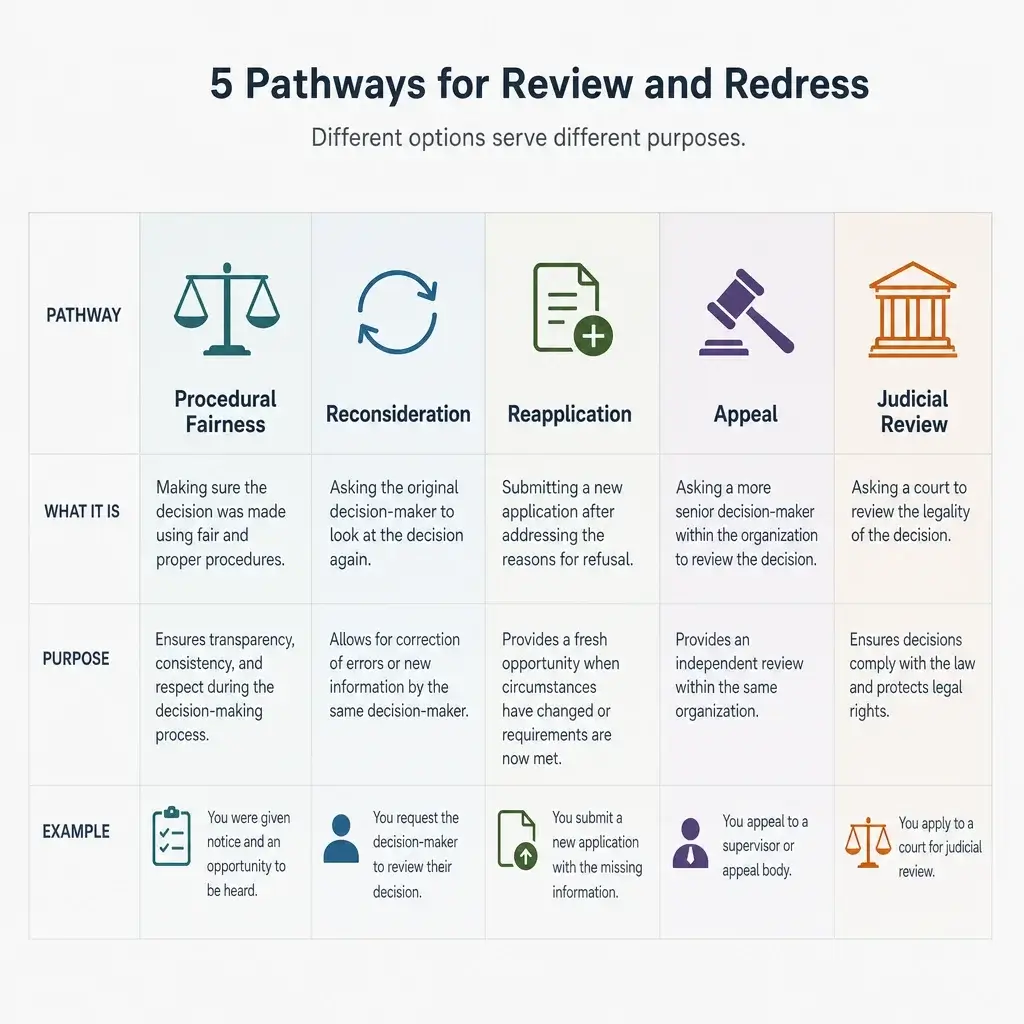
These remedies are different in purpose, timing, and evidence. Mixing them up costs time.
| Option | When it fits | Who decides | What evidence matters most | Main objective | Major risk |
|---|---|---|---|---|---|
| Procedural fairness | Before a final refusal, when IRCC raises a concern | IRCC officer | Response to the concern plus supporting record | Prevent refusal before decision | Missing the response window |
| Reconsideration | After refusal, where the officer may have made an error | IRCC officer or office handling the file | Original record, refusal letter, officer notes if available | Ask IRCC to reopen or revisit the decision | No response or refusal to reopen |
| Reapplication | When the original case was weak or incomplete | IRCC on a new file | New and improved evidence | Build a stronger application | Repeating the same refusal if nothing material changed |
| Appeal | Only where legislation creates an appeal right | Tribunal or appeal body | Record, legal arguments, fresh evidence rules depend on forum | Overturn the decision through the appeal process | Assuming an appeal exists when it does not |
| Judicial review | When the decision may be unreasonable or procedurally unfair | Federal Court, with leave required in many cases | Decision record, legal issues, procedural fairness issues | Challenge the lawfulness or reasonableness of the refusal | Missing strict court deadlines |
Procedural fairness happens before the refusal. Reconsideration happens after the refusal. Judicial review is a court process, not an internal IRCC courtesy request. Appeal rights exist only in certain categories, so never assume that every IRCC refusal can be appealed.
Parallel strategy can matter because judicial review deadlines may run while you wait for an IRCC reconsideration request response. The exact court timelines depend on where the refusal was made and the remedy being considered, so confirm them promptly before you let time pass.
If you received a refusal and do not know whether reconsideration, reapplication, or judicial review fits, this is the stage where a careful case review helps most. A free assessment can be useful for sorting urgency, especially if deadlines may already be running.
Is reconsideration available for your application type?
A reconsideration request IRCC for visitor visa cases is commonly attempted when the officer appears to have missed a document, misstated facts, or misunderstood evidence already in the file. Visitor visa refusals also often involve broad discretion, so weak ties or weak travel-purpose cases may be better rebuilt through a new application.
A study permit refusal can sometimes support reconsideration if tuition payment proof, acceptance documents, or financial records were already filed and not properly addressed. If the refusal rests on a broader concern about purpose of studies or overall credibility, a reapplication with a stronger package may be more realistic.
A reconsideration request IRCC work permit case can make sense where the decision appears tied to a record error, such as misunderstanding the employer documents, job offer terms, or eligibility evidence already submitted. If the underlying eligibility really was not proven, a fresh application is usually cleaner.
Family sponsorship and permanent residence refusals need more caution because some categories may involve appeal rights, legal issues, or consequences that change strategy. In those streams, the best path is often determined by the exact refusal ground, the governing category, and any deadline that applies outside reconsideration itself.
Express Entry and other permanent residence refusals can raise technical issues about completeness, eligibility, points, or legal interpretation. Those files are less suitable for a generic reconsideration template and more suitable for record review before any step is taken.
Deadline, urgency, and whether you can file late
There is no safe reason to wait if you think IRCC made an error. Even where there is no clearly published universal reconsideration deadline across all streams, delay weakens the request and can also damage other remedies.
A commonly cited practical benchmark is 30 days, but I would not present that as a universal legal rule for every stream without checking the current context of the refusal. Treat it as a working urgency marker, not a guaranteed hard deadline.
A late request may still be worth trying where the error is obvious from the original record, especially if the officer overlooked a document that was clearly uploaded before decision. Late filing is still weaker than prompt filing because IRCC may see the matter as stale and because court timelines may be moving in the background.
A simple timeline helps. Day 1: refusal received. Next few days: review the refusal letter, submission record, and account history. Then decide whether the case is really an error case, a reapplication case, or a possible judicial review case.
How to submit a request for reconsideration to IRCC

The main route people use is the reconsideration request IRCC webform, because it creates a submission trail and allows you to attach a concise package. In some cases, correspondence from the application may also identify a specific processing office, but current office-specific communication practices should be checked against the refusal documents and any official instructions available at the time.
Start with the refusal letter, your application number, your UCI, and the exact refusal date. Then identify the alleged error in one sentence before you draft anything else. If you cannot state the error clearly, your case may not be ready for reconsideration.
Build one indexed package if the file size rules permit it. Put the reconsideration letter first. Then add the refusal letter, the exact document(s) you say were overlooked or misunderstood, and any proof showing that the documents were submitted with the original application.
Use plain file names that a tired officer can follow in seconds. Good examples are 01_Reconsideration_Letter, 02_Refusal_Letter, 03_Bank_Letter_Submitted_With_Original_File, and 04_Portal_Upload_Screenshot. A messy package weakens a good argument.
Save every submission confirmation, screenshot, and auto-reply after you send the request. If a representative is still on file, communications may go to that representative, so coordinate before sending a parallel self-submission.
How to identify the visa office that processed your application
The best place to start is the IRCC refusal letter because it may identify the office or at least the stream and channel used for the decision. Your online account history and previous IRCC correspondence can also help narrow the processing office.
GCMS notes can be more precise because officer notes and file routing history may identify the office or processing trail in a way the refusal letter does not. That makes GCMS notes useful not only for reasons analysis but also for figuring out where the file actually moved.
If the office is unclear, do not guess in the letter body as if you know. It is better to identify the application correctly by applicant name, date of birth, UCI, application number, refusal date, and stream than to force an office reference you cannot support.
What to include in the reconsideration package
A usable package includes the refusal letter, applicant identifiers, a concise letter, and only the exhibits that prove the claimed error. The goal is not volume. The goal is traceability.
Your core checklist should include:
- Applicant full name as used in the application.
- Date of birth.
- UCI.
- Application number.
- Refusal date.
- Application type, such as visitor visa, study permit, work permit, sponsorship, or permanent residence.
- A short reconsideration letter.
- The exact documents you say were already in the record or were misunderstood.
- Portal or upload proof, if you have it.
- Relevant excerpts from GCMS notes, if already available.
If you use GCMS notes, cite them precisely by the officer comment or refusal issue they support. Do not dump a long notes file into the package without telling IRCC what line matters.
Before you send, check four things: dates match, names match, documents are legible, and every attachment ties to a refusal ground. If a document does not answer the refusal, cut it.
How to write a strong IRCC reconsideration letter

A strong reconsideration request IRCC sample letter is not really about fancy wording. It is about structure. The best letters are short, respectful, and anchored to the original record.
Use this order:
- Applicant details.
- Application type and number.
- Refusal date.
- Clear request that IRCC reconsider the refusal.
- One-paragraph summary of the alleged error.
- Numbered evidence references.
- Requested remedy, such as reopening or revisiting the file.
- Closing with contact details.
For an overlooked-document case, the core wording can be simple: the refusal states the document was missing, but the document was submitted with the original application and appears at the attached exhibit with submission proof. That is enough if the proof is clean.
For a factual-error case, the core wording should identify the exact wrong fact and correct it with a record citation. Example: the refusal refers to no employment confirmation, but the employer letter dated a specific day was included in the original package and is attached again for ease of reference.
For a misunderstood-evidence case, explain the document-to-conclusion gap. Show how the officer’s stated concern does not match the contents of the record. Keep the tone factual. Accusations of bad faith usually hurt more than help.
Do not copy a generic reconsideration request IRCC sample letter from the internet word for word. Officers see stock language quickly. A plain letter tied to your actual evidence is stronger than a dramatic one.
A simple letter template structure
You can follow this structure without turning the letter into a speech:
Subject: Request for Reconsideration of Refusal
Applicant details: Full name, date of birth, UCI, application number.
Decision details: Application type and refusal date.
Request: I respectfully request reconsideration of the refusal decision.
Error summary: State the exact alleged error in 2–4 sentences.
Evidence references: List each exhibit and explain what it proves.
Remedy requested: Ask IRCC to reopen or reconsider the decision based on the original record and attached supporting references.
Closing: Thank IRCC, confirm contact details, and sign.
That structure works because it respects the officer’s time. It also forces you to stay on point.
Can you include new documents or new evidence?

IRCC is most likely to engage with a reconsideration request when the issue is tied to the original record, not to a rebuilt case after refusal. That is the practical line most applicants miss.
There are three different categories of documents. First, documents already submitted but overlooked. Second, documents that existed at the time but were not uploaded correctly or were cut off by a technical problem. Third, genuinely new evidence created after the refusal.
The first category is strongest for reconsideration because it goes directly to a claimed decision error. The second category is mixed, because the argument may depend on whether you can prove the problem and whether the evidence truly existed at the time of application. The third category usually points toward reapplication rather than reconsideration.
For example, a bank certificate uploaded with the original visitor visa file but ignored in the reasons is a reconsideration fact pattern. A new bank balance obtained after refusal is usually a new-application fact pattern. A missing upload caused by a portal issue sits in the middle and needs careful proof.
Should you order GCMS notes first?

GCMS notes are the internal case notes and decision comments recorded on the file. They often say more than the short IRCC refusal letter, which is why they matter.
ATIP is the access route commonly used to request GCMS notes where eligible. The notes can help you see whether the officer actually missed a document, doubted credibility, or relied on a detail not obvious from the refusal letter alone.
Waiting for GCMS notes can help when the refusal reasons are vague, but waiting can also be risky if another deadline may expire while you are still gathering records. A practical GCMS and ATIP turnaround often falls in the 30 to 90 day range, but current timing should always be checked because delays happen.
Order GCMS notes first when the refusal language is broad, the stakes are high, or the file may involve credibility, inadmissibility, or legal complexity. Act before notes arrive when the error is already obvious from the refusal letter and the original upload record, especially if urgency matters.
A useful review method is simple. Put the refusal reasons in one column. Put the matching original evidence in a second column. Put the GCMS comments in a third column. If the officer’s concern still stands after that exercise, reconsideration may be weak.
Processing time, response expectations, and chances of success
There is no reliable universal reconsideration request IRCC processing time you can bank on across all streams and offices. Response patterns vary by office, application type, case complexity, and whether the request identifies a clear record error.
Do IRCC respond to a reconsideration request? Sometimes yes, sometimes only with an acknowledgment, and sometimes not in a way applicants would consider a real response. Possible outcomes include no substantive reply, a refusal to reopen, a request for more information, reopening of the file, or a later approval or second refusal after review.
The reconsideration request IRCC success rate is not something I would state as a percentage without official data. The practical truth is narrower: success depends heavily on whether you can show a specific error tied to the original record rather than just disagreement with the result.
How long to wait for reconsideration depends on urgency outside reconsideration itself. If you face status loss, family separation, travel needs, or a possible judicial review deadline, you should not sit idle just because the webform was submitted.
Realistic expectation matters here. Reconsideration is a narrow remedy. It is not a substitute for a stronger fresh application, and it is not a guarantee of any reply.
Does IRCC charge a fee for reconsideration?
IRCC reconsideration request fees are generally not treated like a new application fee because reconsideration is a request to revisit a decision, not a fresh application itself. I am not aware of a standard separate IRCC fee specifically for making a reconsideration request, but applicants should still confirm current requirements for their stream before relying on that assumption.
The real cost issue is strategic rather than administrative. A weak reconsideration attempt can consume time while a better reapplication or court remedy becomes harder.
What happens if your reconsideration request is denied or ignored?
A denied or ignored request does not end your options, but it does change the next move. The main paths are reapply with a better record, assess judicial review, use any available appeal right in the category involved, or seek legal advice for inadmissibility and misrepresentation issues.
If IRCC ignores the request, treat silence as a reason to review deadlines, not as a sign that the file is quietly being fixed. Preserve the webform confirmation, your attachments, and every email trail.
Your next-step checklist should be blunt:
- Re-read the refusal letter.
- Compare it to the original evidence.
- Review GCMS notes if available.
- Decide whether the problem was error, weak evidence, or legal unfairness.
- Check whether an appeal right exists in your category.
- Check whether court timelines may apply.
- Reapply only after you can explain what changed.
This is another point where a free assessment can help if you are deciding between a new filing and a court-based remedy. Tight deadlines and complex refusals rarely improve by guessing.
Common mistakes that weaken a reconsideration request
The fastest way to sink a request is to avoid the actual refusal reason. If the officer refused on finances and you send a long hardship story with no financial record analysis, the package is weak on arrival.
Emotional language weakens legal and factual arguments because it replaces proof with pressure. Respectful and direct works better than angry and repetitive.
Too many irrelevant documents also hurt because they bury the one exhibit that mattered. I have seen this same failure in field records and bee logs. When the key data point is hidden, the whole review slows down.
A new theory of the case can also backfire. If your original application said one thing and your reconsideration letter now says something materially different, IRCC may see inconsistency rather than error.
Do not accuse the officer of bias or bad faith without a serious factual basis. Most files do not need that argument, and careless accusations distract from the real issue.
Use this red-flags checklist before sending:
- No clear error identified.
- No exhibit tied to each refusal reason.
- Dates or names do not match the original record.
- Mostly new evidence instead of original-record proof.
- Long emotional narrative.
- Multiple duplicate submissions sent without coordination.
When to speak with an immigration lawyer
An immigration lawyer Toronto applicants trust is most useful when timing is tight, the refusal is complex, or the stakes go beyond an ordinary temporary visa inconvenience. Misrepresentation, inadmissibility, sponsorship refusals, permanent residence refusals, status loss, and possible Federal Court strategy all fit that category.
A lawyer can help sort the file into the right bucket: reconsideration, reapplication, appeal, or judicial review. That sorting work matters because each option uses a different logic, and picking the wrong one first can waste precious time.
This is especially important if a prior representative handled the application poorly, if the refusal reasons are internally inconsistent, or if the record suggests the officer may have overlooked key evidence. In those files, a fast record review often matters more than a longer letter.
If you are unsure which path fits, ask for urgent review rather than sending a template in panic. Calm strategy beats rushed paperwork.
FAQ
What is an IRCC reconsideration request?
It is a request asking IRCC to revisit a refusal because the decision may contain an error based on the original record. It is not the same as an appeal.
Do IRCC respond to a reconsideration request?
They may respond, acknowledge receipt, refuse to reopen, ask for more information, or give no substantive response. No response should not be treated as success.
How long does IRCC reconsideration take?
There is no dependable universal timeline across all offices and streams. Timing depends on office, file type, and how clear the alleged error is.
What are the chances of reconsideration?
There is no safe fixed percentage to rely on. The best cases are the ones showing a concrete error tied to documents already in the original record.
Does IRCC charge a fee for reconsideration?
There is generally no standard separate fee commonly associated with simply asking for reconsideration, but applicants should still confirm the current position for their stream.
Should I reapply instead of requesting reconsideration?
Reapply when the original case was weak, incomplete, or needs substantial new evidence. Request reconsideration when the main issue is an error in the original decision.
Can I request reconsideration for a visitor visa refusal?
Yes, it can be attempted, especially where the visitor visa refusal appears to rest on overlooked or misunderstood evidence already submitted.
Can I request reconsideration for a work permit refusal?
Yes, a reconsideration request IRCC work permit case may be worth trying when the refusal appears tied to a factual or record-based mistake.
Will IRCC consider new documents in reconsideration?
The strongest requests rely on the original record. Truly new post-decision evidence often points toward reapplication instead.
What if my reconsideration request is denied?
Review whether to reapply, pursue any available appeal right, or seek judicial review advice. Do not assume denial of reconsideration ends every other option.
If you received a refusal and the path is unclear, get the record reviewed fast. The right next step is usually visible once the refusal letter, original evidence, and any GCMS notes are read side by side.