

An employer specific work permit application is not just a job offer plus a form. It is a work authorization tied to exact conditions, and the details on that permit decide what work you can legally do in Canada.
Employer-Specific Work Permit in Canada: What It Means
An employer-specific work permit in Canada means the permit is tied to one employer and usually to listed conditions such as the employer name, job, location, and validity period . That is why people also call it a closed work permit Canada, even though IRCC commonly uses the term employer-specific in its guidance .
Those conditions matter because you are authorized only for the work described on the permit . If the permit names one employer in Toronto, for example, you cannot assume you may switch to another employer, move to another worksite, or take a second job without new authorization .
An open work permit is different because it generally lets the holder work for more than one employer, subject to any listed restrictions . An employer-specific permit is narrower, and that narrower scope is what creates most of the questions about LMIA, extensions, and job changes .
This guide is for workers outside Canada, workers already inside Canada, supporting employers, and families travelling together . It covers both the worker side and the employer side, because a work permit application IRCC reviews is often only as strong as the employer documents behind it .
Who Can Apply and Basic Eligibility
You can apply for work permit Canada only if you meet the legal requirements for the stream you are using and you show that you will respect the permit conditions . Eligibility is not one rule for everyone, because an LMIA-based case and an LMIA-exempt case are built on different supporting documents .
The core requirements usually include a genuine job offer where the stream requires one, proof of identity, admissibility to Canada, and documents that match the role and category claimed . Your actual outcome depends on your full file, and being eligible to apply does not guarantee approval .
Applying from inside Canada may be possible only in certain situations recognized by IRCC, such as extending status or applying from a category allowed in Canada . Applying from outside Canada is common, but visa office processing, medical requests, biometrics, and travel document needs can change the practical path .
A short self-check helps before you spend time and filing fees: valid passport, real job offer, stream identified, employer documents ready, qualifications for the job, and no obvious status or admissibility issue . If one of those pieces is missing, the first step is usually fixing the gap, not rushing the application .
LMIA-Required vs LMIA-Exempt: Which Path Applies?
The first split in any Employer-specific work permit Canada case is whether the employer needs a Labour Market Impact Assessment or can use an LMIA-exempt category . In plain terms, an LMIA-required case usually runs through the Temporary Foreign Worker Program, while an LMIA-exempt case usually runs through the International Mobility Program .
A simple decision tree works better than guesswork :
- If the employer already has a positive or valid LMIA, the worker usually follows the LMIA-required path .
- If there is no LMIA, check whether the job fits a recognized LMIA-exempt category under the International Mobility Program .
- If it is LMIA-exempt and employer compliance applies, the employer usually submits the offer through the employer portal work permit system and gets an offer number .
- If neither path fits, the file may not be ready for an employer-specific permit yet .
A LMIA specific work permit is a permit supported by an approved LMIA and the matching job terms . The government reviews whether hiring the foreign worker is justified under that program, and the worker then applies with the LMIA support documents .
An LMIA-exempt offer of employment number is the number generated after the employer submits the job offer through the Employer Portal in cases where that step is required . That number is not the same thing as an LMIA, and mixing them up is a common filing mistake .
TFWP vs IMP comparison
| Issue | TFWP / LMIA-required | IMP / LMIA-exempt |
|---|---|---|
| Main program | Temporary Foreign Worker Program | International Mobility Program |
| Key employer step | Obtain LMIA before worker applies | Submit offer in Employer Portal if required |
| Key worker document | LMIA and supporting job documents | Offer of employment number and supporting category documents |
| Main question IRCC assesses | Is there valid labour market support for this hire | Does the job fit a recognized LMIA-exempt category |
| Common pitfall | LMIA details do not match application | Wrong exemption code or incomplete portal submission |
Can My Employer Apply for My Work Permit?
In most cases, the foreign national is the actual applicant for the work permit, even when the employer does major supporting work behind the scenes . A job offer alone does not create status, and an employer cannot turn an offer letter into work authorization without the worker’s own application and supporting evidence .
The employer’s role is usually to obtain the LMIA if needed or complete the LMIA-exempt portal steps if that stream applies . The worker’s role is usually to file the permit application, upload identity and status documents, complete biometrics or medicals if requested, and answer IRCC questions truthfully .
Employer tasks vs worker tasks
| Task | Employer | Worker | Shared |
|---|---|---|---|
| Identify LMIA or LMIA-exempt path | Yes | Yes | Yes |
| Obtain LMIA if required | Yes | No | No |
| Submit employer portal work permit offer if required | Yes | No | No |
| Prepare passport, forms, and status documents | No | Yes | No |
| Check job details match all documents | Yes | Yes | Yes |
| Respond to IRCC requests | Sometimes | Yes | Sometimes |
The practical rule is simple: the employer supports the file, but the worker usually carries the application burden . If the job title, wages, location, or duties do not line up across the documents, IRCC can treat that as a credibility problem .
Documents You Need for an Employer Specific Work Permit Application

A strong employer specific work permit application starts with a checklist split into mandatory items and conditional items . Most refusals we see in work authorization files come from mismatched or incomplete evidence, not from one dramatic problem .
Document checklist
| Document | Who provides it | When required | Common mistakes |
|---|---|---|---|
| Valid passport | Worker | Mandatory | Passport expires too soon or missing pages |
| Application forms generated in the IRCC online flow | Worker | Mandatory in most cases | Wrong answers carried from old files |
| Digital photo | Worker | Mandatory if requested by system | Wrong size or poor quality |
| Proof of current status in Canada | Worker | Mandatory for inland filings | Expired status not explained |
| Job offer or employment contract | Employer | Usually required | Duties too vague or inconsistent |
| LMIA and annexes | Employer | Required for LMIA-based cases | LMIA terms do not match application |
| Offer of employment number | Employer | Required for many LMIA-exempt employer-specific cases | Number entered wrong or not linked to right exemption |
| Proof of qualifications | Worker | Conditional but common | No evidence for licensing or experience |
| Medical exam proof | Worker | Conditional | Assuming all applicants need one |
| Police certificates | Worker | Conditional if requested | Uploading old or incomplete records |
| Marriage or birth documents | Worker | Conditional for family files | Family relationship not clearly documented |
| Quebec-specific documents | Employer or worker | Conditional for Quebec cases | Federal file filed without required provincial support |
Mandatory worker documents usually include your passport, the online forms, and proof of current status if you are filing from inside Canada . Mandatory employer-side documents depend on the stream, because an LMIA file and an LMIA-exempt file do not use the same core evidence .
Conditional documents become critical when the job is regulated, the occupation has public-health implications, the worker has lived in certain places, or dependants are included . I tell applicants not to treat conditional items as optional until they have checked the exact triggers, because that is where avoidable delays start .
Step-by-Step Application Process: Employer and Worker Workflow

The exact step-by-step process for an employer specific work permit application is easier when you separate the employer workflow from the worker workflow . The sequence matters because the worker often cannot file a complete application until the employer has finished the upstream step .
For an LMIA-required case, the usual order is job offer, LMIA application by the employer, LMIA decision, worker application, biometrics or medicals if required, IRCC review, and then a final decision . If the worker is applying from outside Canada, there may also be a visa or eTA step depending on citizenship and travel document rules .
For an LMIA-exempt case, the usual order is job offer, employer portal submission if required, offer of employment number, worker online application, follow-up requests, and then IRCC’s decision . The offer number is a gating item, so filing before the employer finishes that step can create a defective record .
Workflow checklist
- Confirm the stream: LMIA-required or LMIA-exempt .
- Gather employer documents first .
- Gather worker identity, status, and qualification documents .
- Complete the work permit online application Canada flow through IRCC .
- Pay the government fees shown in the portal .
- Complete biometrics if instructed .
- Complete a medical exam if your file requires one .
- Monitor the account for document requests or updates .
- Wait for the decision and any travel-document instructions that follow .
Some files also involve family applications filed together, which can reduce inconsistent results across the household . If you are unsure whether your category needs an LMIA or an employer portal submission, that is one of the points where tailored legal review can prevent a wrong-path filing; Sutton Law offers free assessments for suitable immigration matters .
Applying from Outside Canada, Inside Canada, or at a Port of Entry
You can apply for an employer-specific work permit from outside Canada, from inside Canada in some circumstances, and at a port of entry only in limited cases where the law allows it . The safest approach is to decide location first, because work authorization while waiting can change dramatically based on where and how you apply .
Outside-Canada applications are common for first-time workers and are processed through the overseas system connected to the applicant’s location or nationality rules . Processing times can run from weeks to months depending on country, security screening, medical requirements, application volume, and completeness .
Inside-Canada applications are usually relevant to extensions, employer changes, or applicants who already have a status category that lets them apply from within Canada . Current status matters because first-time inland applicants usually cannot start working just because they submitted the file, while some timely extension applicants may have maintained status under the rules that apply to their case .
Port of entry applications are not a general shortcut and should not be assumed to be available to everyone . Eligibility depends on the legal category, citizenship, travel status, and current government rules, so this is an area where applicants should verify the latest IRCC guidance before travelling .
Travel during a pending inland file can create complications because re-entry, status, and the practical ability to continue working may not line up the way applicants expect . This is general information, not a legal recommendation for your situation, and travel plans should be reviewed against your exact status history .
Fees, Biometrics, and Processing Times

The fees for a work permit application should be separated into government fees, employer-side program fees, and third-party costs . That keeps applicants from confusing the worker’s filing cost with the employer’s compliance or LMIA costs .
The work permit processing fee is CAD 155 . If biometrics are required, the biometrics fee is CAD 85 per person .
Employer-side government fees depend on the stream used . In LMIA-exempt employer-specific cases, there can be an employer compliance fee under the Employer Portal system, while LMIA-based cases can involve a separate LMIA filing fee under that program .
Third-party costs can include medical exams, police certificates, translations, and document replacement fees . Those amounts are not fixed across all countries or providers, so the reliable way to budget is to separate mandatory filing fees from supporting evidence costs .
Processing times vary by stream, filing location, biometrics, medicals, completeness, and security screening . For that reason, the only safe timing description is weeks to months, and applicants should check the live IRCC processing tool before filing because I cannot quote a reliable timeline without the current stream and office data .
Conditions, Restrictions, and What You Can Actually Do on a Closed Permit
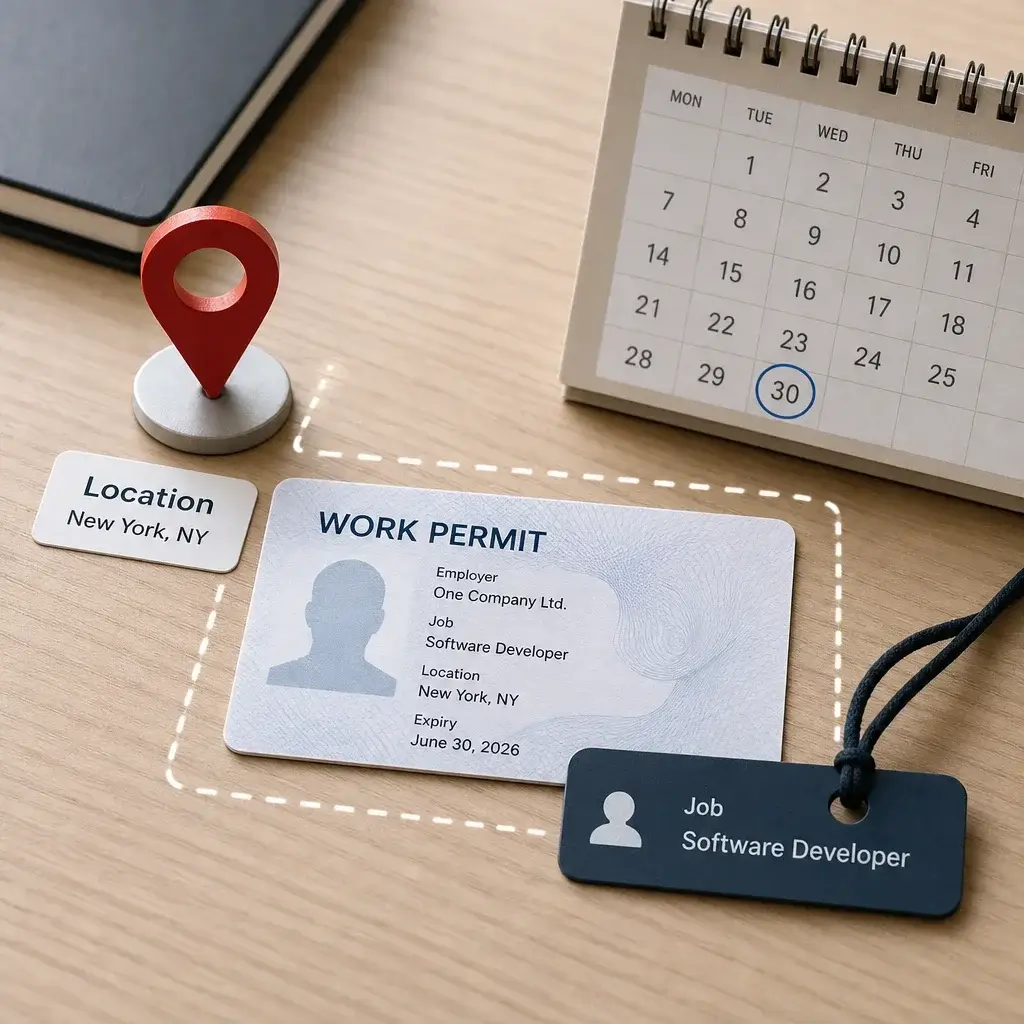
A closed work permit Canada file gives you permission only for the work allowed by the conditions printed on the permit . Common employer-specific work permit conditions include the employer name, occupation, work location, and expiry date .
That means a worker may run into trouble even when still working for the same employer if the actual job changes in a material way . A different city, a new occupation, major duty changes, or taking a second job can all raise authorization issues if the permit does not cover them .
Remote work, overtime, promotions, and worksite moves are not all treated the same in practice, because the key issue is whether the change alters the terms on which the permit was issued . I tell workers not to assume that a harmless-looking internal change is safe, because the wrong assumption can create unauthorized work problems .
Mini troubleshooting chart
| Scenario | Risk | Likely next step |
|---|---|---|
| New employer offers a better job | Unauthorized work if started early | Apply for new authorization before starting |
| Same employer moves worker to a new location | Permit may no longer match the job | Review whether amendment or new application is needed |
| Promotion changes occupation and duties | Original approval basis may no longer fit | Compare new duties to permit conditions |
| Worker wants a second part-time job | Closed permit usually does not authorize it | Check if a separate permit or different category is needed |
Changing Employers, Changing Terms, and Extensions

If you want to change employer-specific work permit conditions, the basic rule is to get the right authorization before the new work starts . A change employer-specific work permit request is not just an HR update, because immigration authorization and employment paperwork are separate systems .
Changing employers usually requires a new work permit process or another form of authorization tied to the new job . You should not start with the new employer until the law allows it, even if both employers agree on the transfer date .
An employer-specific work permit extension may be possible if the worker remains eligible and the supporting documents are updated before expiry . Timing matters because timely filing can affect whether the person keeps authorization under maintained-status rules that apply to their case .
The work permit renewal application form process is now usually driven through the IRCC online system rather than by treating one paper form as the whole answer . What matters more than the form label is whether the extension package matches the current job, current status, and current supporting stream .
You cannot simply convert a closed permit to an open work permit unless you independently qualify for an open category . Examples can include certain spousal or public-policy categories, and in some PR-stage situations a bridging open work permit may exist, but not every worker on a closed permit qualifies for that path .
Change and extension troubleshooting chart
| Issue | Main risk | Practical next step |
|---|---|---|
| Permit expires soon | Loss of status or work authorization | Review extension filing before expiry |
| New employer wants immediate start | Unauthorized work | Secure proper authorization first |
| Same employer changes title and duties | Mismatch with permit basis | Check whether the change is material |
| Worker wants open work rights | Wrong assumption about eligibility | Assess whether a separate open permit category exists |
Can Your Spouse or Children Come With You?

Dependants may be able to accompany the principal worker, but they do not all receive the same status automatically . A spouse, common-law partner, or child may need their own visitor, study, or work authorization depending on current rules and the principal worker’s category .
A spouse does not automatically qualify for an open work permit just because the principal applicant has an employer-specific permit . Spousal eligibility can depend on the worker’s occupation, the permit type, the permit length, and current policy settings at the time of filing .
Children may be able to attend school in Canada depending on age, status, and the current education and immigration rules that apply to them . The practical point is to coordinate family applications when possible so that relationship evidence, travel plans, and timing are presented consistently .
Refusals, Common Problems, and What to Do Next

Most employer specific work permit application refusals come from proof problems, stream mismatch, status issues, or concerns about whether the employment and applicant qualifications line up . A refusal does not tell every applicant the same thing, so the first step is to identify the exact problem instead of rushing into the same filing again .
Common refusal reasons include weak employer documents, an LMIA or offer number that does not match the application, incomplete forms, insufficient proof of training or experience, admissibility concerns, and credibility concerns about the genuineness of the job or the applicant’s plan to comply with the permit terms . Reapplying without fixing the officer’s main concern usually just repeats the same result .
The practical next steps after refusal are to review the refusal reasons, consider requesting the underlying records or officer notes where appropriate, correct the evidence gap, and then decide whether to reapply or get legal advice . Time-sensitive files, job changes, prior refusals, and family-linked cases usually deserve a more careful strategy than a quick resubmission .
If you are dealing with a refusal, employer compliance concerns, changing employers, dependants, or a PR plan tied to work authorization, this is one of the moments where focused legal help can make the file clearer and more consistent . Sutton Law acts on work permit and related immigration matters in Toronto and the GTA, and a free assessment may be available for suitable cases .
Worker Rights, Vulnerable Worker Protections, and Non-Compliant Employers

Being on a temporary foreign worker or employer-specific permit does not remove your workplace rights in Canada . A closed permit can create leverage for a bad employer, but it does not legalize unpaid wages, coercion, threats, or unsafe conditions .
Red flags include bait-and-switch duties, unauthorized deductions, unpaid wages, threats tied to immigration status, and unsafe housing where housing is tied to employment . Those are not minor HR issues when status depends on the job, because they can quickly become legal and personal safety problems .
Workers facing abuse or serious employer non-compliance may have immigration and employment options, but the right path depends on the facts and the current program rules . This is general information, not legal advice for your case, and urgent help matters where there is exploitation, family safety risk, or possible loss of status .
Quebec-Specific Notes for Employer-Specific Work Permits
Quebec employer-specific work permit files can involve an added provincial layer beyond the federal work permit process . Depending on the job and stream, a CAQ or other Quebec-specific step may be relevant through the provincial system now administered under MIFI terminology .
That does not mean every Quebec file follows the same route . The practical point is to check the federal stream and the Quebec-specific requirements together, because a complete federal package can still stall if the provincial support piece is missing where required .
From Closed Work Permit to Permanent Residence
A closed permit can support permanent residence planning because it may help a worker build Canadian work experience or maintain lawful work while pursuing another immigration pathway . That said, permanent residence is not automatic just because you worked in Canada for one employer .
Common pathways can include Express Entry, the Canadian Experience Class where eligible, Provincial Nominee Programs, and other employer-linked or category-specific routes . PR eligibility depends on multiple factors, including work history, language results, education, age, location, and the exact pathway rules in force when you apply .
A question like whether a CRS score of 470 is enough cannot be answered safely as a fixed yes or no because draw patterns and category-based selection change over time . The useful answer is to assess whether your current work permit strategy helps build a stronger PR file instead of relying on one score as a promise .
Some workers later become eligible for a bridging open work permit, often shortened to BOWP, but only if they meet the specific PR-stage requirements of that program . I would not treat BOWP as a general backup plan unless the underlying PR file is at the right stage and the applicant fits the current rules .
2026 Rule Changes and Why Applicants Should Verify Current Requirements
No one should rely on a generic article for supposed new rules for work permits in Canada in 2026 unless those changes are verified against current government guidance . Work permit rules can change through public policy, operational updates, or program-specific reforms, and speculative advice is where people get hurt .
The safe approach is to verify the latest IRCC requirements right before filing, especially for spouse eligibility, port of entry questions, LMIA-exempt categories, and employer-change rules . If a file depends on a changing policy, urgent start date, or a family strategy, legal review is usually more valuable than relying on old forum posts .
FAQ
What is an employer-specific work permit in Canada?
It is a work permit tied to a named employer and usually to listed job conditions such as role, location, and validity period .
Can my employer apply for my work permit?
Usually the worker is the actual applicant, while the employer completes the supporting LMIA or Employer Portal steps where required .
Does my employer need an LMIA for an employer-specific work permit?
Not always. Some cases need an LMIA, while others fit an LMIA-exempt category under the International Mobility Program .
What is an LMIA-exempt offer of employment number?
It is the number generated after the employer submits the offer through the Employer Portal in cases where that step is required .
Can I apply for an employer-specific work permit from inside Canada?
Sometimes, but only if you fit a category IRCC allows to apply or extend from within Canada .
Can I apply for an employer-specific work permit from outside Canada?
Yes, and that is a common path for first-time foreign workers .
Can I apply for an employer-specific work permit at a port of entry?
Only in limited situations where current law and your status make that route available .
How much does an employer specific work permit application cost?
The government work permit fee is CAD 155 and biometrics are CAD 85 if required .
How long does it take to process an employer-specific work permit?
Processing can take weeks to months depending on stream, location, biometrics, medicals, completeness, and security screening .
Can I change employers on a closed work permit?
Usually only after you obtain new authorization tied to the new employer or another eligible status category .
Can I extend my employer-specific work permit?
Often yes, if you remain eligible and apply with updated support before the permit expires .
Can I change an employer-specific work permit to an open work permit?
Not automatically. You must separately qualify for an open work permit category .
Can my spouse get a work permit if I have an employer-specific work permit?
Sometimes, but not automatically, and current policy details matter .
What happens if my employer specific work permit application is refused?
You review the reasons, fix the evidence or legal issue, and then decide whether to reapply or seek legal advice .
Can a closed work permit lead to permanent residence in Canada?
Yes, it can support some PR pathways, but PR depends on a wider set of requirements than just holding the permit .
If your file involves an LMIA question, an inland status issue, a refusal, family applications, or a job change, the next sensible step is to review the exact documents and stream before filing again.