

> General information only. Rules, forms, fees, and processing times change. This page is federal Canada-wide guidance, not Quebec-specific advice, and not legal advice for your exact case.
LMIA work permit to PR: the short answer
An LMIA-backed path can lead toward PR in 3 common ways. First, the LMIA may support a qualifying job offer for a PR program such as Express Entry in limited cases. Second, the LMIA may support a work permit so the worker can gain Canadian experience and apply later. Third, the same job offer may fit a provincial nominee program where employer support matters.
An LMIA does not automatically become PR. A Labour Market Impact Assessment is an employer-side document issued through ESDC/Service Canada. It says, in plain English, that hiring a foreign worker is justified under the stream used. PR is a separate immigration application handled by IRCC.
The right route depends on one concrete business question: does the employer want the worker to start now, only after PR approval, or through an LMIA-exempt option if one exists. That choice changes the paperwork, timing risk, and compliance burden from the start.
If you are in a rush: choose the scenario first
- PR-supporting LMIA: best when the employer is supporting a permanent job offer tied to PR, and the worker may not need to start work immediately.
- Dual intent LMIA: best when the employer wants the worker to start sooner on a work permit while PR is also part of the plan.
- LMIA-exempt work permit: best when the worker already fits an exemption under the International Mobility Program, such as certain intra-company, treaty, francophone, open work permit, or youth mobility categories.
What is an LMIA for PR?
An LMIA for PR usually means an employer is seeking an LMIA to support a permanent residence pathway rather than only immediate work authorization. The named authority is Employment and Social Development Canada, usually through Service Canada, and the core question is labour market impact.
A PR-supporting LMIA is different in purpose from a standard work-permit-focused LMIA. The PR-supporting version is used to help support a permanent job offer for an immigration pathway. A standard LMIA is usually tied more directly to a temporary foreign worker applying for a closed work permit.
The difference between PR supporting LMIA and LMIA used in everyday discussion is mostly about intended use, not the fact that both are LMIAs. One supports a PR step based on a qualifying offer. The other supports work authorization, often right away, if the stream allows it.
A dual intent LMIA sits in the middle. It recognizes one real-world fact: a worker can intend to work temporarily and also seek permanent residence later. That makes it useful where the employer cannot wait for the PR file to finish before the worker starts.
Can you get PR from an LMIA-backed job offer or work permit?
Yes, but only through a separate PR program with its own eligibility rules. The actual lmia work permit to pr process is not a conversion. It is a sequence where the LMIA-backed offer or work permit strengthens one part of a larger application.
A valid path often falls into 3 routes. Route one is arranged employment within Express Entry where the offer meets the program rules. Route two is a work permit first, then Canadian work experience, then PR through a stream like CEC if the worker qualifies. Route three is a PNP stream that values a permanent full-time job offer or local employer support.
Not every LMIA-backed job fits every PR program. Express Entry still tests language, skilled work history, admissibility, and sometimes proof of funds. A provincial stream may also require the job to match a specific occupation, wage level, region, or employer type.
Simple decision tree
1. Need the worker to start now? Look at dual intent LMIA or an LMIA-exempt permit. 2. Worker can wait for PR first? Check whether a PR-supporting LMIA and qualifying job offer fit the target PR stream. 3. Worker already in Canada with status? Check whether Canadian work experience, an open work permit, or a PNP route is stronger than an LMIA-based plan. 4. Occupation or employer may fit an exemption? Review International Mobility Program options before starting LMIA paperwork.
LMIA for PR vs dual intent LMIA vs LMIA-exempt options

The best route depends on whether the employer needs labour immediately, whether the worker qualifies for an exemption, and whether the PR program requires a qualifying job offer. This is where many files go off track. People choose the wrong tool.
A PR-supporting LMIA is usually the cleanest fit where the employer is supporting a permanent job offer and can wait for the PR stage to move first. The main risk is timing. If the PR step stalls, the employer may still have no worker in place.
A dual intent LMIA is often the stronger option where the employer needs the worker sooner. The worker may apply for a work permit first and continue toward PR later. The trade-off is more moving parts: employer compliance, temporary status, work permit timing, and PR timing all run at once.
An LMIA-exempt route can be better than either LMIA option when the worker already qualifies under the International Mobility Program. Common examples include certain intra-company transferees, some CUSMA professionals, Mobilité Francophone, some IEC categories, and some open work permits linked to family or status circumstances. The named legal framework here is the IMP, not the Temporary Foreign Worker Program.
| Route | Main purpose | Can the worker start now? | Main authority | Main risk | Best fit |
|---|---|---|---|---|---|
| PR-supporting LMIA | Support a qualifying permanent job offer for PR | Usually not the main purpose | ESDC/Service Canada + IRCC | Offer may not help if PR timing slips | Employer can wait and PR pathway is clear |
| Dual intent LMIA | Support work permit now and possible PR later | Yes, if work permit is approved | ESDC/Service Canada + IRCC | Two timelines to manage at once | Employer needs worker soon |
| LMIA-exempt route | Avoid LMIA where an exemption applies | Often yes, if exemption fits | IRCC under IMP | Wrong exemption choice can cause refusal | Worker already fits an exemption category |
If you are unsure which route fits, this is the point to get a careful assessment. A good immigration lawyer Toronto employers and workers trust should separate the employer plan from the worker plan, then line up both against the same deadline map.
Which PR programs can use an LMIA-backed job offer?

An LMIA-backed job offer can matter in Express Entry, some PNP streams, and some employer-supported pathways, but it does not create PR eligibility by itself. The program still decides the legal test.
In Express Entry, a qualifying offer may support arranged employment and may add 50 to 200 points depending on the job type and the current rules. Those points are not automatic. The offer must meet the exact criteria in force when the profile or application is assessed.
For FSWP and FSTP, the LMIA-backed job offer can be relevant where the program accepts a qualifying offer as part of the case. For CEC, the core legal fact is different: eligibility is driven mainly by qualifying Canadian skilled work experience, not by the LMIA itself.
A PNP may be a better fit when the occupation, employer, and province line up more clearly than federal draws do. Provincial nominee programs are not interchangeable. A stream in Ontario may value employer support in one way, while another province may require different wage, location, or occupational conditions.
No province is universally “easy” for PR. The real variables are occupation, language level, employer location, work history, and the live criteria on the day you apply. The same worker can be strong in one province and weak in another.
Does an LMIA give points in Express Entry?
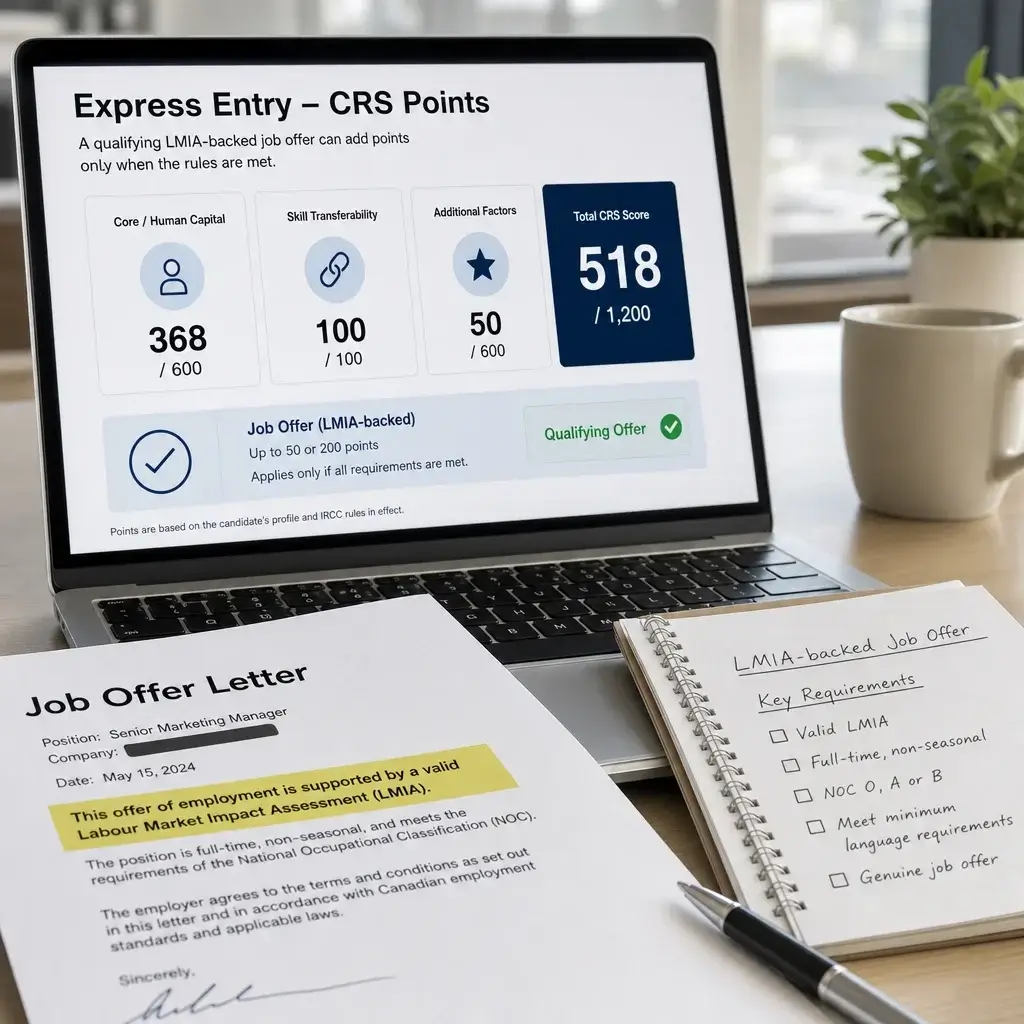
Sometimes yes. A qualifying job offer supported by an LMIA may give additional CRS points, but only if the offer matches the current arranged employment rules. The key fact is legal fit, not the word “LMIA” by itself.
The additional points are commonly described as 50 or 200 under current-style Express Entry frameworks, with the higher amount tied to limited senior management categories. Those figures must always be checked against the latest IRCC rules before a profile is updated.
The offer must also be genuine, supported correctly, and connected to a job that meets the current criteria. If any of those parts fail, the worker may get 0 arranged-employment points even with a positive LMIA in hand.
Employer eligibility and job offer requirements

The employer applies for the LMIA, not the worker. That division matters. If the employer is not ready to meet the compliance burden, the worker cannot fix that alone.
A qualifying employer usually must show a real business, a real need for the role, and the ability to pay the offered wage and maintain the working conditions promised. The named evidence often includes business registration, payroll records, tax records, corporate documents, and recruitment records where the stream requires them.
The job offer must also match the immigration path. That means the NOC/TEER level, duties, wage level, and schedule need to line up with the program being used. A title alone is weak evidence. Duties and wage are what officers compare.
For PR support, the offer often needs to be full-time, non-seasonal, and intended to be permanent if the target PR stream requires that wording. The exact language varies by program, so one offer letter cannot safely be copied across every stream.
Quick employer eligibility checklist
- Genuine Canadian business with active operations.
- Real labour need tied to a real position.
- Wage and duties that match the occupation claimed.
- Ability to keep records and respond to verification.
- Recruitment evidence where the stream requires it.
- Job offer language that matches the chosen PR program.
Step by step: what happens after a positive LMIA

After a positive LMIA, the employer and worker should move in parallel, not in isolation. Delay between those two sides is where expiry problems start.
The employer should issue the compliant job offer, keep the LMIA records, and stay available for any verification. If the path includes a work permit, the employer also needs to provide the documents needed for that permit stage and remain consistent across all forms and letters.
The worker should first confirm the strategy. That means choosing among 3 tracks: work permit now, Express Entry with arranged employment if eligible, or a PNP stream where the offer fits better. Filing the wrong next step wastes validity time.
If a work permit is part of the plan, the worker should apply as soon as the file is complete and status strategy is clear. If Express Entry is part of the plan, the worker should create or update the profile, claim arranged employment only if the rules are met, and keep all supporting documents ready for a possible invitation.
If the worker receives an ITA or a provincial nomination, the PR application still stands on its own evidence. The worker must prove eligibility, identity, admissibility, and document completeness. The LMIA-backed job offer is support. It is not the whole case.
Worker checklist after a positive LMIA
- Get the LMIA documents and final job offer package.
- Confirm whether the file is PR-supporting, dual intent, or work-permit-first.
- Check Express Entry or PNP eligibility before claiming any benefit.
- Apply for the work permit if that is the chosen next step.
- Prepare PR documents early, not at the last minute.
- Maintain legal status in Canada if already here.
Employer checklist after a positive LMIA
- Issue a job offer that matches the chosen immigration stream.
- Keep recruitment and business records organized.
- Support the work permit stage if using dual intent.
- Stay available for ESDC, Service Canada, or IRCC verification.
- Track expiry dates and internal onboarding deadlines.
Processing times, validity, and expiry risks

There is no safe universal answer on PR support LMIA processing time because government workloads and streams change. The honest answer is that LMIA timing depends on the stream, the quality of the file, the region, and current Service Canada workload.
Some online sources cite about 24 weeks for certain LMIA processing scenarios, but I would not treat that as a promise. Official timelines can move, and some categories are processed differently from others.
A positive LMIA is often described as having about 6 months of validity for use, but that point must be checked against the current government rules and the exact purpose of the LMIA. Validity is one of the most mishandled parts of these files.
If the LMIA expires before the PR submission or work permit step it was meant to support, the worker may lose the benefit of that document for the intended use. In some cases, the employer may need a fresh LMIA or updated support process. There is no universal renewal shortcut.
Timing risk box
- Do not wait until the last weeks of validity to choose the next step.
- Do not assume work permit timing and PR timing move at the same speed.
- Do not claim points or arranged employment until the file clearly meets the rule.
- Do not let temporary status in Canada drift while waiting on a PR plan.
After LMIA approved, how much time for work permit?
There is no fixed national number that fits every work permit case. Processing depends on where the worker applies, whether biometrics or medicals are needed, whether the file is inside or outside Canada, and how complete the application is on day one.
The practical answer is simple: apply promptly once the work permit package is complete and the strategy is confirmed. The worker should not spend most of the LMIA validity period deciding whether to apply.
Inside Canada, the status question is often as important as the work permit question. A worker with expiring temporary status may need a separate status plan while waiting, because a positive LMIA by itself does not grant authorization to work.
Fees and real-world costs

Employers should budget for more than one line item. The government fee is only one part of the cost of an LMIA-based strategy.
Many sources refer to an LMIA government processing fee of CAD 1,000 in standard situations, and some PR-only support situations may have a fee exemption. That exemption must be confirmed against current official rules before anyone relies on it.
Beyond the government fee, the real cost usually includes recruitment advertising, HR time, payroll coordination, translations, document collection, and legal review if the file is complex. Those are not optional in practice if the employer wants a clean record and a consistent application.
A weak filing often costs more than a careful filing. The hidden expense is delay. If an employer files the wrong LMIA type first, the worker can lose months and the business can lose the hire.
Required documents: employer checklist and worker checklist
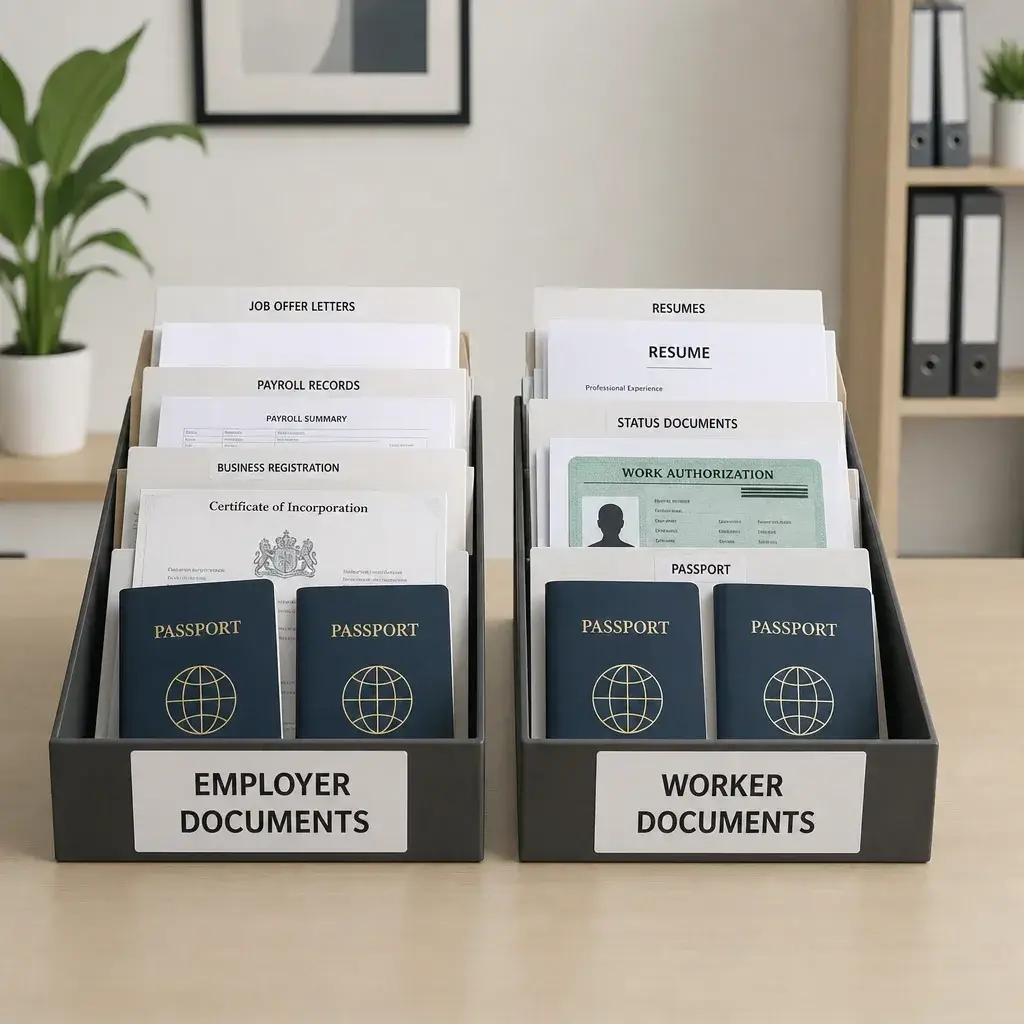
The cleanest way to build an LMIA-supported PR application is to separate employer documents from worker documents. Mixed files cause contradictions.
Employer documents
- Business registration and corporate records.
- Payroll, tax, or financial records showing active operations.
- Recruitment and advertising records where required by the stream.
- Job description with duties, wage, hours, and location.
- Signed job offer letter that matches the immigration pathway.
- Compliance records or internal HR materials if relevant to the stream.
Worker documents
- Passport and identity documents.
- Resume and detailed work history.
- Education records where the PR stream requires them.
- Language test results where the PR stream requires them.
- Current Canadian status documents if the worker is in Canada.
- LMIA and job offer package from the employer.
- Police certificates and medicals where the immigration step requires them.
The exact list changes by stream. A work permit file, an Express Entry file, and a PNP file do not use the same document logic even when the same job offer sits underneath them.
What if PR is refused, the LMIA is negative, or the worker cannot wait?
A positive LMIA supports the employer’s hiring position. A negative LMIA means Service Canada was not satisfied under the applied stream. That is the practical difference in plain English.
If PR is refused after an LMIA-based job offer, the next step depends on the worker’s status, the stream used, and whether there is another valid route such as a work permit extension, a different PR program, an appeal-capable issue, or an LMIA-exempt option. There is no automatic salvage rule.
If the worker is in Canada and current authorization is expiring, status planning becomes urgent. The legal issue then is not only PR. It is also whether the person can remain and work lawfully while the next strategy is built.
A refusal does not always kill the employer-worker plan, but it usually changes it. This is where early review matters. It is easier to redesign the file before deadlines collapse than after.
LMIA-exempt alternatives that may be faster or better
An LMIA is not always the right first move. Some workers can use the International Mobility Program instead, which avoids the LMIA entirely.
Common LMIA-exempt categories include certain CUSMA professionals, some intra-company transferees, Mobilité Francophone, some IEC streams, and some open work permit categories tied to family or status rules. Each exemption has its own legal test. Similar job titles do not mean similar eligibility.
An LMIA-exempt work permit can still support a later PR strategy. In practice, the worker may gain Canadian skilled experience, improve language scores, and build a stronger case than a rushed LMIA-based filing would have produced.
This is one of the most useful planning points for employers as well. If an exemption fits, the employer may avoid LMIA recruitment obligations and move faster, while still keeping a later PR path open.
Common misconceptions about TR to PR and 2026 updates
TR to PR public policies are separate from LMIA-based pathways. People mix them together, and that leads to bad planning.
There is no safe basis to predict a new TR to PR stream for 2026 without a verified government announcement. The same caution applies to questions like “Is Canada giving PR in 2026?” or “Who is eligible for TR to PR 2026?” Program design can open, close, pause, or change.
The right planning factors are more stable than public-policy rumors. Focus on job offer quality, work authorization, language ability, admissibility, and whether the chosen PR program actually fits the worker’s record.
No province should be sold as the “easy” answer. Provincial criteria are occupation-driven and policy-driven. A strong case is built on fit, not on internet rankings.
When to speak with an immigration lawyer
Legal help is most useful when there is expiry risk, a refused application, uncertain Express Entry eligibility, employer compliance exposure, inadmissibility concerns, or more than one possible route. Those are the files where a wrong first step creates months of damage.
A good immigration lawyer Toronto workers and employers can rely on should assess both sides of the case together: the employer’s LMIA obligations and the worker’s PR or work permit eligibility. That is the only way to choose properly between LMIA for PR, dual intent LMIA, and an LMIA-exempt route.
Sutton Law can help assess the right path, prepare employer and worker documents, and respond quickly where timing mistakes could hurt the case. If you are weighing a PR-supporting LMIA against a work-permit-first plan, a free assessment can save a false start.
FAQ
Can I convert LMIA to PR in Canada?
No. An LMIA cannot be directly converted into PR. It can support a qualifying job offer, a work permit, or a broader PR strategy.
How does LMIA work for PR?
It supports one part of the PR pathway. Usually that means a qualifying job offer, arranged employment in the right case, or a work-permit-first path that leads to Canadian experience.
How long after LMIA can I apply for PR?
There is no one answer. You can move quickly if the PR program fit is already clear and the documents are ready, but the LMIA validity period still matters and must be checked against current rules.
Does an LMIA give points in Express Entry?
Sometimes. A qualifying LMIA-backed job offer may add CRS points if the offer meets the arranged employment rules in force at that time.
What is the difference between LMIA for PR and dual intent LMIA?
A PR-supporting LMIA is aimed at supporting a permanent residence path through a qualifying job offer. A dual intent LMIA is used where the worker may also start earlier on a work permit while PR remains part of the plan.
Who can apply for an LMIA?
The employer applies, not the worker. The employer must show a genuine business, a real job, and compliance with the stream requirements.
How long is a positive LMIA valid for PR purposes?
Validity must be checked against current rules and the specific LMIA use. Many sources mention about 6 months, but no one should rely on that without checking the latest official guidance.
What happens if the LMIA expires before PR submission?
The document may no longer support the intended step. The employer may need to start a new or updated support process depending on the case.
Is there a fee for an LMIA used only to support PR?
There may be a fee exemption in some PR-support-only situations, but that point must be verified under current rules before filing.
What happens if PR is refused after a positive LMIA?
The refusal does not create one automatic next step. The worker’s status, the employer’s needs, and any alternate work permit or PR options must be reviewed immediately.
I would test every file against one final question before spending more money: is this really an LMIA case, or is it an exemption case wearing the wrong label? That is often where the best next step appears.