

SINP step by step process at a glance
The full path is usually: choose the right stream, confirm eligibility, create an Expression of Interest if your stream uses one, receive an invitation if required, prepare documents, submit the provincial application online, wait through review and assessment, receive a decision, and then complete the federal PR stage with IRCC if nominated.
A nomination is a major step, but it does not automatically give you permanent residence because IRCC still reviews medical, criminality, security, admissibility, and completeness at the federal stage.
Some streams use an EOI pool, while others depend on a Saskatchewan job offer and employer-side steps such as position approval. That is why the SINP processing steps are not identical for every applicant.
Timeline from eligibility to nomination to PR
The process of PR in Saskatchewan is usually a provincial stage first and a federal stage second. A pre-application stage can take days or weeks depending on how fast you gather language results, education records, work proof, and identity documents.
An EOI stage, where applicable, does not have a guaranteed wait time because invitations depend on program criteria, draw activity, and your score compared with other candidates.
A submitted SINP application then moves into completeness review, assessment, possible document requests, and decision. If you are nominated, you move to IRCC, where the PR stage is separate from the province and has its own forms, fees, and processing timeline.
How the SINP process works from start to finish
- Choose the right stream. Your stream depends on factors like whether you have a Saskatchewan job offer, Saskatchewan work experience, an active Express Entry profile, and whether your occupation fits current program criteria.
- Check the stream rules before filing. SINP requirements change by pathway, and using the wrong category can lead to a returned or refused file even if you are otherwise a strong candidate.
- Create an EOI if your stream requires one. An Expression of Interest is not a full application. It is a screening profile used to rank candidates before invitations are issued.
- Wait for an invitation if your stream is invitation-based. Being in the pool does not mean you will be invited, because invitation thresholds can change from draw to draw.
- Collect and review your supporting documents. This usually includes identity records, civil status records, work history proof, education documents, language results where required, and job offer or employer documents if your pathway needs them.
- Submit the SINP application online. The province uses an online portal, often still referred to by applicants as the SINP OASIS login or SINP login. You complete forms, upload documents, make declarations, and pay a fee if your pathway requires one.
- Wait through pre-screening and assessment. The province first checks whether the file is complete enough to assess, then an officer reviews eligibility, documents, and any employer-linked requirements. SINP may ask for more information before making a decision.
- Receive the provincial decision. Common outcomes include nomination, refusal or ineligibility, return due to incompleteness, closure, or withdrawal. The result depends on the stream rules and the evidence in your file.
- Apply to IRCC after nomination. The next step after SINP nomination is usually a federal permanent residence application, either through Express Entry if your nomination is aligned with it, or through the non-Express Entry provincial nominee process if it is a base nomination.
Which SINP pathway should you choose?
The right pathway depends first on whether you have a Saskatchewan job offer, because some streams are tied to employer support and others can be used without one.
If you already work in Saskatchewan or have recent Saskatchewan work authorization and local work history, a Saskatchewan Experience type of pathway may be the closer fit. If you are outside the province, the analysis usually starts with International Skilled Worker options and whether they are open and match your profile.
If you have an Express Entry profile and meet a stream aligned with it, the federal stage can connect differently after nomination than a base stream does. Eligibility for an Express Entry-linked path does not automatically mean you qualify for the base version, or the reverse.
If your pathway requires an employer step, you need to confirm early whether the employer must complete position approval before you can file. That issue alone can change both timing and strategy.
| Pathway type | Best for | Job offer usually needed | EOI used | Employer approval involved | Federal next step |
|---|---|---|---|---|---|
| International Skilled Worker, EOI-based | Skilled workers outside or inside Canada who match current criteria | Not always | Often yes | Sometimes no | PR after nomination, route depends on stream alignment |
| International Skilled Worker, employment offer-based | Applicants with a Saskatchewan offer | Usually yes | Stream-dependent | Often yes | PR after nomination |
| Saskatchewan Experience | Workers already in Saskatchewan in qualifying situations | Usually tied to current work/employment conditions | Stream-dependent | Often yes | PR after nomination |
| Express Entry-aligned SINP stream | Applicants who already qualify federally under Express Entry and fit SINP criteria | Not always | Often yes | Stream-dependent | Accept nomination in Express Entry, then proceed federally |
| Base SINP stream | Applicants nominated outside Express Entry | Stream-dependent | Stream-dependent | Stream-dependent | Separate non-Express Entry PR application to IRCC |
Pathway decision tree

The first branch is job offer versus no job offer. If you do not have a Saskatchewan job offer, focus on whether a current skilled worker pathway without an offer is open and whether your occupation, education, language, and work history fit that stream.
The second branch is Saskatchewan experience versus no Saskatchewan experience. If you already work in the province, local work and permit history may matter as much as your education or foreign experience.
The third branch is Express Entry versus base nomination. If you already have a valid Express Entry profile and fit an aligned stream, the post-nomination process can move through your federal profile. If not, a base stream leads to a separate federal PR filing after nomination.
The practical rule is simple: choose the stream you actually qualify for on the date you apply, not the stream that looks fastest online. This is general information, not legal advice for your file.
Documents to prepare before you apply
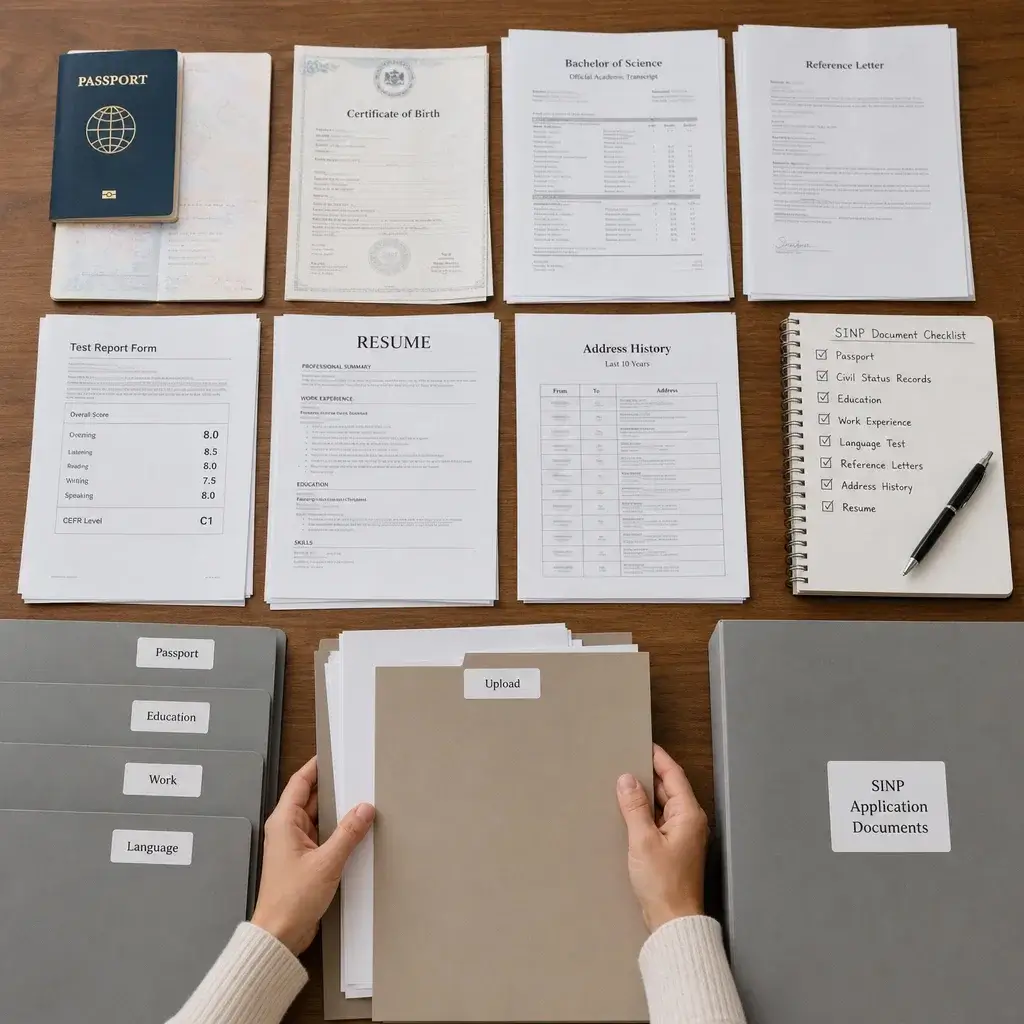
Most SINP applications need a core document package: passport identity pages, civil status records, education records, work history proof, address history, and any required language test results. Missing or inconsistent documents are a common reason files are delayed, returned, or refused.
Work history proof usually matters more than applicants expect. Officers often look for documents that line up on job title, dates, employer identity, and duties, because inconsistent employment evidence can create credibility issues.
Education documents should match what you claim in your forms. If your stream requires an educational assessment or specific credential proof, that should be checked before submission rather than after a request arrives.
Job-offer cases usually need extra employer-linked records, and Express Entry-aligned cases usually need details that match the federal profile exactly. Provincial and federal filings should tell the same story on dates, family members, work history, and status history.
Translations must be complete and legible, and unofficial summaries are not a substitute for proper translated records where the program requires translation. The exact translation rules should always be confirmed on the official government page for your stream.
Practical checklist
- Passport and identity pages
- Birth, marriage, divorce, or name-change records if applicable
- Education certificates, transcripts, and assessments if required
- Language test results where the stream requires them
- Reference letters and employment proof
- Resume and address history
- Proof tied to Saskatchewan work or job offer if relevant
- Express Entry profile details if using an aligned stream
- Clear scans and organized file names for upload
SINP points, EOI, and invitations explained
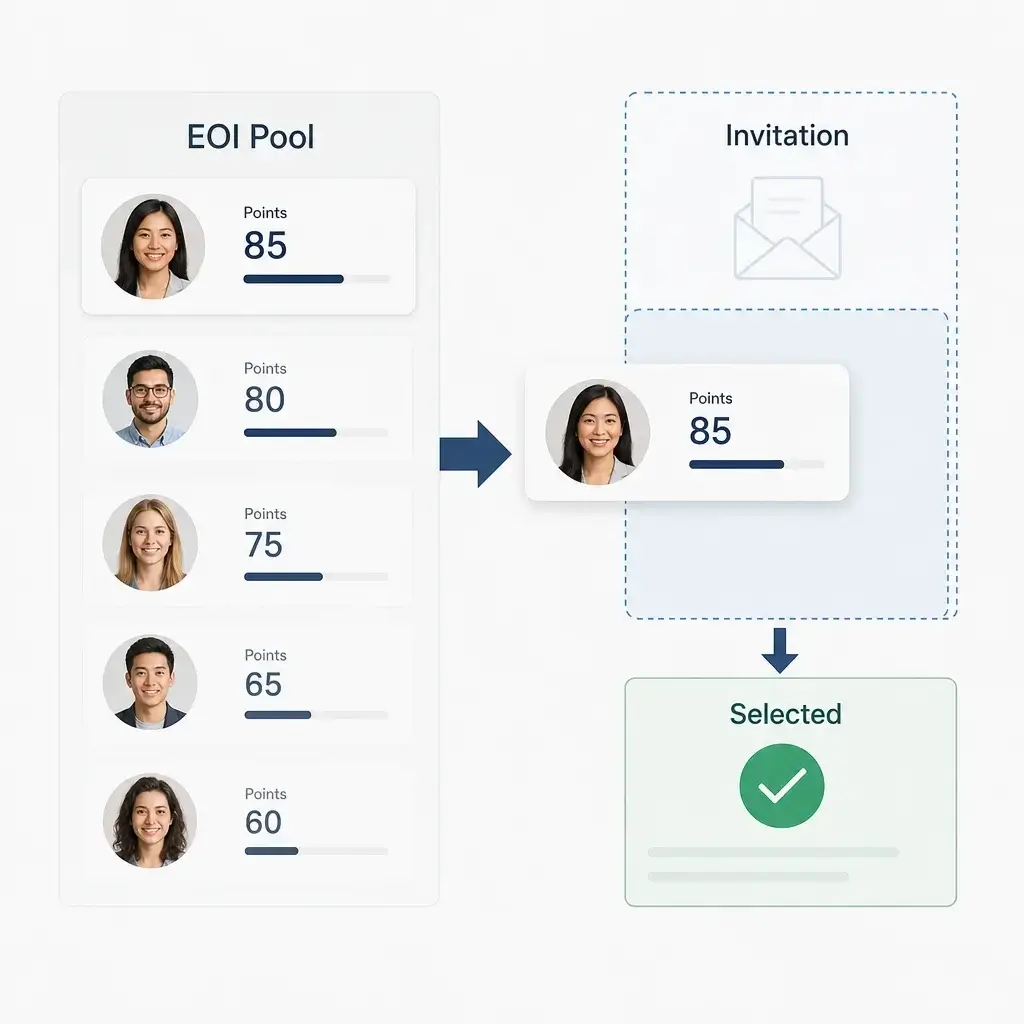
An EOI is a screening profile, not a nomination and not a full SINP application. It lets the province rank candidates before deciding who can submit a complete file.
The SINP points calculator concept usually involves factors such as age, education, language ability, work experience, and sometimes Saskatchewan connections depending on the pathway. The exact grid and the exact minimum should always be checked against the current official stream criteria before you rely on a score.
An invitation matters because it changes you from a pool candidate to an applicant. Until you are invited, you are not in the assessment stage, and there is no nomination decision for the province to make.
Invitation thresholds are not fixed promises. They can change based on draw activity, occupation targeting, program priorities, and the number of candidates in the pool.
How to apply online through SINP or OASIS

The application is filed through the official Saskatchewan online system, and applicants should use only the government portal rather than third-party websites or old screenshots posted elsewhere.
The online process usually includes account creation, profile completion, document upload, declarations, fee payment if your stream charges one, and final submission. Keep copies of the confirmation screen and any submission number.
The SINP application fee may apply only to some pathways, not every stream. Because fees and payment workflow can change, you should verify the exact amount and whether it is refundable on the official program page before you submit.
File naming and document organization can save you real time later. We see this in regulated applications generally: a clean upload package makes officer review easier and reduces avoidable requests for clarification.
SINP application status explained: what “in process” means

SINP application status in process usually means the province has received your file and it is moving through review, but no final decision has been issued yet. The same idea applies when applicants see SINP in process status in the portal.
That status is broad, not precise. It does not tell you whether the file is at completeness review, active assessment, verification, or waiting in a queue between internal steps. A lack of visible movement does not always mean a problem.
You can usually track your file through the online portal, where messages, document requests, and status updates are posted. Some systems also send email notifications, but the portal itself is the safer place to monitor because email notices can be missed or filtered.
Status glossary
| Status | What it usually means | Do you need to act? | Common next step |
|---|---|---|---|
| EOI submitted | You entered the candidate pool but have not been invited | No, unless your profile changes and the system allows updates | Wait for draw activity or update profile if permitted |
| Invited | The province has invited you to submit a full application | Yes | Gather final documents and file before the deadline |
| Application submitted | Your full file was sent through the portal | Usually no immediate action | Wait for intake and review |
| Received | The system shows the province has the file | Usually no | File moves to review stage |
| Pre-screening or completeness review | Basic review for required forms and documents | Possibly, if something is missing | File moves to assessment or request stage |
| In process | File is under review but not decided | Usually no, unless a message is posted | Assessment, verification, or request for more evidence |
| Waiting for additional information | Officer needs more documents or clarification | Yes | Upload the requested items by the deadline given |
| Decision made | A final result has been entered | Yes, review the letter | Nomination, refusal, return, or closure |
| Nominated | Saskatchewan approved the provincial stage | Yes | Complete the federal IRCC stage |
| Returned | File was not accepted for full processing, often due to completeness or filing issues | Possibly later, depending on the reason | Review reasons and consider refiling if eligible |
| Ineligible or refused | The officer found the file did not meet program rules | Possibly, depending on review options | Get advice on next steps and reapplication strategy |
| Withdrawn | The file was closed at the applicant’s request | Yes | Confirm records and any fee consequences |
SINP processing times: what to expect at each stage
There is no single SINP processing time that fits every file because timing changes by stream, application volume, completeness, employer issues, verification needs, and policy changes.
EOI waiting time, where applicable, is separate from application processing time. You can stay in a pool without immediate movement because invitations depend on draw criteria, not filing date alone.
Post-submission timing usually breaks into intake, completeness review, officer assessment, possible additional document requests, and final decision. Files with missing evidence or inconsistent records often take longer because the officer cannot finish the assessment cleanly.
SINP processing time after nomination is also a separate issue because once the province is done, the federal IRCC stage controls the PR timeline. The province cannot finalize your permanent residence after nomination.
| Stage | What affects timing | What you can control |
|---|---|---|
| Eligibility and document prep | Language testing, education records, employment proof, translations | Gather documents early and keep evidence consistent |
| EOI wait, if applicable | Draws, score, occupation targeting, program priorities | Keep profile accurate and current if updates are allowed |
| Application intake and completeness review | File volume and whether documents are missing | Submit a complete, well-organized package |
| Assessment | Verification, officer workload, employer issues, document quality | Respond quickly and clearly to requests |
| Post-nomination federal PR stage | IRCC inventory, medicals, security, criminality, completeness | File promptly and keep all forms consistent |
If you need the current published processing figure for your exact stream, use the official Saskatchewan page and the current IRCC tool for the federal stage. I would not rely on an old blog screenshot for live timing.
What happens after SINP receives your application

The first review is usually a basic intake or completeness check. The province looks at whether the right forms, declarations, and core documents are present before deeper assessment begins.
A pre-screening stage generally means the file is being checked for initial readiness rather than fully decided on the merits. That is why a file can be accepted into review and still face refusal later if the detailed evidence does not support eligibility.
The assessment stage is where an officer reviews eligibility, documents, work history, family details, employer-linked requirements if any, and consistency across the file. Verification can happen here, and additional documents may be requested.
If SINP asks for more information, the deadline in the portal matters. Missing a request window can lead to closure, refusal, or a negative decision based on the record already before the officer.
The main outcomes are nomination, return, refusal or ineligibility, withdrawal, or another closure outcome defined by the program. A returned file is not the same as a refused file, because a return often means the case did not proceed to a full merits assessment.
Base stream vs Express Entry SINP
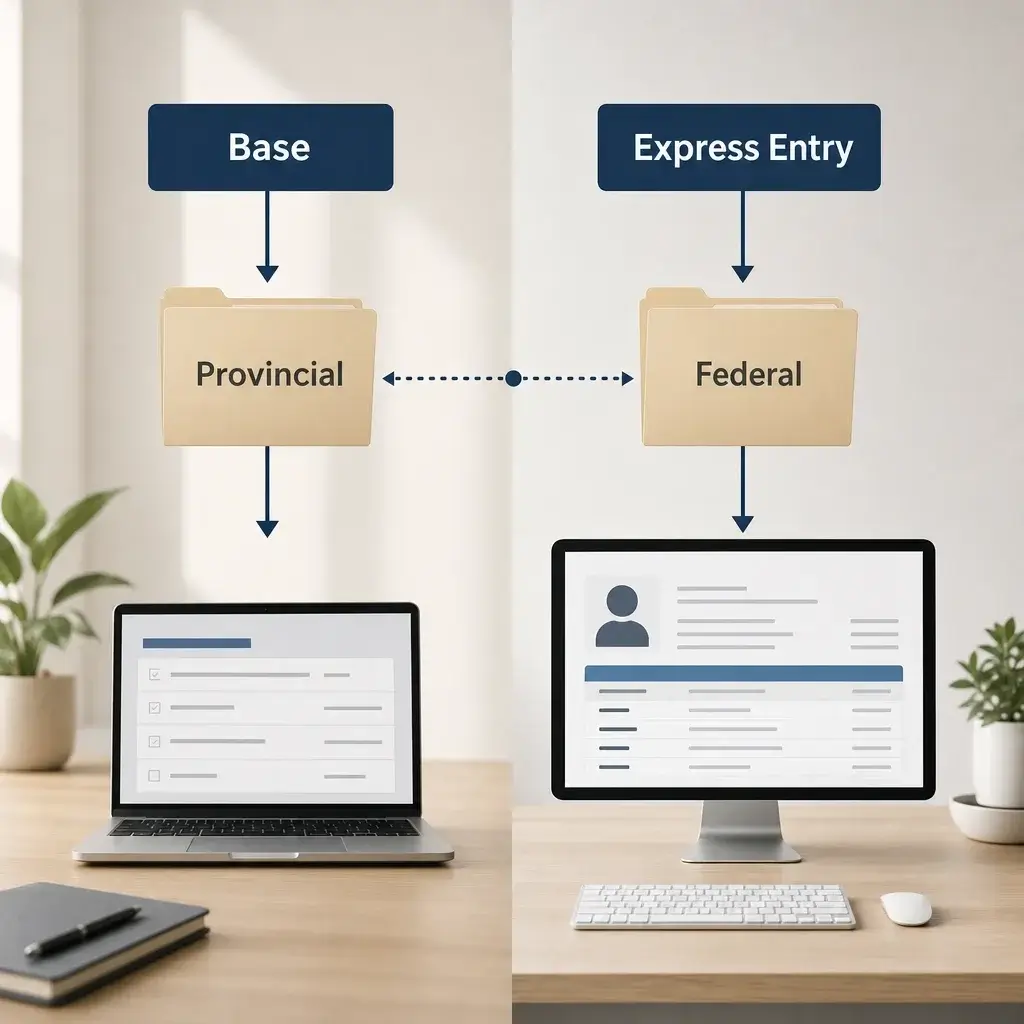
A base stream nomination and an Express Entry-aligned nomination both start with the provincial stage, but they split at the federal stage. That difference matters more than most applicants realize.
A base nomination usually leads to a separate provincial nominee permanent residence application to IRCC outside Express Entry. The federal file is still mandatory, and nomination alone does not complete immigration.
An Express Entry-aligned nomination interacts with your federal Express Entry profile. After nomination, the applicant usually has to accept the nomination within the federal system before moving ahead at the IRCC stage. The exact acceptance window should always be confirmed on the current federal instructions because deadlines can change.
| Issue | Base SINP stream | Express Entry-aligned SINP stream |
|---|---|---|
| Need Express Entry profile first | No | Yes |
| Federal step after nomination | Separate non-Express Entry PR filing | Continue through Express Entry after accepting nomination |
| Main risk after nomination | Delay or error in federal filing | Missing nomination acceptance or profile inconsistency |
| Does nomination equal PR | No | No |
What is the next step after SINP nomination or approval?
The next step after SINP approval is usually a federal application to IRCC, because Saskatchewan cannot grant permanent residence by itself. That answers both “what is the next step after SINP nomination” and “does SINP lead to permanent residency.” It can lead to PR, but it does not guarantee it.
At the federal stage, IRCC checks the application for completeness and then reviews admissibility issues such as medical, criminality, and security. A provincial nomination helps, but it does not remove the need to meet federal requirements.
If your nomination is conditional or tied to facts that later change, you need to deal with that carefully and quickly. Changes in address, family composition, employment, or status can matter at both the provincial and federal stages.
If you are unsure how to move from nomination to PR, especially with deadlines, document requests, or inconsistent records, getting a legal assessment early is usually cheaper than trying to fix a preventable refusal later. Sutton Law offers free assessments for immigration matters.
Common reasons SINP applications are rejected, returned, or delayed
A refusal, a return, and a delay are three different problems. A refusal means the officer decided the application did not meet the rules. A return usually means the file could not proceed properly, often because of filing or completeness issues. A delay means the file is still alive but not moving as fast as expected.
Wrong stream selection is one of the biggest avoidable issues. A file can look strong on paper and still fail if it was filed in a category that does not actually fit the applicant’s facts.
Inconsistent work history is another common problem. If dates, duties, employers, or job titles do not line up across letters, forms, resumes, and federal records, the officer may question whether the claimed experience is proven.
Missing evidence, expired documents, language or education problems, employer approval problems, and failure to answer document requests can also hurt a file. Misrepresentation concerns are more serious because they can affect future applications, not just the current one.
Troubleshooting table
| Problem or status | What it usually means | Can the file continue? | What to do next |
|---|---|---|---|
| Returned | File was not processed fully, often due to completeness or filing issue | Sometimes, by refiling if still eligible | Read the return reason carefully and correct the issue |
| Closed after request | The program did not receive what it needed in time | Sometimes not in the same file | Check whether a new application is possible and whether deadlines were missed |
| Ineligible or refused | Officer found you did not meet the stream rules | Depends on review options and future eligibility | Get legal advice before reapplying on the same facts |
| Conditional issue after nomination | Some fact changed or must still be satisfied | Sometimes yes, if handled properly | Report the change and assess impact immediately |
| Waiting for information | Officer needs more proof before deciding | Yes | Submit clear, complete, consistent documents by the stated deadline |
| Long in-process period | File is under review or queued internally | Yes | Monitor the portal and confirm whether any request was missed |
Can you edit, withdraw, or update a SINP application after submission?
Direct editing is usually limited after submission. In many immigration systems, the safer assumption is that material changes must be reported through the portal or the program’s update process rather than by silently changing the original record.
You should usually report changes that affect identity, passport details, contact information, family composition, employment, or immigration status. A file that no longer matches your real circumstances can create problems at decision stage or later at IRCC.
Withdrawal may be possible, but the right move depends on timing and the reason. If a file was submitted in the wrong stream or now contains a serious inconsistency, strategy matters. I would not tell anyone to withdraw or keep going without reviewing the exact facts first.
Fee refund rules, where a stream charges a fee, should be confirmed on the current official instructions because non-refundable payment terms are common in government application systems.
Employer steps: EPA, JAL, and job-offer pathways
Some SINP job-offer pathways require an employer-side approval step before the worker can complete the full immigration sequence. That is where terms like Employer Position Assessment, or EPA, and Job Approval Letter, or JAL, usually come into the discussion.
In plain language, the employer may need provincial approval for the position, and the worker may need the resulting approval record to support the immigration application. If that employer step is missing or delayed, the worker’s file can stall even if the worker’s own documents are ready.
Applicants should confirm early what they need from the employer, what the employer must do first, and whether the role actually fits the pathway rules. A job offer by itself is not always enough if the program requires separate employer validation.
If you are searching for Sinp job approval letter processing time, treat old forum posts with caution. Employer-side timing can change, and the official Saskatchewan source is the better place to confirm current expectations.
SINP changes, pauses, and how to check updates
SINP criteria, targeted occupations, intake windows, and stream availability can change, pause, reopen, or be revised without matching what older blogs still show. That is why any advice about “latest draw” or “is SINP paused in Saskatchewan” should be checked against the official Saskatchewan site first.
If your status is expiring, your employer situation changed, or your nomination step is urgent, do not build a plan on stale draw news. Immigration timing is where old information costs people real opportunities.
When legal help makes the biggest difference
Legal help is usually most valuable when the file has a refusal risk, a credibility issue, a mismatch between provincial and federal records, an employer complication, a missed deadline, or a post-nomination problem. Those are the stages where a clean strategy matters more than generic online advice.
A lawyer can also help when you are not sure which stream fits, when you received a request for documents, or when your file has sat in process without clarity and you need to decide the next safe step. This article is general information, not legal advice for your situation.
FAQ
What is the SINP step-by-step process?
The SINP step by step process is usually: choose the right stream, confirm eligibility, create an EOI if required, wait for an invitation if the stream uses one, gather documents, submit the online provincial application, go through review and assessment, receive nomination or another decision, and then file the federal PR stage with IRCC if nominated.
How long does SINP processing take?
There is no single timeline for every stream. Processing depends on stream type, application volume, completeness, employer-side steps, and whether the province asks for more documents. The federal IRCC stage after nomination is separate again.
What does SINP application status in process mean?
It usually means the file has been received and is under review, but no final decision has been made. It does not tell you the exact internal step.
Can I track my SINP application online?
Yes, applicants can usually track the file through the official online portal where status updates and requests appear. The portal is the primary place to monitor messages.
Does SINP guarantee PR?
No. Saskatchewan nomination can support a permanent residence application, but IRCC still decides the federal PR stage.
What is the next step after SINP nomination?
The next step is usually a federal application to IRCC, either through Express Entry if your nomination is aligned with it, or through the non-Express Entry provincial nominee process if it is a base stream.
Why would a SINP application be rejected?
Common reasons include wrong stream choice, weak or inconsistent work proof, missing documents, employer approval issues, language or education problems, or failure to answer requests.
Can I update my SINP application after submission?
You may need to report important changes after submission, but direct edits are often limited. The correct method depends on the program’s current portal and update rules.
Do I need a job offer for SINP?
Not always. Some pathways can work without a job offer, while others depend on employer support and position approval. The answer depends on the exact stream.
What is the difference between SINP nomination and permanent residence?
Nomination is provincial approval. Permanent residence is a federal decision by IRCC after the nomination stage is complete and all federal requirements are met.
If your file is stuck, you received a request for documents, or you are not sure which pathway fits, the next practical step is a proper file review before you submit anything else.