
Many applicants still follow old citizenship rules they found on random blogs. That is a mistake. The Canadian citizenship process is simple on paper, but small errors in days, documents, or form choice can cost months.
I like clear checklists. So I will walk this the way I would check a hive before winter. First eligibility. Then presence days. Then documents. Then filing. Then what happens if IRCC pushes back.
Canadian citizenship process at a glance
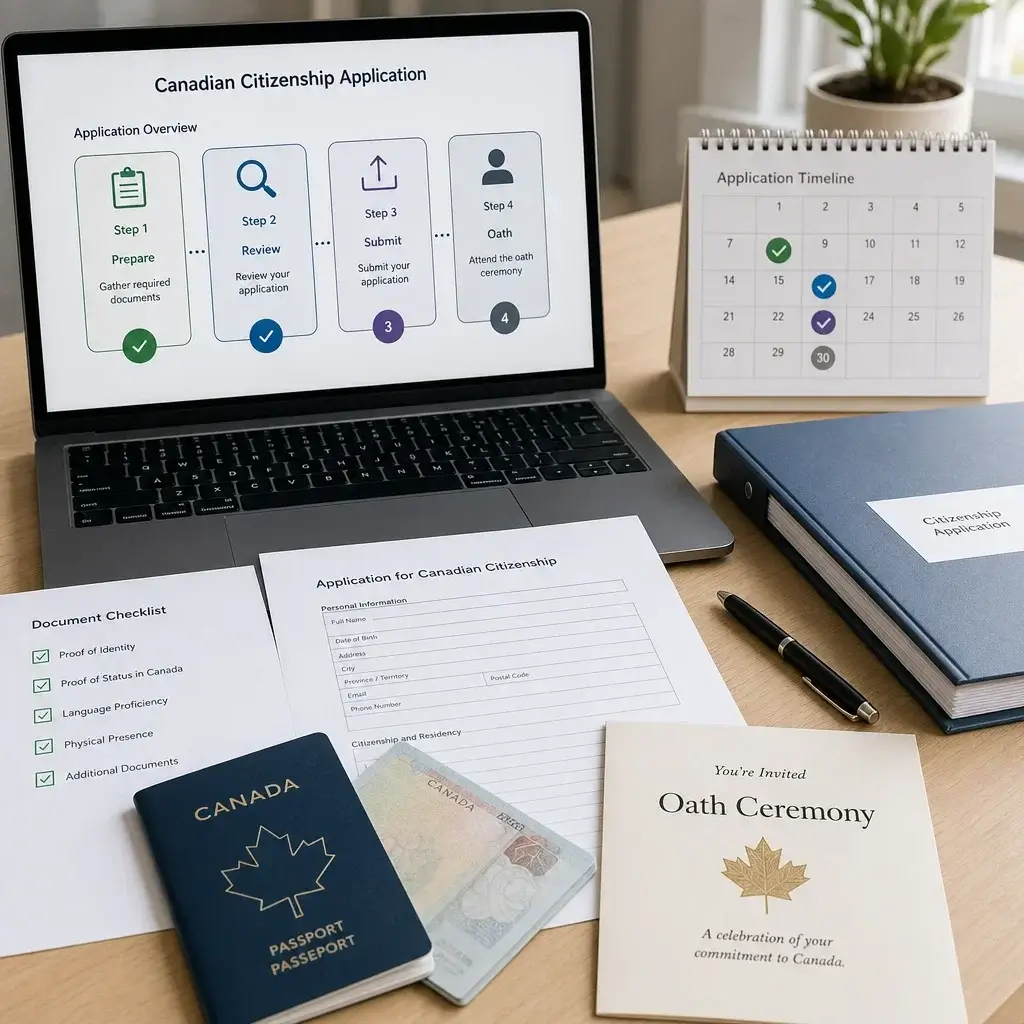
The process to apply for Canadian citizenship usually runs in this order: confirm you are eligible, calculate physical presence, gather documents, complete the application, submit it online or by paper if your category allows, respond to IRCC requests, take the test if required, attend an interview if required, then attend the oath ceremony and receive your certificate. The official department handling this is Immigration, Refugees and Citizenship Canada, or IRCC.
The standard adult grant route is not the same as every other route. A minor application, a family filing, and a proof of citizenship case for a child born outside Canada can follow different forms and rules. That distinction matters because a proof application is about showing existing citizenship, while a grant application is about becoming a citizen.
The safest starting point is current IRCC guidance, not an old forum thread. Online sources still repeat outdated residency rules from the old 4-in-6 system, and that can make an otherwise strong file inaccurate on day one.
Who can apply for Canadian citizenship?
Most adult applicants need five core things: permanent resident status, enough physical presence in Canada, tax filing compliance if required under the law, language proof if they fall in the required age band, and no prohibition that blocks a grant of citizenship. Those are the real bones of the Canadian citizenship application process.
Permanent resident status comes first. You generally apply for citizenship after PR, not before it, and unresolved removal issues, immigration fraud reviews, or other status problems can affect whether IRCC will move the file forward.
Physical presence is usually measured against a 5-year look-back period and a threshold of 1,095 days. That is the rule most applicants mean when they ask how to apply for Canadian citizenship after PR. You do not need to guess the count. IRCC requires applicants to use its official physical presence calculator.
Tax compliance is about whether you met your filing obligations, not whether you owed money. The rule commonly applied is filing taxes for at least 3 taxation years within the relevant 5 years, but applicants should still confirm the current IRCC wording before submission because statutory wording and portal instructions can change.
Language proof and the citizenship test usually apply to applicants aged 18 to 54. Applicants outside that band are commonly exempt from those two requirements, which is why the over-55 question comes up so often. I would still confirm the current age rule on IRCC the same week you file.
A prohibition can block approval even if the rest of the file looks clean. Criminal charges, certain convictions, immigration investigations, misrepresentation findings, or being under a removal order are examples of issues that can make a file risky and worth legal review before you submit.
Physical presence requirement: how to count your days correctly

You count backward from the date you sign the application, not from the date you started thinking about filing. The key number for most adult grant applications is 1,095 days of physical presence in the 5 years before the application date.
IRCC’s calculator is not optional busywork. It is the official record you use to turn travel history into a presence total, and your entries should match passports, visas, tickets, work travel records, and any CBSA travel history you have available.
The biggest counting mistake is using the wrong filing date. If you calculate on Monday, sign on Friday, and travel on Thursday, the count can shift. People near the threshold should not rush. A few days of patience is better than a returned or challenged file.
Short trips are where many files go crooked. Same-day U.S. shopping trips, weekend conferences, and layovers that crossed a calendar date can all matter because IRCC compares declared absences against the travel record you provide and the documents already in the file.
Old internet advice still confuses pre-PR time and the former 4-in-6 rule. That old rule is outdated. Current applicants should use the present IRCC calculator and current instructions rather than trying to rebuild the count from an article written years ago.
A simple example shows the method. If an applicant signs on June 30 of a given year, they look back exactly 5 years to July 1 of the earlier year, list every absence in that window, and let the calculator total presence under the current rules. The right practice is not memory alone. It is memory checked against records.
The safest move near the threshold is to build a buffer. I take the same approach in my bee yard with winter feed. If the count is barely over 1,095 days, one forgotten trip can sink the application.
Tax filing, language proof, and other core requirements

Tax filing for citizenship is not a demand that you must have paid tax in each year. It is a demand that you filed when the Income Tax Act required you to file, for the required number of taxation years in the eligibility period.
Language proof is usually required only for applicants in the prescribed age band, and acceptable proof often includes approved language test results, evidence of completed secondary or post-secondary study in English or French, or another document IRCC lists as acceptable at the time of filing. The exact document list should be checked against current IRCC instructions because accepted proof categories can be revised.
Applicants over 55 often ask whether they still need to prove language and take the test. Under the commonly cited current rule, applicants age 55 and older are generally exempt from both. That exemption does not remove the need to meet presence, PR, and prohibition requirements.
Background issues do not always mean refusal, but they do change the risk profile of the file. A criminal record, unresolved charge, prior misrepresentation concern, or immigration enforcement history can trigger deeper review, and that is not the point to rely on guesswork.
Documents checklist: what you need before you apply
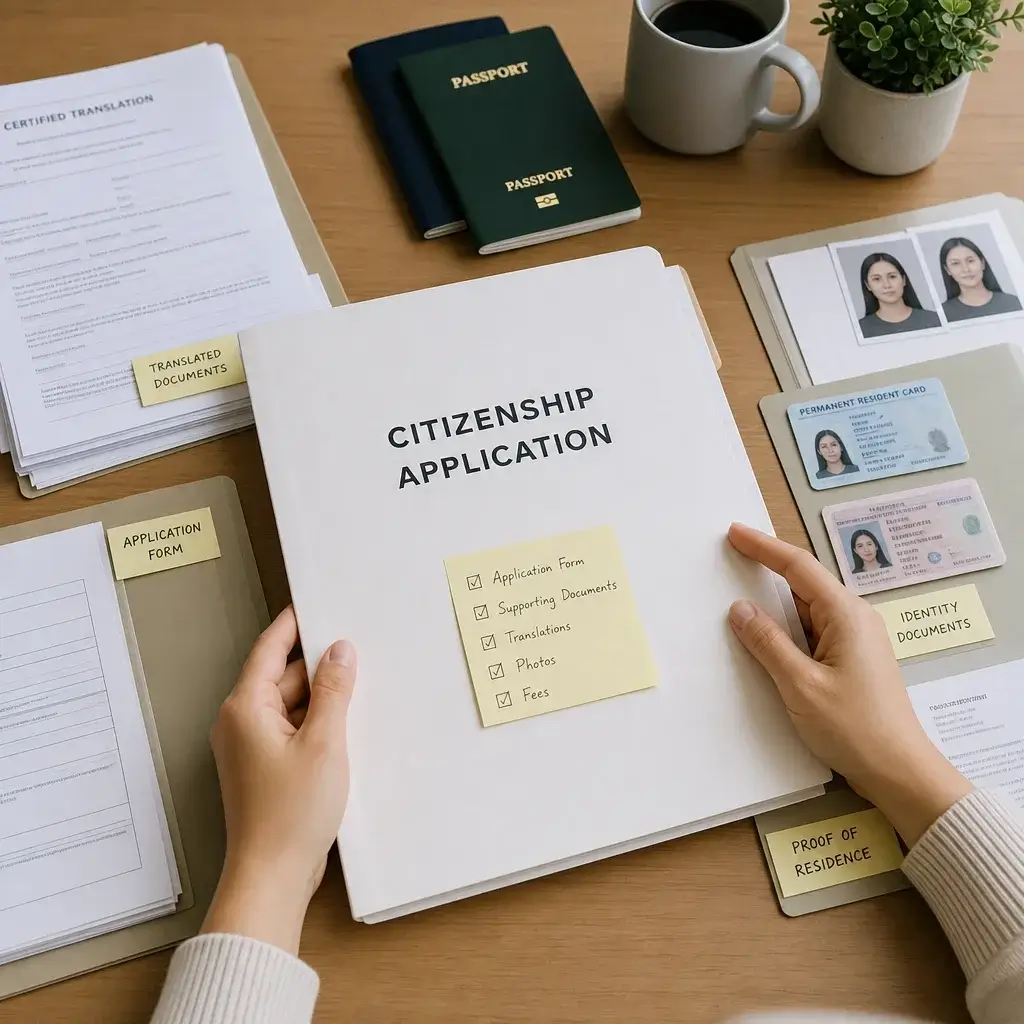
A strong file starts with identity documents that all tell the same story. Names, dates of birth, passport numbers, travel dates, and PR details should match across the application, scans, and supporting records.
Most applicants should prepare identity documents, proof of permanent resident status, all passports and travel documents covering the eligibility period, language proof if required, and any minor-specific or parent-specific records if a child is applying. Those are the categories that matter more than random extras.
Passport evidence is not just a formality. IRCC uses travel documents to test whether your physical presence calculation is believable, so missing pages, unreadable stamps, or a renewed passport that is not explained can slow the review.
The Canadian citizenship application form PDF matters mainly for paper filers or applicants checking the current package. Do not pull a PDF from a third-party website. Use the current IRCC version only, because an old form edition can lead to a returned application.
Digital document quality matters in online filing. Clear scans, complete pages where required, readable stamps, consistent file names, and properly combined PDF files reduce the chance that IRCC will later ask for the same thing twice.
Translations need care. If a document is not in English or French, applicants should follow the current IRCC translation instructions for certified translations and any required affidavit or translator declaration rather than improvising with a family translation.
Online vs paper application: which one should you use?

Online filing is usually the easier path when your applicant type is eligible for it. It reduces mailing risk, makes uploads faster, and gives a clearer digital record of what you submitted.
Paper filing still matters because not every citizenship category has always been treated the same way by IRCC. Adults, minors, family groups, and special cases can have different online availability at different times, so the right answer is the current IRCC page for your exact category, not a blanket rule from last year.
The main difference is control over evidence. Online filing lets you upload documents directly and submit from one account, while paper filing depends on the current package, physical signatures where required, and the correct mailing instructions in force on the day you send it.
Mailing addresses can change. If you are filing by paper, get the address from the current IRCC instructions the same day you prepare the package. Do not copy a destination from a blog post or an old PDF saved to your desktop.
| Filing method | Best for | Main advantage | Main risk |
|---|---|---|---|
| Online | Applicant types currently accepted by IRCC | Faster submission and easier document upload | Wrong file format, missing upload, unreadable scan |
| Paper | Categories that still require paper or applicants who cannot use the portal | Familiar package review on paper | Old form version, wrong address, missing signature |
Step-by-step: how to apply for Canadian citizenship

The Canadian citizenship application process works best as a straight sequence. Do not jump to forms before you prove eligibility.
Step 1 is confirming permanent resident status and checking for red flags. You need PR first, and you should review any criminal, immigration, or identity issue before you build the file.
Step 2 is calculating physical presence with the official IRCC calculator. This is where the process to apply for Canadian citizenship usually goes right or wrong, because every later document depends on the travel history being accurate.
Step 3 is collecting your supporting records. Gather passports, PR proof, language documents if required, identity records, and any child or family documents that match the application type.
Step 4 is completing the right application package or portal submission. Review every field for consistency. A wrong date in one box can collide with a passport scan and create a delay that did not need to exist.
Step 5 is paying the required fees through the current IRCC payment workflow. I will not invent a fee here. Fees change, and the official payment page is the right source to check before you submit.
Step 6 is submitting online or by mail, depending on your category. Keep a full copy of everything you filed, including the final calculator result, uploaded files, confirmation pages, and fee receipt.
Step 7 is monitoring the file after submission. That includes the completeness check, status updates, requests for fingerprints or more documents, test scheduling if required, interview scheduling if required, and then the oath ceremony.
Step 8 is taking the oath and receiving proof of citizenship. Citizenship is granted at the end of the process, not when you first upload the form.
Fees and processing time: what to expect

Fees and timelines change, and this is one area where outdated articles do real harm. Before filing, check the current IRCC fee page and the current Canadian citizenship processing time page for your applicant type.
Overall processing time depends on completeness, background screening, travel history complexity, test scheduling, fingerprint requests, interview needs, local office workload, and ceremony availability. A clean file can still wait, and a messy file can wait much longer.
The Canadian citizenship application processing time after the test is not a separate guaranteed clock. Some files move from test to oath without much drama, while others pause because IRCC still needs identity clarification, document review, fingerprints, or an interview.
The only honest way to read timeline estimates is as broad service guidance, not a promise. If your job, travel, or family planning depends on a citizenship date, build margin into the plan and do not assume the posted estimate is your personal deadline.
After you submit: completeness checks, tracker, and next stages

After filing, IRCC first decides whether the package is complete enough to open and process. Missing signatures, wrong form editions, unpaid or mispaid fees, blank answers, inconsistent travel history, or unreadable scans are common reasons a file is returned or delayed.
If the file is accepted into processing, applicants may receive an acknowledgement and then move through background checks, test steps if required, interview steps if required, and ceremony scheduling. The exact milestone labels can change, but the logic stays the same: completeness first, substantive review after.
The citizenship application tracker is the practical tool for watching the file move. It lets applicants see status updates for major stages, and it is often more useful than waiting for a generic email that says little.
The tracker does not mean every silence is a problem. Some stages sit for long stretches with no visible movement, especially when checks are being done in the background or a local office has not scheduled the next event yet.
Follow-up makes sense when IRCC asked for something and the deadline is close, when you missed a notice, or when the file is well beyond the posted processing norm with no clear explanation. Delay alone is frustrating, but it is not automatic evidence of refusal.
Canadian citizenship test and interview: format, scoring, and preparation

The citizenship test is usually required for applicants in the current test age band, while minors and older exempt applicants generally do not take it. For most people asking about the Canadian citizenship test, the right first move is to confirm whether their age category still requires one on the date they apply.
The official study guide has long been Discover Canada: The Rights and Responsibilities of Citizenship. Applicants should study the current IRCC version only, because test preparation based on summaries and flashcards alone can leave gaps in history, government, rights, and symbols.
Many sources state the test is 20 questions, the pass mark is 15 out of 20, and the time allowed is about 30 minutes. Those figures are widely cited, but they should still be checked against current IRCC instructions before relying on them.
The interview is usually not a trap. It is used to verify identity, review documents, assess language if that is still at issue, and clear up concerns about travel history, residence calculation, or information in the application.
A fingerprint request or interview notice does not automatically mean refusal. It usually means IRCC needs one more piece of evidence to finish a review step. Panic wastes time. A full and timely response helps more.
If you fail the test, the process does not always die there. IRCC can provide a further step under its current procedures, which may include another chance or a hearing-type follow-up depending on the facts and the rules in force at that time.
What if something goes wrong? Returns, missing documents, fingerprints, test failure, and rescheduling
Most problems in a citizenship file are procedural first, not fatal first. The fix is usually speed, accuracy, and complete records.
If an application is returned as incomplete, it usually means IRCC did not start full processing. Common causes are missing signatures, missing pages, old forms, incorrect fee steps, or documents that do not support what the form says.
If IRCC asks for more documents, give exactly what was requested and keep a copy of the full response. Partial answers create second requests, and second requests usually mean more delay.
If IRCC asks for fingerprints, treat the deadline seriously. A fingerprint request is a defined procedural step, not proof that your case will be refused, but missing the response window can stall the file hard.
If you miss a test, interview, or ceremony, use the current IRCC rescheduling instructions right away. Silence is the worst response. If the miss happened for a real reason, explain it clearly and provide proof where possible.
If you receive a fairness concern, a refusal, or a notice tied to criminal or immigration complications, that is the point to get legal help fast. This is where a careful review can save months and sometimes the whole file.
| Issue | What it usually means | What to do next |
|---|---|---|
| Application returned | File was incomplete at intake | Correct every defect and refile with current forms |
| Request for more documents | IRCC needs missing or clearer evidence | Respond fully by the deadline |
| Fingerprint request | Identity or background check needs completion | Follow the current fingerprint instructions promptly |
| Test failed | Knowledge step was not passed on that attempt | Follow the next IRCC notice and prepare again |
| Missed interview or ceremony | Attendance step was not completed | Request rescheduling immediately with explanation |
Special cases: family applications, minors, over-55 applicants, children born outside Canada, and other exceptions
Families can often prepare their files together, but that does not always mean one blended application in every scenario. Applying for Canadian citizenship as a family online depends on the current IRCC portal rules for linked or grouped submissions and the exact applicant mix.
A child does not always follow the same grant process as an adult. Minor applications can have different forms, different signatures, and different supporting documents, which is why parents should not assume that one adult checklist covers the whole family.
Minors generally do not face the same language and test requirements as standard adult applicants. That is one of the main practical differences when people ask how to apply for Canadian citizenship as a family.
Applicants over 55 usually focus on the exemption issue. Under the commonly used rule, how to apply for Canadian citizenship over 55 is mostly the same as for other adults, except language proof and test obligations are generally exempt once the applicant is in the exempt age category.
A child born outside Canada may not need a grant of citizenship at all. That case can be a proof of citizenship question instead. This is a major distinction. Do not use a grant application if the child may already be a citizen by descent under the current law.
Special categories such as Crown servants, Canadian Armed Forces members, or applicants with unusual residence facts can have different rules or strategic issues. Those files deserve current rule checking before submission because one exception can change the whole route.
Citizenship ceremony, certificate, and getting a passport
The final legal step is the oath of citizenship. At the ceremony, applicants take the oath and then receive proof of citizenship under the current IRCC practice, usually as a citizenship certificate rather than an old-style card.
Ceremonies may be in person or handled in another format if IRCC is using both methods at the time. The notice you receive controls what to bring, how identity is checked, and what the exact attendance instructions are.
Bring what the notice tells you to bring. That usually includes the ceremony notice itself, identity documents, and any status documents IRCC instructs you to return or present. The safest practice is to follow the notice line by line.
If someone misses the ceremony, the file is not always dead, but rescheduling should be requested quickly under the current IRCC instructions. Delay without explanation makes a simple problem heavier.
You can apply for a Canadian passport only after citizenship is granted and you have the required proof. Citizenship approval and passport issuance are separate government processes with separate forms and service standards.
Common questions
What are the 5 requirements to become a Canadian citizen?
The usual five are PR status, physical presence, tax filing compliance where required, language proof if required for your age group, and no prohibition that blocks citizenship.
What is the process to get Canadian citizenship?
Check eligibility, calculate your days, gather documents, complete the right application, submit it, respond to IRCC, take the test if required, attend any interview if required, then take the oath.
How long does it take to get Canadian citizenship after applying?
There is no honest fixed answer here without checking IRCC’s current posted estimate. Processing time depends on completeness, screening, travel history, local scheduling, and whether IRCC asks for more evidence.
Can I apply for Canadian citizenship online?
Many applicants can, but online eligibility depends on your applicant type and current IRCC portal rules. Some categories may still require paper filing at a given time.
Do I need to be a permanent resident before applying for citizenship?
Yes. Citizenship by grant generally requires permanent resident status first.
How many days do I need in Canada to qualify for citizenship?
Most adult applicants look to the 1,095-day physical presence rule within the relevant 5-year period, using the official IRCC calculator.
Do I need to file taxes before applying for Canadian citizenship?
You generally need to have met your tax filing obligations for the required number of taxation years in the eligibility period. Owing no tax is not the point. Filing when required is the point.
Do I need to take the Canadian citizenship test if I am over 55?
Under the commonly cited current age rule, applicants age 55 and older are generally exempt from the test and language proof. Check the current IRCC rule before filing.
What documents are required for a Canadian citizenship application?
Expect identity documents, PR proof, passports and travel documents, language proof if required, and any minor or family records that fit your application type.
Can my family apply for Canadian citizenship together?
Families can often prepare and file around the same time, but the exact online or paper process depends on whether each person is an adult, minor, or in a different citizenship category.
What happens after I submit my citizenship application?
IRCC checks completeness, opens processing if the file is acceptable, runs background steps, schedules the test or interview if needed, then schedules the ceremony if the file is approved.
How do I check my citizenship application status?
Use the citizenship application tracker if your file is eligible for tracking under current IRCC systems.
What happens if I fail the citizenship test?
Follow the next IRCC notice. A failed first attempt does not always end the process, but you need to respond and prepare for the next procedural step.
Can I travel while my Canadian citizenship application is being processed?
Usually yes, but travel can still affect document access, notices, scheduling, and your ability to respond to IRCC quickly. Keep your records current and watch deadlines.
Can I get a Canadian passport right after the citizenship ceremony?
You can apply for a passport after citizenship is granted and you have the proof required for the passport application. It is a separate process.
If your file is close on presence days, messy on travel history, tied to a child or family application, or already hit with an IRCC request, get it reviewed before you send it. That is often the cheapest month you will ever save. If you want, you can request a free assessment before you file.