
Many people searching for a Canadian citizenship application fee waiver land on U.S. or U.K. pages. That is the first mistake. In Canada, you need to separate a real IRCC rule from foreign content, old news, and hopeful forum posts.
Canadian citizenship application fee waiver: the short answer
There is no broad, general IRCC program that lets most applicants request a fee waiver for citizenship application on the basis of low income or ordinary financial hardship, and readers should verify the current IRCC fee and policy pages before filing because government rules can change.
That means a general waiver of citizenship fees is not the current default path for adult or minor grant applications in Canada, and search results that mention USCIS Form I-912 or U.K. hardship waivers do not apply to Canadian citizenship files.
The practical issue is not only whether citizenship fees waived language appears online, but whether IRCC has an active official process, form, or portal for waiving Canadian citizenship application fees, and if no such process exists, you should plan around the published fee, possible refund rules, and any separate test or language exemptions.
Current IRCC citizenship fees in Canada
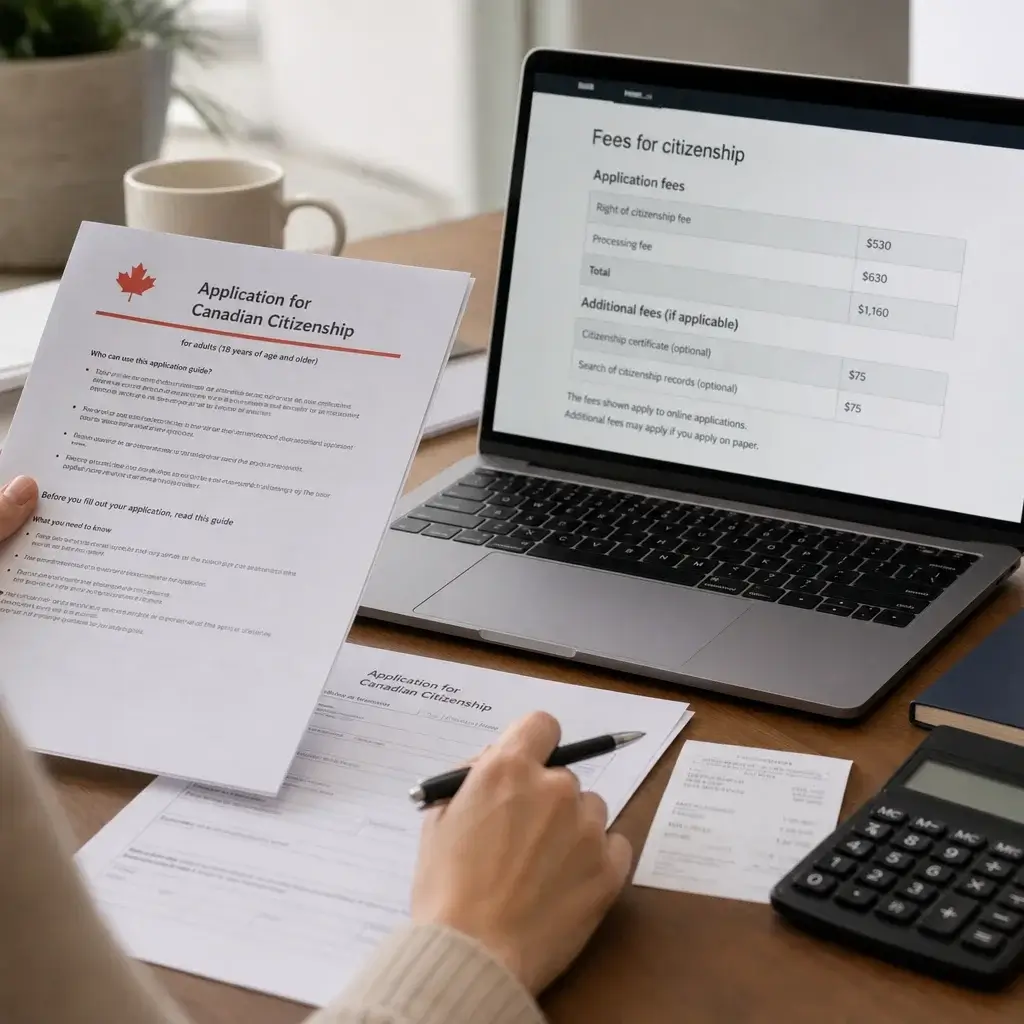
The current online government fee tool lists the adult grant of citizenship fee at $649.75 and the minor grant of citizenship fee at $100.00.
For adults, the $649.75 total is split into a processing fee of $530.00 and a right of citizenship fee Canada calls $119.75, while minors pay only the $100.00 processing amount because the right of citizenship fee does not apply to a child grant application.
Here is the clean fee table most readers need before they pay IRCC:
| Application type | Fee now |
|---|---|
| Adult grant of citizenship | $649.75 |
| Minor grant of citizenship under 18 | $100.00 |
| Adult processing portion | $530.00 |
| Right of citizenship fee Canada | $119.75 |
A proof of citizenship application, which people also call a citizenship certificate application, is a different process with a separate government fee of $75.00.
If you are searching for Canadian citizenship fee 2026, the safe answer is to use current fees unless IRCC has already published a future change, because old blog posts often freeze outdated numbers and payment errors can make an application incomplete.
Myth vs fact: Canada is not the U.S. or the U.K.
Myth: Canada has the same kind of citizenship fee waiver system as the U.S. naturalization process. Fact: U.S. naturalization fee relief belongs to USCIS rules and forms, not IRCC rules for Canadian citizenship.
Myth: A U.K. citizenship hardship waiver proves Canada has one too. Fact: U.K. citizenship fee waiver rules are separate legal schemes and do not govern Canadian files.
Myth: If a website says citizenship fees waived, that must include Canada. Fact: In this topic, country matters more than the word waiver, and IRCC instructions control a Canadian application.
Does Canada actually have a citizenship fee waiver?
The core answer remains no broad public fee-waiver program is currently built into ordinary Canadian citizenship grant applications for adults or minors, which is why a search for Canadian citizenship fee waiver for low-income applicants usually ends in confusion.
The confusion comes from three recurring sources: foreign immigration content, older policy discussions about reducing citizenship costs, and the separate Canadian rules on citizenship tests, language evidence, or accommodations that are not the same as waiving canadian citizenship application fees.
If the government announces a future change, that matters only when IRCC updates its official fee page, application guide, or instructions, and until then the working rule is simple: pay the listed fee for the correct application type.
Fee waiver vs fee exemption vs refund vs citizenship test waiver
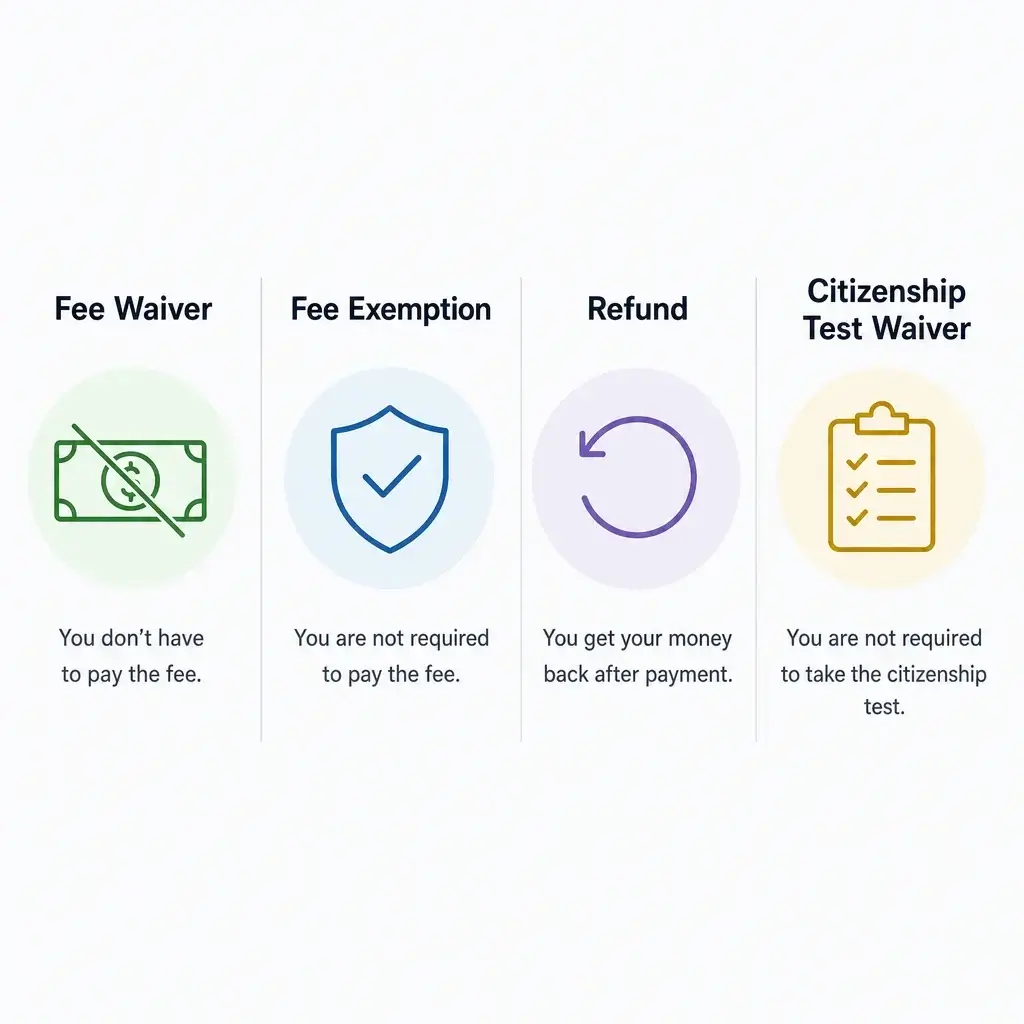
A fee waiver means the government lets an eligible person file without paying a fee that others must pay, usually because a law or policy creates that relief.
A fee exemption means a specific category is outside a fee requirement from the start, and in Canadian citizenship this matters more for application type and applicant category than for a general hardship system.
A refund means money already paid may be returned under IRCC rules in a defined situation such as a returned incomplete file, a duplicate payment, or a component that is refundable after refusal, withdrawal, or non-approval if the rules say so.
A citizenship test waiver, more accurately a test or language exemption or accommodation, is different from a waiver of citizenship fees because it concerns eligibility steps, medical limits, age rules, or procedural accommodations rather than payment.
Who may qualify for any exemption, special rule, or alternative relief
Low income alone does not create a general Canadian citizenship fee waiver for low-income applicants under the ordinary grant rules unless IRCC has formally created that program, so do not build your case around foreign hardship standards.
Seniors do not have a general Canadian citizenship fee for seniors discount built into the standard adult grant fee, and age-related relief in this area usually concerns the test or language requirement rather than the application price.
Children receive the main built-in fee relief through the lower minor grant fee of $100.00, which is far below the adult total of $649.75.
Province-specific exceptions are not the normal framework for citizenship grant fees because citizenship is federal, so a province may fund settlement help or legal information, but it does not usually rewrite IRCC citizenship charges.
If you cannot afford the citizenship fee: practical options in Canada
If you cannot pay now, the safest move is usually to wait and file a complete application later rather than send an underpaid package that risks return or delay.
A second practical step is to confirm the exact fee on the IRCC payment page on the day you pay, because fee pages and tools are the source IRCC staff will match against your receipt.
A third practical step is to budget by applicant, since family applications do not convert into one flat household fee and each person must usually be counted in the correct category, adult or minor.
Community legal clinics, newcomer agencies, and settlement organizations may help with form review, referrals, or planning, but that support is not the same thing as citizenship fees waived by IRCC.
A lawyer cannot create a fee waiver where none exists, but legal review can prevent a returned file, the wrong application type, a mistaken physical presence calculation, or confusion between a grant application and proof of citizenship.
How to apply if a fee waiver or exemption exists
If IRCC does not publish a current fee-waiver process, there is no separate Canadian citizenship waiver form to file for an ordinary hardship request.
That means you should not use U.S. Form I-912, U.K. waiver forms, or generic online templates, because those documents have no legal function in a Canadian citizenship case.
If IRCC later creates a real process, the only safe route will be the exact IRCC form, portal, guide, and evidence list named by the government, and approval timing would need to be checked before you submit the citizenship application itself.
What documents would be required if IRCC allows a fee waiver request
At this time, there is no standard evidence package for a broad Canadian citizenship fee waiver, because there is no general public process to prove inability to pay for ordinary citizenship grant fees.
If IRCC ever launches such a process, the evidence would need to come from official instructions and might include items like income records, benefit records, household details, or guardian documents, but no one should invent cutoffs or a homemade checklist before IRCC publishes one.
Children, family applications, and parents applying for minors

Children do not pay the same fee as adults, because the current minor grant fee is $100.00 while the adult grant fee is $649.75.
Parents or guardians can handle filing and payment for a child applicant, but the child still has a separate application and separate fee category under the citizenship grant system.
There is no standard bundled family discount on citizenship grant fees, so a household with two adults and two minors would usually budget four separate application fees, using the adult rate for each adult and the minor rate for each child.
Some families confuse a child grant application with proof of citizenship through a Canadian parent, but those are different legal paths and the proof application carries its own separate fee structure.
Seniors, disabilities, and citizenship test exemptions

For seniors and applicants with disabilities, the important distinction is that Canadian law may relieve some people from the test or language requirement without removing the application fee itself.
Under the current age rules, applicants aged 18 to 54 must generally meet the language and citizenship test requirements, while applicants under 18 or aged 55 and over are not required to meet those two requirements.
A disability issue can also support an accommodation request or, in some cases, an exemption analysis for the test or language requirement, but that is not the same as a fee waiver for citizenship application costs.
IRCC uses a medical opinion process for certain citizenship accommodations or exemptions, and readers should rely on the current application guide and forms page for the exact document name and version before filing.
What happens if you pay the wrong fee or submit without payment
If you submit the wrong amount or no valid payment receipt where one is required, IRCC can treat the application as incomplete and return it or stop it from moving forward until the fee issue is fixed.
The practical result is lost time, because even a simple payment mistake can push the file back to the start of the intake line instead of preserving momentum.
The safest checklist before you pay is short and strict:
- confirm the application type: adult grant, minor grant, or proof of citizenship
- confirm the current fee on the IRCC payment page that day
- match each applicant to the right fee category
- save the receipt immediately after payment
- include the correct receipt with the package or portal record
I take a hard line on this. Do not guess at old screenshots. Government fee pages change faster than forum advice.
Refunds: what money, if any, can be returned

A refund is not a fee waiver, and the amount returned depends on which part of the citizenship fee was paid, how far the file progressed, and the reason the matter ended.
For adult grants, the right of citizenship fee of $119.75 is generally the component people most often ask about because the processing fee and the right fee are treated differently in IRCC materials.
Here is the practical refund map readers should verify against current IRCC rules before they rely on it:
| Scenario | Likely refund position |
|---|---|
| Application returned as incomplete | Fees are generally returned because processing has not properly started |
| Duplicate payment | Duplicate amount may be refundable |
| Adult application refused | Refund may depend on whether the refundable component includes the right of citizenship fee only |
| Withdrawal after processing starts | Processing portion is often non-refundable once work begins |
If you need the exact current refund rule for refusal or withdrawal, check IRCC’s refund page before acting, because refund language can be technical and the right-of-citizenship component has changed in amount over time.
Other citizenship-related fees people confuse with the application fee
The main citizenship grant fee is not the same as the proof of citizenship fee, passport fees, PR card renewal fees, or replacement document fees.
A proof of citizenship or citizenship certificate application is used to confirm existing citizenship, not to become a citizen through the grant process, and its fee is separate at $75.00.
Passport rules are also separate from citizenship rules, so a passport fee waiver for low income is not a substitute for a Canadian citizenship application fee waiver.
PR card renewal belongs to permanent resident documentation, not citizenship, and mixing those categories is one of the easiest ways to file the wrong application or budget the wrong amount.
How long things take and where to check official updates
There is no separate Canadian citizenship waiver processing time to rely on if no active IRCC fee-waiver process exists.
For the citizenship application itself, current published processing times can change month to month, so the only safe source is IRCC’s official processing-time tool rather than a cached blog post.
If you are searching by year, such as Canadian citizenship fee 2026, treat that as a prompt to re-check the live IRCC fee page right before payment rather than a reason to trust an older article.
When legal help is worth it
Legal help is most useful when the fee issue is tied to a bigger strategic problem, such as a past refusal, residence concern, criminal charge history, family applications with mixed statuses, or uncertainty about whether you need a grant application or proof of citizenship instead.
It also helps when a disability accommodation, test exemption issue, or urgent family planning decision sits beside the citizenship file, because the payment question may be only one piece of the real case.
Sutton Law can review eligibility, confirm the correct IRCC path, and help you avoid preventable delays or returned applications, and if you are unsure whether to apply now, wait, or use another immigration route first, you can book a free assessment for guidance tailored to your facts.
FAQ
Can I apply for a fee waiver for Canadian citizenship?
As a general rule, no broad IRCC hardship waiver process exists for ordinary adult or minor citizenship grant fees, so applicants should verify official IRCC updates rather than rely on foreign waiver content.
Is there a Canadian citizenship fee waiver for low-income applicants?
There is no broad published low-income citizenship fee waiver program for standard grant applications unless IRCC creates one officially.
How much is the Canadian citizenship application fee right now?
The current fees are $649.75 for an adult grant and $100.00 for a minor grant.
What is the right of citizenship fee in Canada?
It is the adult-only component currently listed at $119.75 and included in the total adult grant fee.
Do children pay the same citizenship fee as adults in Canada?
No. Minors currently pay $100.00 and adults pay $649.75.
Do seniors get a discount on Canadian citizenship fees?
No general senior discount applies to the standard adult grant fee under current rules.
Can disability make someone exempt from the citizenship test but not the fee?
Yes. Disability issues can affect accommodations or test and language exemptions, and that is separate from the application fee.
What happens if I submit my citizenship application with the wrong fee?
IRCC can treat the file as incomplete, return it, or delay processing until the payment issue is corrected.
Will IRCC refund any part of my citizenship fee if my application is refused?
Refund rules depend on the fee component and the stage of processing, so you need the current IRCC refund page for the exact answer in your scenario.
Is there a separate Canadian citizenship waiver form?
Not for a broad ordinary hardship waiver process, unless IRCC later creates one and publishes it.
Can a parent apply on behalf of a child for citizenship in Canada?
Yes. A parent or guardian can handle a child’s filing and payment, but the child remains a separate applicant.
Are passport fee waivers the same as citizenship fee waivers in Canada?
No. Passport and citizenship are separate systems with different fees and rules.
Final checklist before you pay IRCC fees
Use this short list before you click pay or mail anything:
- verify the application type
- verify the live IRCC fee page
- check whether the applicant is an adult or minor
- confirm whether you need a grant application or proof of citizenship
- save the payment receipt
- re-check the current guide before submission
This article is general information, not legal advice. If you are unsure whether a fee waiver exists, whether a test exemption may apply, or whether filing now is strategically wise for your family, book a free assessment with Sutton Law.