

Most applicants read mpnp application status assessment in process and assume a decision is close. That is not what the status means. It usually means Manitoba has moved past basic intake and is actively reviewing your file, but it is not an approval, a refusal, or a promise about timing.
What “assessment in process” means in MPNP
Assessment in process usually means an officer is reviewing your Manitoba Provincial Nominee Program file against the stream rules and the evidence you submitted. That review can include identity documents, work history, education, language results, Manitoba connection, and your Settlement Plan. This is a stage of active review, not a final decision. The exact wording in the portal can change over time, so your actual status label should be read together with your account messages and email notices.
A status that says your application is in process or in progress generally means the file is moving through internal review rather than sitting only at basic receipt. That does not tell you whether the officer is satisfied, whether verification calls are happening, or when a decision will be issued. Silence during this stage is common and does not, by itself, mean refusal.
MPNP status terms explained: pending, in process, information requested, complete
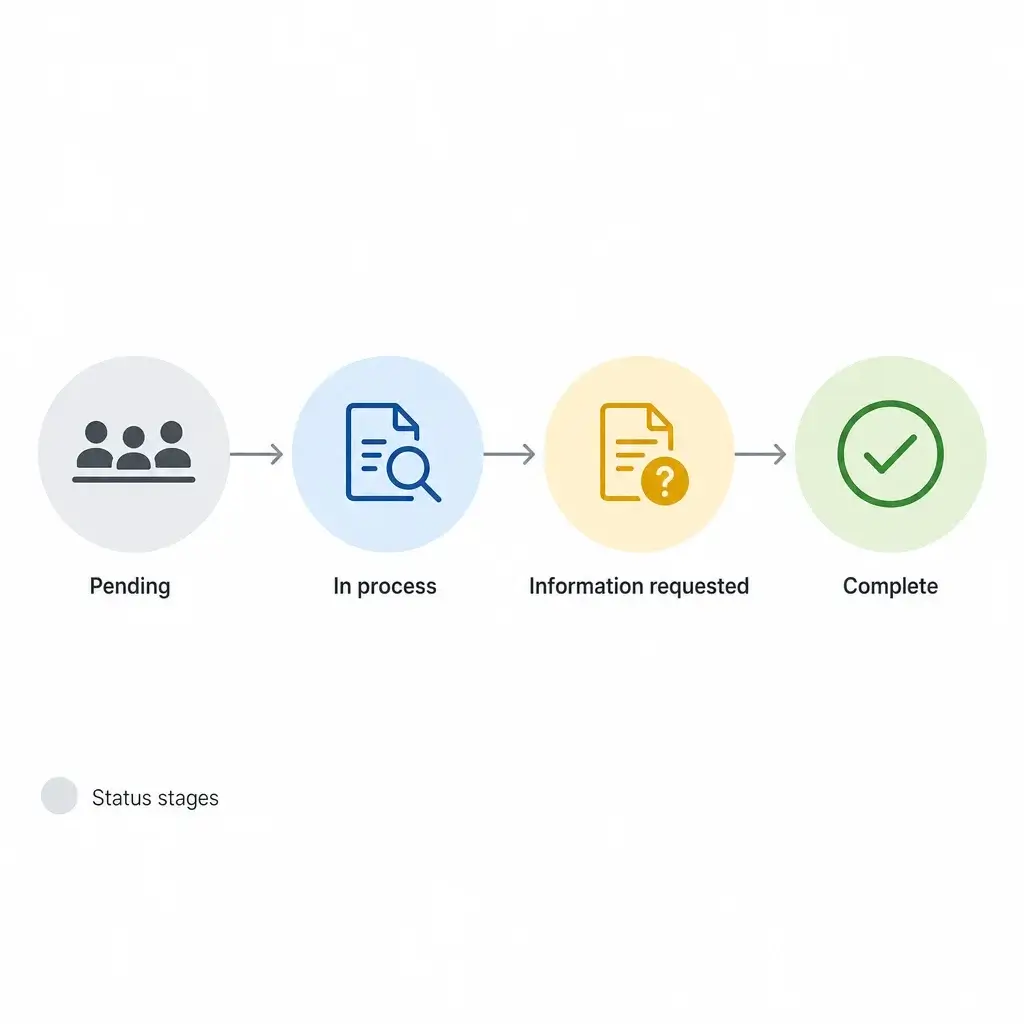
The clearest way to read your file is to treat each status as a stage marker, not a prediction. Assessment pending usually means the application is submitted and waiting in queue for review. Assessment in process usually means active review has started. Information requested usually means MPNP wants more documents, clarification, or updated evidence before deciding. Assessment complete usually means the review stage has ended and a decision or outcome notice is the next thing to watch for. Portal wording can change, so rely on the current label shown in MPNP Online.
| Status term | What it usually means | What to do |
|---|---|---|
| Received / Submitted | File was filed and recorded | Keep copies and watch your account |
| Assessment pending | Waiting for officer review | Wait, monitor messages, keep documents current |
| Assessment in process | Active eligibility and document review | Be ready for requests or verification |
| Information requested | More evidence or explanation is needed | Respond fully and on time |
| Assessment complete | Review stage is finished | Watch for nomination, refusal, or further instructions |
Where “assessment in process” fits in the full MPNP to PR timeline
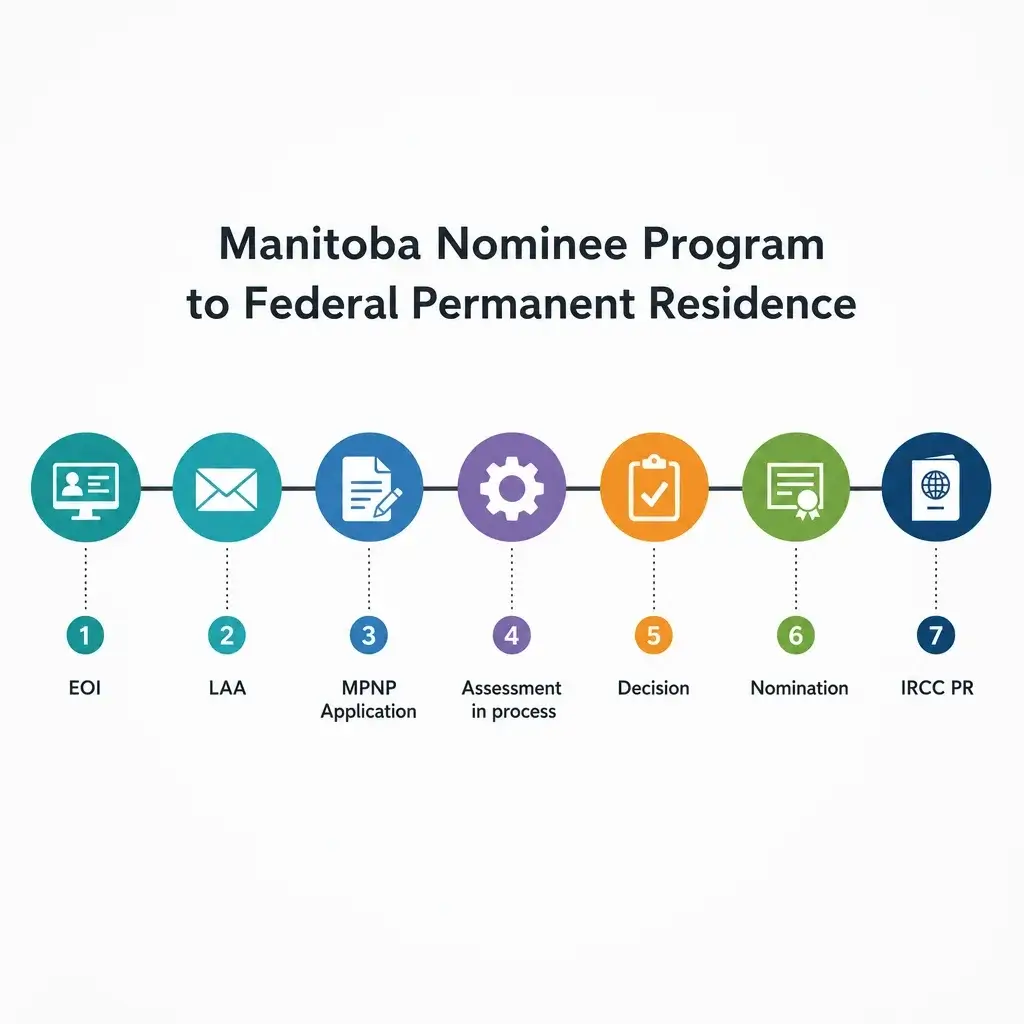
The MPNP stage sits in the middle of a longer immigration process. A simple timeline is: EOI submission → Letter of Advice to Apply (LAA) → full MPNP application → assessment pending → assessment in process → decision → nomination if approved → federal PR application with IRCC. A provincial nomination is not the same as permanent residence. IRCC makes the federal PR decision after the provincial stage is finished.
That separation matters because applicants often confuse an MPNP status with an IRCC status. MPNP reviews whether you meet Manitoba’s nominee criteria. IRCC reviews admissibility and the federal permanent residence application after nomination. A file can be finished provincially and still remain in federal processing for months afterward. The two systems use different portals, different messages, and different timelines.
How to check your MPNP application status
The safest way to check status is through your MPNP Online account and the email address tied to that account. Your portal is usually the primary source for updates, document requests, and status changes. You should also check your spam or junk folder and any account message centre if one appears in the portal. Do not rely on old forum screenshots because portal layouts and labels can change.
You can usually track your MPNP file only at a high level, not line by line like courier tracking. In plain terms, Can I track my MPNP application? Yes, but only through status labels, messages, and official correspondence, not through a detailed live progress bar. Once you move to the federal PR stage, status checking shifts to IRCC tools rather than MPNP Online.
How long MPNP processing may take after submission
There is no safe fixed answer unless Manitoba publishes a current service standard, and applicants should not treat forum timelines as official. Processing can move faster or slower based on application volume, stream rules, completeness, verification needs, document quality, and policy updates. If you are searching Current processing time for mpnp or MPNP processing time 2026, check the current official Manitoba page before treating any number as reliable. This article stays general because exact processing figures can change and should be verified at the source.
The same caution applies to mpnp to pr processing time. Provincial assessment time and federal PR time are separate. Even after nomination, the federal stage can involve medicals, biometrics, background checks, and admissibility review. If your question is really How long does IRCC take to approve PR?, the answer depends on the federal stream and the current IRCC service standard, not your MPNP portal status alone.
What happens while your file is in assessment in process
During active review, MPNP may assess whether your evidence matches the stream requirements you claimed. That can include employability, adaptability, education history, language scores, occupation alignment under the correct NOC and TEER, and any licensing issue for regulated work. If you applied under Skilled Worker Overseas or Skilled Worker in Manitoba, the officer still compares the file to the criteria of that stream rather than only to your own summary in the forms.
Verification can happen during this stage, but the status text does not confirm that it has happened. MPNP may review employment letters, compare job duties to the claimed occupation, look at wage or payroll evidence, and in some cases contact employers, supporters, or other third parties if the program rules allow verification. A static portal does not mean nothing is happening internally.
How MPNP assesses employability, adaptability, language, NOC/TEER, and settlement plans

Employability usually means whether your background supports real labour market integration in Manitoba. Officers may look at recent and relevant work experience, whether your duties match the NOC code claimed, your education and training, and whether the occupation needs licensing before you can work in Manitoba. A title match alone is not enough if the job duties do not line up with the NOC description.
Adaptability usually means whether your connection to Manitoba and your settlement planning look credible. Depending on the stream, that can involve family or community ties, prior study or work, current employment, invitation pathway evidence, or a supporter-based connection where the rules still allow it. Weak or overstated Manitoba ties can create concerns even if the rest of the file looks strong.
Language is assessed through approved test results where the stream requires them, and the officer will look at whether the results are valid and match the minimum required level for that pathway. Because language thresholds can be stream-specific and change with program updates, applicants should verify the current rule on the official program page rather than rely on an old score screenshot.
A Settlement Plan is your written explanation of how you plan to live and establish yourself in Manitoba. A strong plan is specific, individualized, and consistent with your work history, destination plans, and support network. A weak plan is generic, copied, or unsupported by the rest of the file. If your pathway still involves a Manitoba Supporter or Settlement Plan Part 2, the supporting evidence has to match the relationship and settlement story you presented.
What documents or evidence MPNP expects to see

A credible file usually includes identity and civil status documents, passports, education records, language results where required, work reference letters, and proof that your claimed Manitoba connection is real. Employment evidence is stronger when duties, dates, hours, and employer details line up across letters, contracts, tax slips, payroll records, or other supporting documents. Translation issues, missing pages, and inconsistent dates are common reasons files slow down.
Supporter or connection evidence, where relevant, should show the relationship clearly and consistently. That can include status documents, proof of residence, family records, communication history, and evidence the supporter actually understands your settlement plan. Applicants cause problems when they overstate job prospects, exaggerate supporter involvement, or submit documents that tell different stories.
Normal delays vs. red flags: when to wait and when to act
A delay is often normal when the file is complete but the program is dealing with volume, backlogs, or extra verification. Other ordinary causes are poor scans, unclear translations, inconsistent job records, occupation review, licensing questions, supporter review, and requests that have not yet reached your file in queue. Those are frustrating, but they are not automatic refusal signs.
A delay becomes a red flag when there is a concrete issue you can point to. Examples include an unread portal message, a missed deadline, a bounced email address, a major life change you have not reported, account access problems, or an information request you do not understand. Repeated unnecessary follow-ups usually do not speed a case up, but a real communication or compliance issue should be addressed promptly.
If you are asking How long can a file stay in assessment in process before I should worry?, the practical answer is this: worry less about the age of the status by itself and more about whether you have missed or cannot access an official communication. Without a published follow-up threshold from Manitoba, the safer approach is to keep monitoring the portal and use the official enquiry channel only when there is a specific reason to do it.
What to do now: checklist for applicants with status “assessment in process”

The best next step is organized waiting, not guesswork. Use this checklist while the file is under review.
- Confirm you can log into MPNP Online and still access your submitted forms.
- Check your portal messages, inbox, spam folder, and the email address on file.
- Re-read the application you filed so your future answers stay consistent.
- Gather updated employment, address, passport, and civil status records in case they are requested.
- Prepare for possible verification calls by making sure your employer or supporter can answer truthfully and consistently.
- Report material changes through the current official process if the program requires updates.
- Do not upload unsolicited documents unless the portal or instructions clearly allow it.
- Get legal help quickly if you receive a fairness concern, refusal, or a request you cannot answer properly.
If your information changes while the file is in process, the important issue is materiality. Changes like a new passport, new address, family composition change, job loss, or major employment update may need to be disclosed depending on the current program rules. Because update rules can change, use the official Manitoba instruction page or get legal advice on your own file rather than assume a forum answer is still right.
If MPNP asks for more information or sends a Procedural Fairness Letter

Mpnp application status information requested usually means the officer needs more documents or clarification before making a decision. That can be routine. It may involve clearer work letters, updated civil documents, missing pages, better translations, or an explanation for inconsistent dates. The right response is complete, organized, and on time. Guessing, over-explaining, or sending unrelated documents can make the record worse.
A Procedural Fairness Letter is more serious than a routine document request. It usually means the officer has identified a concern that could affect the outcome, such as credibility, eligibility, inconsistency, or possible misrepresentation. A fairness response should be timely, evidence-based, and internally consistent. If you receive one, this is general information, not legal advice for your case, and urgent professional review is usually wise because the record you create at that stage can matter later.
You can prepare for a fairness issue before one arrives by organizing source documents now. Good preparation includes employment proof, education records, translations, passports, relationship evidence, supporter documents where relevant, and a clear chronology of addresses, jobs, and travel. If a future concern is raised, you do not want to be rebuilding the file from memory under a short deadline.
If your MPNP file has stalled, you received an information request or a Procedural Fairness Letter, or you are unsure whether to update your application, a free assessment with Sutton Law can help you understand the next step without guessing.
After assessment complete: approval, refusal, nomination, reapplication, or withdrawal
Assessment complete usually means the review stage is finished, but you still need to read the actual notice to know the outcome. The next step may be approval and nomination, refusal, or further instructions tied to the result. An approval at the provincial stage generally leads to a nomination document or nomination-related processing, not immediate permanent residence.
If refused, read the refusal reasons carefully before deciding what to do next. The legal options can differ depending on whether the problem was missing evidence, weak eligibility, credibility concerns, or possible misrepresentation. Some applicants may consider reapplying with stronger evidence, while others may need to look at reconsideration arguments if available or judicial review advice where appropriate. Those rights and timelines are case-specific and should be verified before action is taken.
Withdrawal may be possible in some situations, but the consequences can depend on timing and the reason. Applicants should follow the current official instructions rather than abandon the file informally. A withdrawal decision made after a serious fairness concern can have different practical consequences than a withdrawal made early for personal reasons, so this is not something to do casually.
Can you appeal an MPNP refusal or do you need another strategy?
Many applicants use the word appeal loosely, but not every refusal comes with an internal appeal right. The real options may include reapplication, a request for reconsideration if the program permits it, or judicial review advice in the right case. Which path makes sense depends on the refusal reasons, the evidence record, and the timeline. No one should assume a refusal is final forever, but no one should assume it is easy to overturn either.
This is where legal guidance can matter most. A refusal based on weak documents may call for a stronger reapplication. A refusal based on a fairness concern may require a very different strategy. Because deadlines and remedies are accuracy-sensitive, you should get advice on your own facts rather than act on a generic internet checklist.
Troubleshooting MPNP login, status check issues, and missing notifications
A technical problem can look like a case problem when it is not. If you cannot access MPNP Login or your Mpnp online application, start with basics: confirm the email address on file, try the password reset function, use an updated browser, clear cache, and check whether the portal is under maintenance. Missing notifications can also be caused by spam filtering or an old email address.
If the portal loads but shows no new movement, that does not prove your file is stuck. MPNP status systems are not always real-time progress trackers. Treat technical troubleshooting and substantive delay as two separate issues. If you still cannot access the account after basic steps, use the official Manitoba support or enquiry channel rather than relying on unofficial forum advice.
FAQ: quick answers to the questions applicants ask most
Assessment in process means active review has usually started on your MPNP file. It does not mean approved, refused, or ready for nomination.
How to check MPNP application status? Use your MPNP Online account, watch your registered email, and check spam or junk folders for official notices.
Can I track my MPNP application? Yes, but only through high-level portal statuses and messages, not through a detailed step-by-step tracker.
Why is MPNP taking so long? The common reasons are application volume, verification, incomplete evidence, translation problems, occupation review, licensing issues, and policy changes.
What does MPNP application status information requested mean? It usually means Manitoba needs more documents or clarification before deciding your file.
What happens after assessment complete? The next notice may be nomination, refusal, or further instructions, and the portal status alone does not tell you which one until the decision message arrives.
How do I know if IRCC has started reviewing my application? That answer belongs to the federal PR stage, not the MPNP stage, and you should check your IRCC account or official IRCC correspondence after nomination and PR submission.
What does your application is in progress mean in IRCC? It usually means IRCC has your federal file under active processing, but it does not confirm the result or the exact decision date.
How do I know if a PR application is approved? You will know from an official IRCC approval or final decision notice, not from the earlier MPNP status alone.
Can I call IRCC to check my application status? For the federal stage, IRCC contact options may be available depending on where you are and what type of application you filed, but that does not replace checking your online account. For the provincial MPNP stage, use Manitoba’s official channels instead of IRCC.
Can I reapply after an MPNP refusal? Sometimes reapplication is possible, but whether it is sensible depends on the refusal reasons and current program rules. Read the refusal carefully and get advice before filing again.
The practical takeaway is simple. Read the status as a stage, not a verdict. If your file is only waiting, stay organized. If you receive a document request, fairness letter, refusal, or a confusing status change, get specific advice on your own record before you respond.