

The hardest part of the OINP application status stages is not the portal. It is knowing what each label actually means, what the province is doing, and when you need to act.
OINP application status stages at a glance
The full OINP process usually runs in this order: choose the right stream, create the required profile or registration, wait for a draw or invitation if the stream uses one, submit the full application, pass completeness review, move into assessment, receive a decision, then use the nomination in the federal permanent residence step. That provincial nomination is not permanent residence on its own. Ontario and IRCC are separate decision-makers.
The main OINP processing stages people usually track are these:
- EOI registered or in pool for streams that use an Expression of Interest
- NOI received in an Express Entry-linked stream, or invitation to apply in an EOI-based stream
- Application started or submitted in the OINP e-Filing Portal
- Completeness check or intake review
- Assessment or officer review
- Decision in progress, if that label appears for the stream or portal version
- Nomination issued, refusal, return as incomplete, withdrawal, or expiry/closure depending on what happened
- Federal PR step after nomination, usually through Express Entry or a non-Express Entry PR application path
The exact wording can change by stream and portal version. Readers should compare the wording on their own file to the glossary below and confirm any current label on Ontario’s official OINP pages before acting. This is general information, not legal advice for your case.
How the OINP process works from start to finish
The OINP process starts with stream selection because each stream has a different entry point. Some streams need a valid Express Entry profile. Some need an Ontario Expression of Interest registration. Some depend on an Ontario employer and job offer.
An Express Entry-linked stream usually begins after a candidate creates a federal Express Entry profile and then receives a provincial Notification of Interest, often called an NOI. An NOI is not the same thing as permanent residence and is not the same as an IRCC Invitation to Apply for PR. It is Ontario saying you may be eligible to submit a provincial application.
An EOI-based stream usually begins with an OINP Expression of interest registration in the provincial system. That registration puts the candidate into a pool, and Ontario may later issue an invitation to apply through an OINP draw. Being in the pool is not the same as having filed a full application.
After invitation or NOI, the applicant completes the full provincial file in the portal, uploads documents, signs declarations, pays the application fee, and submits before the deadline shown in the account. Deadlines vary by stream and can change, so applicants should rely on the date inside the invitation and current provincial instructions rather than an old forum post.
After submission, Ontario checks whether the file is complete enough to process. If key documents, signatures, translations, or forms are missing, the file can be returned or treated as incomplete instead of moving into full assessment. That is why a file with the lowest stress level is usually the one reviewed carefully before submission, not after.
After nomination, the file moves to the federal stage. In Express Entry-linked streams, a provincial nomination can add 600 CRS points for qualifying nominations. In non-Express Entry routes, nomination still does not grant PR by itself. The applicant must still file the federal permanent residence application and remain eligible.
Which OINP stream fits your situation?

The right stream depends first on whether you have Express Entry eligibility, an Ontario job offer, or qualifying Ontario education such as a master’s or PhD. Those are the three broad families most applicants compare.
Express Entry streams usually fit candidates who already qualify under a federal economic class and have an active Express Entry profile. In those cases, Ontario may search the federal pool and issue an NOI based on factors such as occupation, education, language, or work experience. The provincial file then builds on the federal profile instead of replacing it.
Employer Job Offer streams usually fit candidates with a qualifying Ontario employer and a job offer that meets the stream rules. Those files involve both the applicant and the employer, which is why delays can happen if the employer has not completed its side properly. Employer-led pathways are not just applicant forms with a job letter attached.
Graduate streams usually fit eligible master’s or PhD graduates from Ontario institutions. These pathways are different from job-offer streams because a job offer may not be the central requirement, but the applicant still has to meet the stream’s current criteria and submit the right proof.
Occupation category, NOC or TEER alignment, language results, education, settlement history, and job-offer details can all affect whether a stream makes sense. An OINP score calculator can help with rough direction, but no calculator can replace the actual stream rules or predict whether Ontario will invite a profile in a future draw.
How to apply in the OINP e-Filing Portal

The practical portal sequence is usually account access, stream selection, form completion, document upload, declarations and consents, fee payment, final submission, and status tracking after filing. That is the basic logic of the OINP e-Filing Portal even when screen names change.
The OINP login system has changed over time, which is why old screenshots can mislead applicants. The safe approach is to start from Ontario’s current official OINP page, use the current account access link there, and ignore unofficial guides that still show older login systems.
A clean portal file usually includes identity documents, immigration status records if you are in Canada, education documents, language results where required, work history evidence, civil-status records if relevant, and employer documents for job-offer streams. Missing one core document can hold up the whole file more than a small typo ever will.
Unreadable scans, inconsistent names, untranslated documents, expired language tests, and unsigned forms are common upload problems. If a passport shows one name format and an education record shows another, applicants should make sure the file explains the difference clearly rather than hoping the officer will infer it.
Representatives can assist only if the program allows it and the representation is authorized properly. In a legal context, that usually means the applicant should understand who is signing, who is receiving notices, and whether the representative is legally permitted to provide immigration representation.
OINP application status stages explained: what each status means
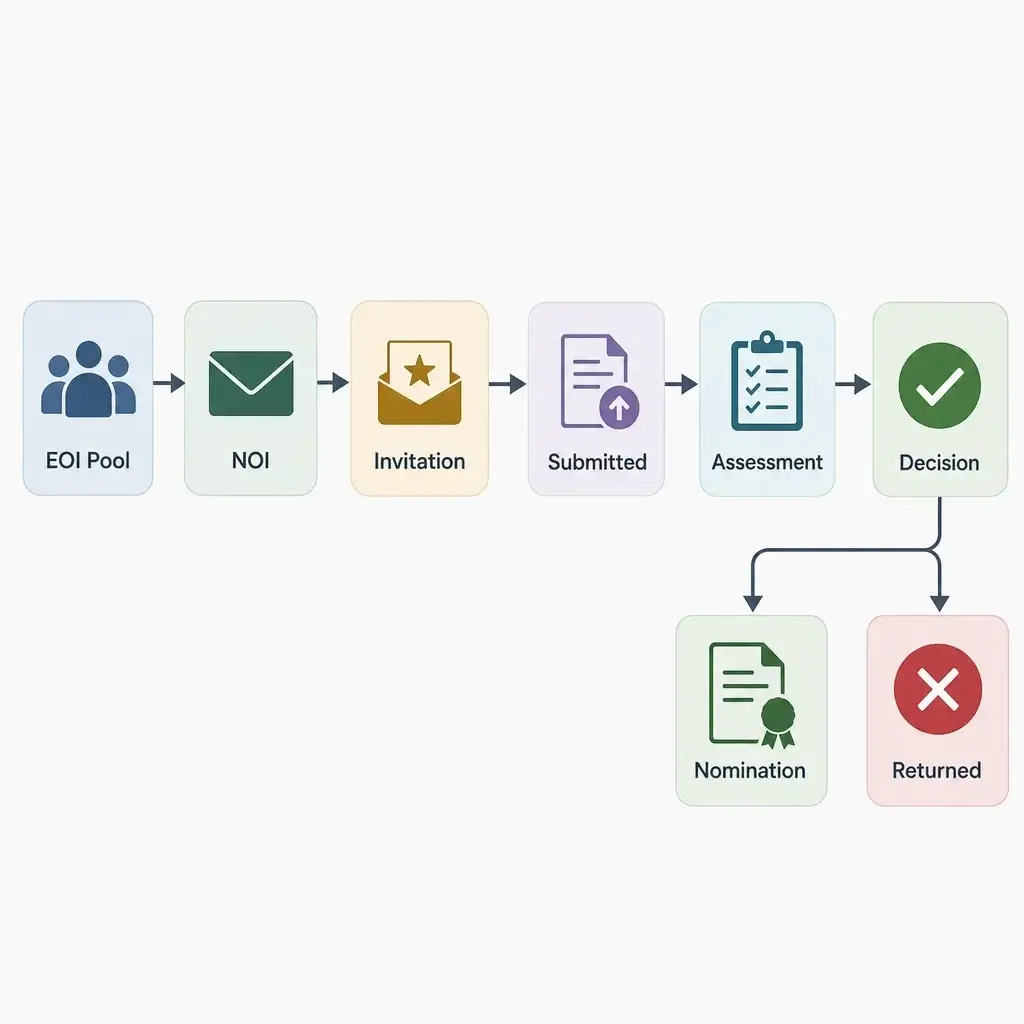
The clearest way to read OINP application status stages is to separate pool statuses from actual application statuses. A profile sitting in an EOI pool is not under full document assessment yet. A submitted application is.
| Portal status | What it usually means | What Ontario may be doing | What you should do next | When to seek help |
|---|---|---|---|---|
| EOI registered / in pool | Your Expression of Interest is active in the pool for that stream. | Ontario may rank profiles for future draws. | Keep your information accurate and monitor for invitations. | Get advice if your score assumptions or stream choice may be wrong. |
| NOI received | Ontario identified your Express Entry profile for a possible provincial application. | Ontario has not nominated you yet. It has invited a provincial filing step. | Review eligibility carefully and submit on time if you proceed. | Get help fast if the invitation window is short or your records are inconsistent. |
| Invitation to apply | Ontario invited you from an EOI pool to submit the full application. | The province is waiting for your complete filing and fee payment. | Gather documents, complete forms, and submit before the deadline. | Get help if employer documents, translations, or graduate proofs are incomplete. |
| Submitted | Ontario has received the full application. | The file is usually waiting for intake or officer assignment. | Check portal messages and email regularly. Avoid duplicate submissions. | Seek help if you realize a major document error after filing. |
| Completeness check / intake review | Ontario is checking whether the file has the minimum required forms and documents. | The province may return incomplete files before full assessment. | Stay available for requests and keep supporting records organized. | Get advice if you receive a return warning or document concern. |
| Assessment / under assessment | This is the core OINP assessment status. An officer is reviewing eligibility, evidence, and consistency. | Ontario may verify work history, education, employer details, language proof, or status documents. | Monitor for additional document requests and respond exactly as instructed. | Seek help if the request is unclear, your evidence is mixed, or your profile may have changed. |
| Decision in progress | Review appears advanced, but no outcome is guaranteed. | Final checks, internal review, or decision drafting may be underway. | Wait, monitor messages, and avoid assuming approval or refusal. | Get help if the file has prior refusals, possible inadmissibility issues, or urgent status expiry. |
| Nomination issued / approved | Ontario approved the provincial file and issued a nomination. | The next step moves to the federal PR system. | Follow the nomination instructions and preserve eligibility. | Seek help if you are unsure how to use the nomination or your federal path changed. |
| Returned / incomplete | Ontario did not accept the file for full processing because something required was missing or defective. | The file may stop without a merits decision. | Review the return reason and reassess whether you can refile. | Get help before refiling so the same issue does not repeat. |
| Refused | Ontario made a negative eligibility decision. | The province found the file did not meet the stream rules or evidence standard. | Read the refusal carefully and assess options quickly. | Legal review matters most here, especially if the refusal affects future filings. |
| Withdrawn / closed / expired | The file ended without a nomination because it was withdrawn, not completed in time, or no longer valid. | Ontario will not continue processing that file. | Confirm whether a fresh registration or application is possible. | Get advice if a profile expiry, invitation deadline, or employer change caused the issue. |
Assessment status in plain English means an officer is now testing the file against the stream’s rules. That can include checking whether the job offer is genuine, whether the work history matches the claimed NOC, whether the language result is still valid, and whether names and dates line up across the evidence.
Decision in progress does not automatically mean rejection. It usually means the file is beyond basic intake and is moving toward an outcome, but applicants should treat it as pending until Ontario issues the decision formally.
How long each OINP stage can take
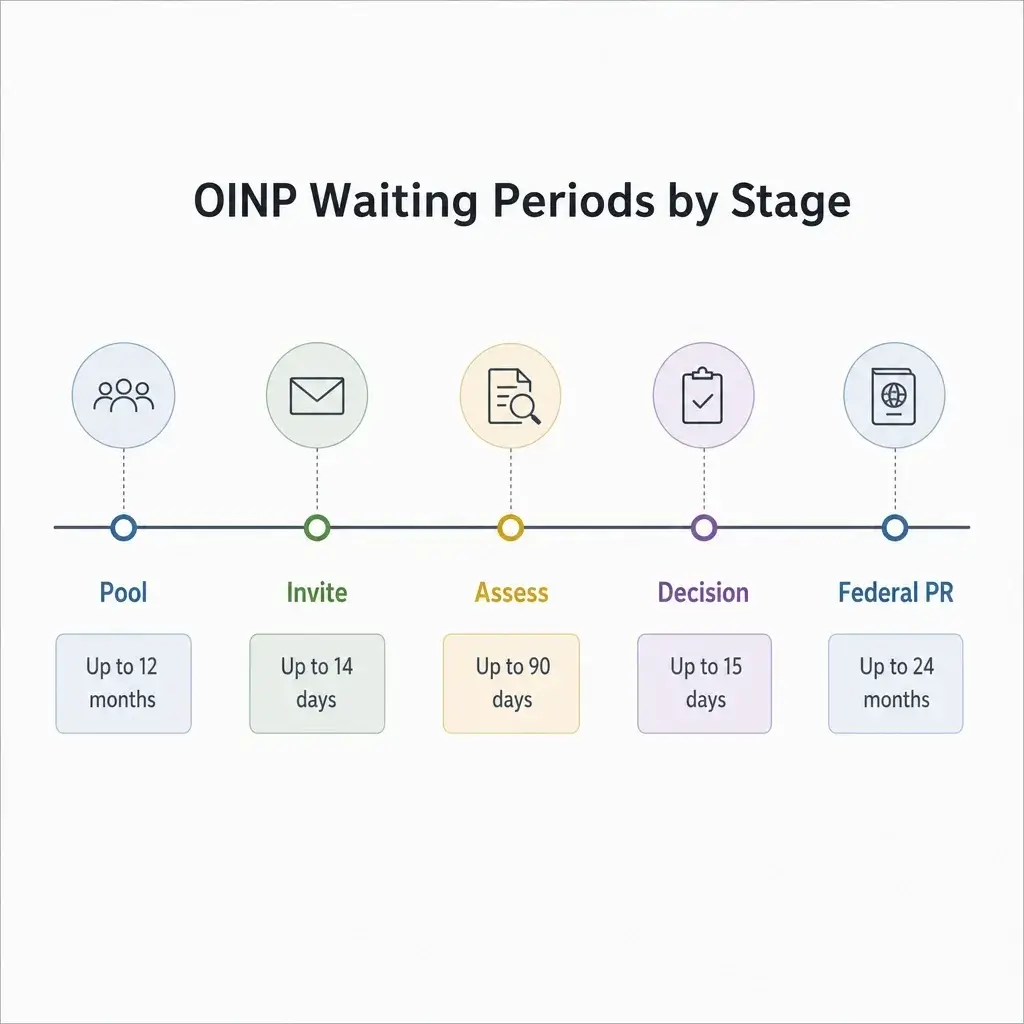
The most honest answer on OINP processing time is that each stage has its own clock. Waiting for a draw, filing after invitation, provincial review, and the later federal PR stage are all separate timelines.
An Ontario EOI registration can remain valid for up to 12 months if the stream’s current rules say so. That does not mean an invitation will arrive within that period. It only means the profile may remain in the pool for that maximum validity period unless withdrawn or no longer eligible. Applicants should verify the current stream rule before relying on that timing.
Submission windows after an NOI or invitation are stream-specific and can change. Some public guides mention windows in the 14 to 45 calendar day range, but that must be checked against the current invitation instructions before acting. The date inside the portal matters more than any blog.
The OINP assessment stage has no safe universal number that should be quoted as a promise. Files can move faster or slower based on completeness, employer verification, translation issues, application volume, and whether Ontario asks for more documents. That is why older forum timelines age badly.
The same caution applies to decision in progress. There is no fixed published period that every file will spend in that label. A short stay in that status does not prove approval, and a long stay does not prove refusal. It only shows the file has not reached a final communicated decision yet.
After nomination, federal permanent residence timing depends on the PR pathway used and current IRCC processing. Ontario’s nomination is one step, not the last one. Applicants should check the current IRCC processing page for the federal stage rather than relying on provincial timing alone.
Why your OINP may be taking longer than expected

Most OINP delays come from verification work, incomplete evidence, or file-specific complications rather than from one hidden portal meaning. Employer checks, document inconsistencies, language-test validity, and high application volumes are more common delay causes than applicants expect.
A file can slow down when the employer has not completed its part fully in an employer job offer stream. That can include missing corporate records, unclear job details, or signatory issues. When the employer side is weak, the applicant’s side can be perfect and the file can still stall.
A file can also slow down when names, dates, and work history do not match across documents. An officer reviewing a graduate, Express Entry, or employer-led file will usually compare the entire record, not just the uploaded résumé. Consistency matters because Ontario is testing eligibility, not just form completion.
Applicants should check portal messages, junk or spam folders, profile validity, and employer follow-through before assuming the province lost the file. Duplicate submissions usually do not speed anything up and can create more confusion instead.
The practical wait-versus-act checklist is simple:
- Wait if the file is moving through a normal status and no request has been missed.
- Act if a deadline is approaching, a profile has expired, an employer changed key terms, or a document request is unclear.
- Seek help quickly if you received a return warning, refusal, procedural fairness concern, or status issue tied to work authorization or federal deadlines.
Common OINP mistakes that can delay, return, or weaken an application
The most expensive OINP mistake is filing under the wrong stream. A strong candidate in the wrong stream still has a weak application because the legal test is stream-specific.
Another common mistake is confusing an EOI pool registration with a full application. Being in the pool means Ontario may consider the profile in a future draw. It does not mean the province has started a full evidence review.
Missed deadlines can end a file before the officer reaches the merits. If Ontario gives a submission or response deadline, the safer assumption is that the system and the officer will treat that date strictly unless the program instructions say otherwise.
Poor scans, missing translations, unsigned forms, expired language results, and inconsistent work histories can all lead to return, delay, or refusal. In practice, document quality is often the difference between a file that moves and one that keeps stopping.
Yes, OINP and other PNP applications can be rejected. Refusal, return as incomplete, closure, and expiry are not the same result, though. A refusal usually means Ontario assessed eligibility and said no. A return usually means the file never made it properly into full processing.
Fees, refunds, and document checklist basics
Applicants should verify current OINP fees on the official Ontario page before payment because fee amounts can change and may differ by stream or location. Some competitor pages cite fees in the $1,500 to $2,000 range, but that should be treated as unverified until matched to the current official schedule.
Refund rules are not one-size-fits-all. Incomplete, returned, withdrawn, refused, and partially processed files may be treated differently under current OINP rules, so applicants should review the official fee and refund terms for the exact stream before assuming money will come back.
A practical document checklist usually includes these groups:
- Identity documents such as passport pages and name-change records if applicable
- Current immigration status documents for applicants in Canada
- Education records such as degrees, transcripts, or Ontario credential proof where the stream requires them
- Language test results where the stream requires valid language proof
- Work experience evidence such as letters, pay records, and supporting employment documents where applicable
- Employer and job-offer records for employer-led streams
- Civil-status records when the stream or family composition requires them
Translation rules matter because OINP generally expects documents not in English or French to be translated according to current instructions. Applicants should check whether certified translation, affidavits, or supporting copies are required for their exact document type before uploading.
Special situations: profile expiry, IRCC ITA, employer-led steps, and nomination aftercare
If an Express Entry profile expires while an OINP file is being processed in an Express Entry-linked stream, eligibility and processing can be affected because the provincial stream depends on a valid federal profile. The applicant should review current OINP instructions immediately and not assume Ontario will simply transfer the file automatically.
If an applicant receives an IRCC Invitation to Apply while OINP is still pending, the right response depends on timing, stream rules, and the applicant’s full facts. There is no safe one-line answer for every file. The decision can affect strategy, timing, and which pathway remains available. That is the kind of issue where individualized legal advice earns its place.
In employer job offer streams, employers are not passive bystanders. The employer may need to provide business information, job details, supporting records, and the proper signing authority through the required Ontario process. A mismatch between what the employer submits and what the applicant submits can create avoidable problems.
After OINP approval, the next step is usually to use the nomination in the federal system and preserve all eligibility factors that supported the provincial decision. For qualifying Express Entry-linked nominations, the nomination can add 600 CRS points. That can change the federal ranking sharply, but PR still requires a separate federal application and decision.
If your status has stalled, your employer documents are under review, or you are not sure how to handle a pending deadline, a legal assessment can help frame the next step without guessing. That matters most when the issue is not the form itself, but what the form means for the larger immigration strategy.
When to get legal help with an OINP file
Legal help is most useful when the issue is not routine delay but a file problem with consequences. Prior refusals, inconsistent records, employer compliance concerns, expiring profiles, unclear document requests, and invitation deadlines are the common pressure points.
A lawyer can also help when the portal status is only the surface issue. An OINP assessment status may look ordinary while the real risk sits underneath in the NOC match, work proof, job-offer structure, or federal profile validity. The label alone never tells the whole story.
For applicants in Toronto and the GTA, this is where organized review matters more than speed for its own sake. A rushed answer to the wrong issue can cost more time than a careful response to the right one. Sutton Law handles OINP-related strategy, refusals, employer-stream concerns, and the PR step after nomination, and case assessments are available for time-sensitive files.
FAQ
What are the stages of OINP application?
The usual stages are stream selection, profile or EOI setup if required, invitation or NOI, full application submission, completeness review, assessment, decision, nomination if approved, and the later federal PR application. Exact labels can vary by stream and portal version.
What does status assessment mean in OINP?
It usually means an officer is actively reviewing whether the file meets the stream’s requirements and whether the documents are consistent and credible. It is more than intake and less than a final decision.
How do I check my OINP application status?
Applicants usually check through the current Ontario OINP portal account linked to their application. The safest route is to start from the official Ontario OINP page because login systems and portal naming can change over time.
How long does OINP assessment take?
There is no single reliable number that fits every stream or file. Assessment length depends on completeness, verifications, employer involvement, document issues, and current program volume.
How long does decision in progress take in OINP?
There is no fixed period that applies to every file. Decision in progress means the file is still pending an official outcome, not that approval or refusal is guaranteed.
Why is my OINP taking so long?
The common causes are document gaps, translation issues, employer verification, inconsistent records, profile-validity issues, and high program volume. A long wait by itself does not prove a refusal is coming.
What happens after OINP approval?
The applicant uses the nomination in the correct federal PR pathway and keeps all relevant eligibility factors valid. Provincial approval is not the same as permanent residence.
How long does it take to get PR after OINP approval?
That depends on the federal pathway and current IRCC processing, not just Ontario’s timeline. Applicants should check current IRCC processing information for the final stage.
Can OINP or PNP applications be rejected?
Yes. They can also be returned as incomplete, withdrawn, closed, or expire. Those outcomes are different, and the next step depends on which one occurred and why.
What are common OINP mistakes?
The biggest ones are choosing the wrong stream, missing deadlines, filing incomplete documents, using poor scans, relying on expired language tests, and submitting records that do not match each other.
If you are still stuck between waiting and acting, start with one practical step: match your current portal label to the glossary above, then check whether anything in your file has changed since submission. That usually tells you more than reading one more forum thread.