

An engineering degree is not an immigration program. Canadian immigration for engineers requires a route that fits your experience, language results, education and family situation. Your professional licence is a separate issue.
Engineers can pursue permanent residence through Express Entry or provincial nomination. Others arrive through employer-supported work permits or eligible Canadian study programs. There is no single Canadian engineer visa.
Canadian immigration for engineers: choose the route before collecting documents
The right starting point is a comparison between direct permanent residence and temporary work authorization. Direct PR can suit an experienced engineer abroad without a Canadian employer. A work-permit-first strategy can suit someone with employer support but a weaker immigration score. Neither route automatically grants engineering licensure.
I’m Alex Sutton, and I separate these issues when reviewing engineering profiles at Sutton Law: immigration eligibility, permission to work and professional regulation. An Educational Credential Assessment, or ECA, supports an immigration application. It does not grant permission to practise professional engineering.
Main immigration pathways
| Route | Who it suits | Job offer needed? | Main advantage | Main drawback | Relationship to PR |
|---|---|---|---|---|---|
| Express Entry: Federal Skilled Worker Program | Engineers with qualifying foreign experience, education and language results | Not necessarily | Can support direct PR from abroad | Eligibility does not guarantee an invitation | Direct PR selection system |
| Express Entry: Canadian Experience Class | Engineers with qualifying Canadian skilled work experience | Not necessarily | Uses Canadian work history | Not all work performed in Canada qualifies | Direct PR selection system |
| Provincial Nominee Program | Applicants matching a province’s labour needs, employer requirements or selection priorities | Stream-specific | Can open a route outside general federal competition | Province-specific conditions and genuine settlement intention | Nomination supports a PR application |
| Employer-supported work permit | Engineers with a qualifying Canadian job or corporate transfer | Usually | Allows qualifying employment before PR | Employer cooperation and permit restrictions | Can help build eligibility; does not guarantee PR |
| Canadian study followed by eligible graduate work | Applicants with a genuine education plan and adequate funding | Not for the study route itself | Canadian education and qualifying work can strengthen a profile | Tuition, living costs and graduate-permit eligibility | Indirect route, not a PR promise |
| Atlantic Immigration Program | Engineers hired by a designated Atlantic employer | Yes | Connects employer recruitment with permanent immigration | Requires a qualifying offer and provincial endorsement | Employer-supported PR route |
Best pathway by engineer profile
The strongest route follows your evidence, not your job title. A mechanical engineer abroad and a mechanical engineer working in Ontario can have different options because Canadian experience, employer support and provincial connections affect eligibility.
| Your profile | Primary route to assess | Backup route | Main obstacle |
|---|---|---|---|
| Foreign experience, strong language, no Canadian offer | Federal Skilled Worker through Express Entry | Provincial selection or French-language opportunities | Competitive CRS ranking |
| Eligible for Express Entry but low CRS | Provincial nomination and applicable category-based selection | Employer-supported work followed by qualifying Canadian experience | Finding a route that genuinely matches your occupation and circumstances |
| Canadian engineering degree | Canadian Experience Class after qualifying work | Provincial graduate or employer-supported routes | Graduation alone does not establish PR eligibility |
| Qualifying Canadian engineering experience | Canadian Experience Class | Provincial nomination | Proving authorized, eligible work |
| Canadian employer ready to support recruitment | LMIA-based or qualifying LMIA-exempt permit | Employer-supported provincial nomination | Employer eligibility and supporting documents |
| Employee of a multinational with Canadian operations | Intra-company transfer, where eligible | LMIA-based employment | Corporate relationship, prior employment and qualifying duties |
| American or Mexican citizen with an engineering offer | CUSMA professional work permit, where eligible | Other employer-supported routes | Citizenship, professional qualifications and the proposed work |
| Spouse has stronger language, age or education factors | Compare both spouses as principal applicant | Separate employer or provincial options | Choosing the stronger complete profile, not the higher salary |
For regulated engineering work, run immigration and licensing plans together. A permit might authorize employment with a company while provincial law restricts independent engineering practice or protected titles. The employer must structure the role accordingly.
Express Entry: when engineers can apply directly for PR
Engineers can qualify for permanent residence without Canadian experience through the Federal Skilled Worker Program. The baseline includes qualifying skilled work, an approved language test, education requirements and the program’s selection assessment. Foreign education normally requires an immigration ECA.
Federal Skilled Worker eligibility includes at least one continuous year of qualifying paid work within the preceding ten years, minimum Canadian Language Benchmark 7 in each language ability, and at least 67 out of 100 selection points. These selection points are different from the Comprehensive Ranking System, or CRS, used to rank Express Entry candidates.
The Canadian Experience Class generally requires at least one year of qualifying, authorized Canadian skilled work within the preceding three years. Work gained during full-time study and self-employment generally do not count toward its minimum experience requirement. Engineering roles classified in TEER 0 or 1 require CLB 7 for this program.
Express Entry follows a specific sequence: establish program eligibility, create a profile, receive an invitation, then submit the PR application. Entering the pool is not applying for permanent residence, and meeting minimum requirements does not guarantee selection.
Eligibility checklist before entering the pool
- Match your actual duties to an eligible National Occupational Classification, or NOC, occupation.
- Obtain an approved English or French immigration test. IELTS General Training, CELPIP-General and PTE Core are accepted English options.
- Obtain an immigration ECA for foreign education where required.
- Calculate qualifying experience using dates, hours, pay and work authorization.
- Establish settlement funds where the program requires them. Federal Skilled Worker and Canadian Experience Class rules differ here.
- Identify accompanying and non-accompanying family members correctly.
- Review prior refusals, criminal history and medical issues that affect admissibility.
Category-based draws and engineering occupations
An engineering title does not automatically qualify someone for an occupation-targeted invitation. Your exact NOC must appear in the applicable category, and you must meet its experience conditions. You must also qualify for an Express Entry-managed immigration program.
Do not treat every engineering occupation as a STEM invitation opportunity. Civil engineering, software development and engineering management have different NOC classifications. A category’s occupation list, experience requirement and invitation criteria determine eligibility, not the broad label “engineer.”
Engineering NOC codes: duties matter more than titles
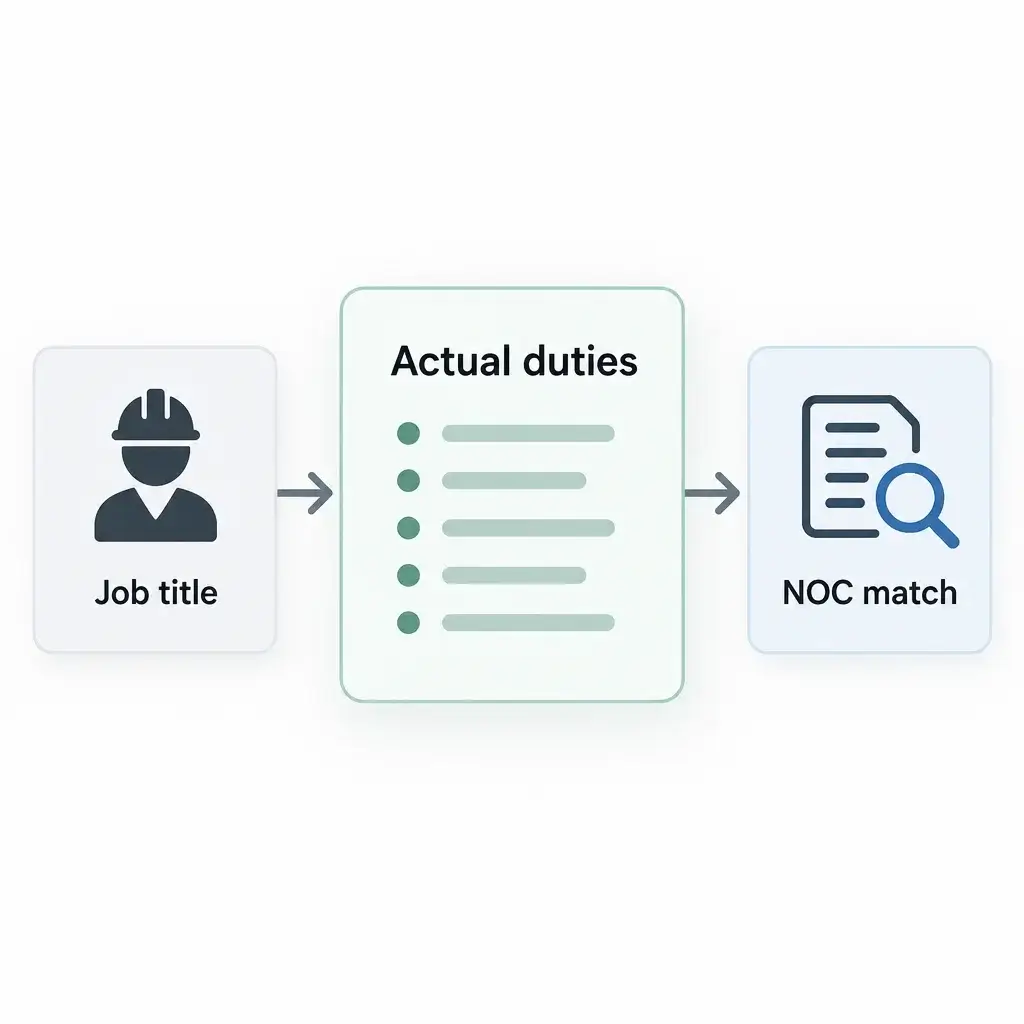
Choose your NOC from the work you actually performed. IRCC assesses the occupation’s lead statement and relevant main duties, rather than accepting a title alone. A reference letter saying only “project engineer” leaves the decision-maker without the evidence needed to assess your experience.
| Occupation | NOC 2021 code | Evidence to distinguish the role |
|---|---|---|
| Civil engineers | 21300 | Infrastructure design, construction engineering, analysis and project responsibilities |
| Mechanical engineers | 21301 | Mechanical systems, equipment design, testing and technical analysis |
| Electrical and electronics engineers | 21310 | Electrical or electronic systems design, development and testing |
| Computer engineers, except software engineers and designers | 21311 | Computer hardware, networks and related engineering duties |
| Industrial and manufacturing engineers | 21321 | Production systems, plant processes, efficiency and manufacturing methods |
| Metallurgical and materials engineers | 21322 | Materials properties, processing, development and technical investigations |
| Mining engineers | 21330 | Mine planning, development, operations and extraction engineering |
| Software engineers and designers | 21231 | Software architecture, design, integration and engineering responsibilities |
| Engineering managers | 20010 | Managing engineering functions, staff, budgets and technical operations |
A software engineer is not automatically a software developer for immigration purposes. Likewise, a maintenance engineer might perform mechanical engineering, technical maintenance or management duties. The correct classification follows the substance of the work.
There is no universal “Skilled Worker Canada list” that guarantees engineers admission. A search for a “Canada skilled occupation list 2026” can mix federal eligibility, category-based selection and provincial occupation lists. Those are different selection tools.
Provincial nomination and choosing where to settle
A Provincial Nominee Program, or PNP, can help when your federal ranking is weak but your provincial fit is strong. An Express Entry-linked nomination adds 600 CRS points. Other provincial routes operate outside Express Entry and have their own application process.
No province is automatically easiest for engineers. Selection can turn on a qualifying employer, occupation, language results, provincial connections and genuine intention to settle there. A nomination is not simply a points purchase followed by a planned move elsewhere.
| Province or region | Engineering sectors to research | Immigration route types to assess | Licensing and settlement considerations |
|---|---|---|---|
| Ontario | Manufacturing, infrastructure, consulting and technology | Ontario Immigrant Nominee Program employer, graduate or Express Entry-linked routes | Professional Engineers Ontario; compare GTA housing and commuting costs with other Ontario centres |
| British Columbia | Infrastructure, clean technology, software and resource projects | Employer-supported provincial pathways | Engineers and Geoscientists BC; role eligibility and employer support matter |
| Alberta | Energy, industrial operations, construction and technology | Alberta worker and Express Entry-linked pathways | APEGA; match experience to the employer’s actual project needs |
| Saskatchewan and Manitoba | Manufacturing, agriculture-related industry, mining and infrastructure | Provincial worker pathways based on applicable employment, connections or selection criteria | APEGS or Engineers Geoscientists Manitoba; smaller labour markets reward targeted applications |
| Atlantic provinces | Utilities, marine work, infrastructure and manufacturing | Provincial nomination or Atlantic Immigration Program | Provincial engineering regulator; designated-employer recruitment can be relevant |
| Quebec | Aerospace, manufacturing, infrastructure and technology | Quebec’s separate economic immigration selection system | Ordre des ingénieurs du Québec; French and provincial professional requirements are important |
| Northern and remote locations | Mining, utilities and public infrastructure | Employer-supported territorial or other applicable routes | Local professional registration, travel and family settlement logistics require planning |
Ontario nomination does not replace Ontario engineering licensing. Professional Engineers Ontario, or PEO, regulates professional engineering in Ontario. An OINP nomination addresses immigration selection, not permission to sign or seal engineering work.
Work permits: TFWP, IMP, CUSMA, ICT, GTS and PGWP
A work permit can be a practical bridge to PR, but it remains temporary authorization. Employer-specific permits restrict employment according to their conditions. Qualifying Canadian work can later support Canadian Experience Class or provincial eligibility, without guaranteeing an invitation or approval.
| Route | How it works | Employer involvement | Engineering-specific issue |
|---|---|---|---|
| Temporary Foreign Worker Program, or TFWP | Employer generally obtains a positive Labour Market Impact Assessment, or LMIA, before the worker applies | Recruitment, wage and business evidence are central | A shortage claim alone does not establish LMIA eligibility |
| International Mobility Program, or IMP | Work authorization under an applicable LMIA exemption | Employer compliance steps usually apply to employer-specific permits | The exemption must fit the facts; an engineering degree is not itself an exemption |
| CUSMA professional | Qualifying American or Mexican professionals undertake pre-arranged Canadian professional work | Canadian offer or qualifying contract documentation | Engineer is a listed profession, but qualifications and proposed duties must fit |
| Intra-company transfer, or ICT | Qualifying multinational transfers eligible executives, managers or specialized-knowledge employees | Corporate and employment evidence required | Being employed overseas by a company with a Canadian address is not enough |
| Global Talent Stream, or GTS | Employer applies through a specialized LMIA stream | Employer eligibility and a Labour Market Benefits Plan matter | Not every engineering role qualifies; applicable category or occupation conditions control |
| Post-graduation work permit, or PGWP | Eligible Canadian graduates apply for an open work permit | No job offer required for the permit itself | School, program, study history, language and applicable field-of-study conditions matter |
An employer hiring a foreign engineer must address immigration and professional compliance separately. Employment and Social Development Canada assesses LMIA applications; IRCC issues work permits. The provincial regulator governs professional practice. A positive result from one does not replace the others.
For a graduate route, select the education program before paying tuition, not after. Attendance at a designated learning institution does not make every program PGWP-eligible. Degree and non-degree graduates can also face different graduate-permit requirements.
PR, work authorization and P.Eng. are different approvals
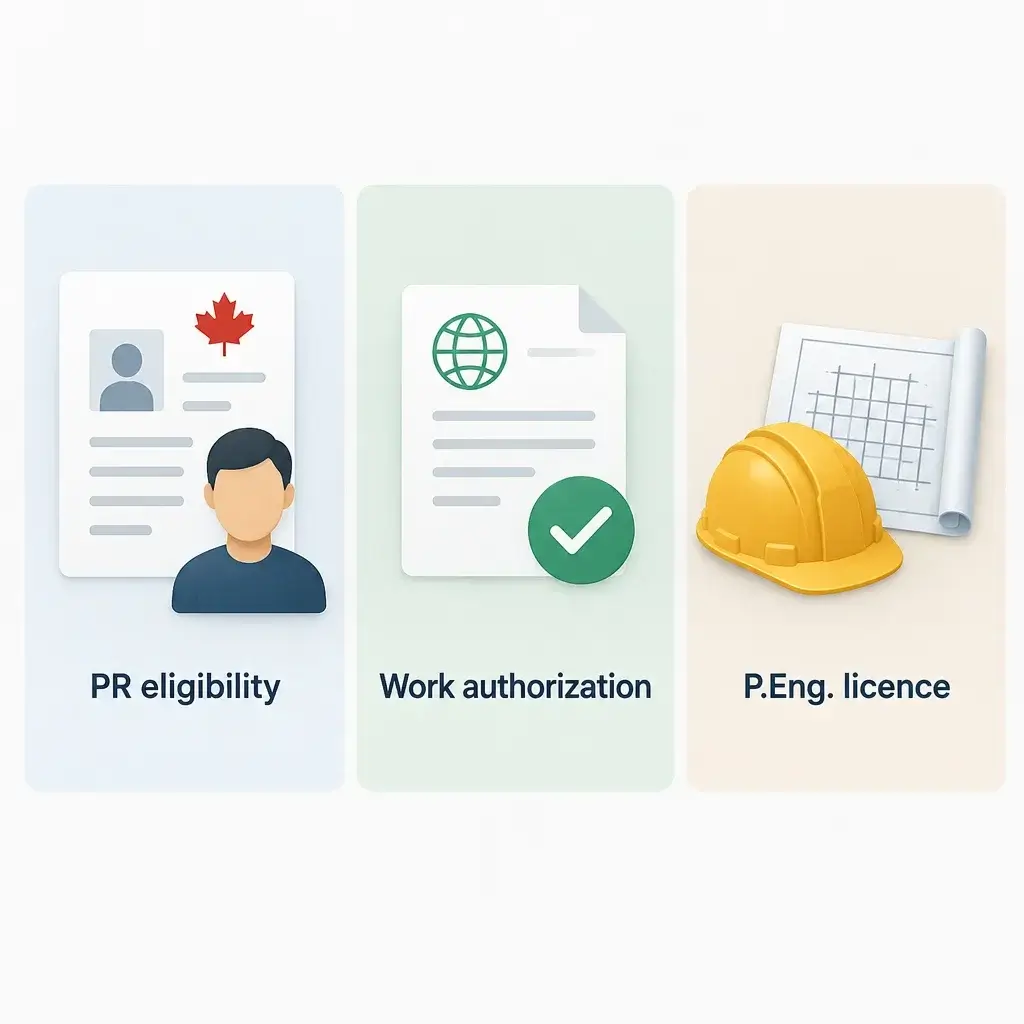
You generally do not need a P.Eng. before immigrating to Canada. Permanent residence eligibility concerns immigration criteria. Professional licensure concerns whether you can undertake regulated engineering practice or use protected titles in a particular province or territory.
| Immigration eligibility | Work permit or PR status | Professional licensure |
|---|---|---|
| Determines whether you qualify under an immigration program | Determines whether, and under what conditions, you may work in Canada | Determines your authority to practise regulated engineering and use protected titles |
| Assesses matters such as language, education, experience and admissibility | A work permit can restrict employer or occupation; PR generally removes immigration-based employer restrictions | Provincial and territorial regulators assess professional requirements |
| An ECA assesses foreign education for immigration purposes | Neither a work permit nor PR is a P.Eng. licence | Academic assessment, competence, ethics and other regulator requirements remain separate |
Working before full licensure
Some engineering-related employment is possible before full licensure, including appropriately supervised work and roles outside reserved professional practice. The province, duties, title and supervision arrangement determine the limits. Independent responsibility for regulated engineering work requires the appropriate professional authorization.
In Ontario, PEO regulates professional engineering practice and protected professional titles. Engineers and Geoscientists BC and Alberta’s APEGA perform corresponding regulatory roles in their provinces. Engineers Canada is not a national licensing authority that can issue a licence covering all Canadian practice.
Foreign experience can support both immigration and licensing, but each process assesses it differently. IRCC examines qualifying work against immigration program rules and NOC duties. A regulator assesses engineering competence and its own licensing requirements; foreign experience is not automatically rejected merely because it occurred outside Canada.
Which engineering specialization fits which route?
Your specialization helps identify employers and provinces, but it does not determine PR eligibility by itself. Language results, education, age, documented experience and employer support can outweigh the difference between mechanical and electrical engineering in an immigration assessment.
| Specialization | Practical route and job-search focus | Main evidence or licensing issue |
|---|---|---|
| Software and computer | Express Entry, qualifying technology employers, corporate transfers and applicable GTS recruitment | Separate software design, development, hardware and management duties; do not assume a technology role qualifies for an occupation-targeted draw |
| Civil | Infrastructure employers, engineering consultancies and provincial employer pathways | Design responsibility, supervision and authority to sign or seal work |
| Mechanical and electrical | Manufacturing, utilities, industrial operations and equipment employers | Explain design and analysis duties rather than listing equipment serviced |
| Industrial and manufacturing | Production, process improvement and plant operations | Distinguish engineering systems work from production supervision |
| Mining, materials and metallurgical | Resource operations, processing facilities and specialist consultancies | Document technical responsibilities, remote-site work and project locations |
| Engineering management | Senior employer recruitment, qualifying transfers and economic immigration | Prove management duties; a senior technical title alone does not establish management experience |
Canadian employers recruit engineers across infrastructure, resources, manufacturing and technology, but national demand does not establish demand for your exact profile. Province, project cycle, language, specialization and licensing readiness affect hiring. A job advertisement is employment evidence, not proof of immigration eligibility.
Documents engineers should prepare
Strong employment letters prove the work claimed in the application. They should identify employment dates, positions, hours, pay and substantive duties, with employer contact information. A résumé or generic letter confirming employment does not establish the full immigration claim.
Before creating an Express Entry profile
- Passport and accurate personal-history records.
- Approved language results and an immigration ECA where required.
- Degree certificates, transcripts and records supporting the assessment.
- Employment letters, contracts and supporting payroll or tax records.
- A duty-based NOC analysis for each claimed position.
- Marriage, divorce, common-law and children’s records relevant to the application.
After an invitation or nomination
- Obtain the police certificates required for your residence history.
- Follow the medical examination instructions applicable to your application.
- Document settlement funds where required, including the source of significant deposits.
- Upload complete employment, education and civil-status evidence.
- Arrange required translations and reconcile inconsistent names or dates.
- Submit within the deadline in the invitation or provincial instructions.
Before filing an employer-supported work permit
- Obtain the applicable LMIA or LMIA-exempt employer documentation.
- Include the offer, contract and evidence you meet the position’s requirements.
- Explain how licensing restrictions will be addressed where relevant.
- Include corporate-transfer or treaty-professional evidence if using those exemptions.
- Prepare accompanying family applications around each person’s eligibility.
For self-employed engineers, contracts alone rarely tell the whole story. Client letters, invoices, payment records, business registration and tax evidence can establish services and remuneration. Self-employment treatment differs between Federal Skilled Worker and Canadian Experience Class rules.
Improving CRS: age, language, spouse and experience
There is no universal age ceiling for engineers applying through economic immigration, but age affects Express Entry ranking. Language results, foreign and Canadian education, qualifying experience and accompanying-spouse factors also affect CRS. Calculate both spouses’ profiles before choosing the principal applicant.
The most useful score improvements are evidence-based: stronger approved language results, French proficiency, recognition of additional eligible education, qualifying Canadian experience or an Express Entry-linked nomination. A nomination adds 600 CRS points. A Canadian job offer does not itself attract CRS job-offer points, although it can still matter for program eligibility, work permits and provincial selection.
Language results are valid for two years, while an immigration ECA is generally valid for five years. Expiring results can affect both profile eligibility and the later PR filing. Build document expiry dates into the plan rather than treating testing as a completed administrative task.
Timelines and costs: budget for separate stages
There is no engineer-specific immigration processing queue. The full timeline includes document collection, credential assessment, language testing, waiting for selection and government processing. An employer-supported case can also require recruitment and an LMIA before the work permit application begins.
For preparation alone, allow roughly four to twelve weeks when education and employment records are accessible. Missing university records, unresponsive employers, translations and overseas police certificates can extend that stage. Invitation waiting time is separate and cannot be inferred from application-processing targets.
A practical preliminary budget separates testing, credential assessment, government charges and professional fees. The following are planning ranges, not Sutton Law quotations or fixed government fees.
| Expense | Planning approach |
|---|---|
| Approved language testing | Budget approximately CAD $250–$450 per attempt, depending on test and location |
| Immigration ECA | Budget approximately CAD $250–$450 for a standard assessment, with delivery and document charges potentially extra |
| Translation and certification | A document-heavy file can require roughly CAD $200–$1,000 or more, depending on language and volume |
| Immigration government charges | Calculate application, biometrics and permanent-residence charges for the selected route and each family member |
| Medical examinations and police documents | Budget separately for each person who requires them; country, clinic and document requirements drive the amount |
| Engineering licensing | Separate application, assessment, examination, annual registration and any additional education costs; the regulator and academic assessment determine the total |
| Legal representation | Scope changes with the route, family size, prior refusals, employer involvement and evidentiary problems; employer-side work and PR preparation are different services |
An engineer with clear employment records and straightforward eligibility may prepare an application without representation. A lawyer adds particular value where NOC classification, self-employment, refusals, employer exemptions or family admissibility complicate the evidence. The work involves selecting the legal route and proving eligibility, not simply uploading forms.
Family planning alongside the engineering application
A spouse or common-law partner and eligible dependent children can generally be included in an economic PR application. Family members must be declared accurately, including relevant non-accompanying relatives, and examination requirements can still apply. Omitting a family member can damage later sponsorship options.
A temporary worker’s spouse does not automatically receive an open work permit. Eligibility turns on the applicable family-worker category, the principal worker’s occupation, permit validity and immigration pathway. Children’s study authorization requires separate planning based on their circumstances.
For separated parents, children’s travel and immigration documents need particular attention. Parenting orders, decision-making arrangements and the other parent’s consent can affect relocation. Canadian immigration approval does not resolve a dispute over whether a child may move.
Common mistakes that weaken engineering applications
The avoidable failures are usually evidence failures or route-selection failures. A strong degree cannot repair an unsupported work history, an ineligible permit exemption or inconsistent declarations across applications. IRCC assesses the application submitted, not the qualifications the applicant intended to prove.
- Choosing a NOC by title: “systems engineer” can describe materially different occupations. Match duties instead.
- Copying NOC wording into a reference letter: describe real projects and responsibilities, supported by employment records.
- Confusing an ECA with licensing: immigration credential recognition does not grant a P.Eng.
- Assuming any job offer produces PR: program eligibility, selection and admissibility remain separate requirements.
- Counting ineligible Canadian work: unauthorized work and excluded student work do not establish Canadian Experience Class eligibility.
- Ignoring previous refusals: disclose them accurately and address the underlying concern.
- Missing temporary-status deadlines: an Express Entry profile does not extend permission to remain or work in Canada.
- Paying for a promised LMIA: employers cannot recover LMIA processing fees or prohibited recruitment charges from workers. A purchased offer is not a reliable immigration strategy.
Step-by-step roadmap from engineer abroad to Canada
A workable plan links each immigration step to evidence and a deadline. Keep the licensing file separate, but coordinate it with job applications where professional registration affects the role. An immigration ECA and a regulator’s academic assessment serve different purposes.
- Identify your occupation. Compare actual duties with the NOC, including any move from technical work into management.
- Separate the approvals. Identify the immigration route, work authorization and professional licensing requirements.
- Compare principal applicants. Assess both spouses’ language, education, age and experience factors.
- Complete the eligibility evidence. Arrange language testing and an immigration ECA where required.
- Build the employment record. Collect detailed references and supporting financial records before an invitation deadline arrives.
- Choose the filing track. Create an eligible Express Entry profile, pursue provincial selection or secure the required employer support.
- Prepare the complete application. Reconcile dates, duties, travel history, civil records and prior immigration declarations.
- Coordinate family applications. Address accompanying relatives, temporary permits and children’s relocation documents.
- Plan settlement and professional registration. Begin regulator steps when eligible and align the job’s duties with your authorization.
Job search, credential recognition and settlement resources
A targeted search works better than sending the same résumé to every engineering vacancy. Identify employers that use your technical experience, then explain your immigration position and licensing stage accurately. Do not describe yourself as Canadian-licensed unless you hold the relevant authorization.
- Job Bank: occupation information and Canadian job postings; an advertisement does not establish employer willingness or ability to support immigration.
- Employer career pages: consultancies, utilities, manufacturers, technology companies and resource operators recruit directly.
- Engineers Canada: information about the profession, accreditation, regulators and international mobility arrangements; it does not issue provincial licences.
- Provincial and territorial regulators: licensing assessment, title restrictions, professional examinations and registration requirements.
- Settlement.Org and local newcomer agencies: Ontario settlement information, employment preparation and referrals; service eligibility depends on the program and immigration status.
- Windmill Microlending: credential-recognition financing for eligible skilled immigrants and refugees; funding is a loan, not automatic licensing approval.
Engineers Canada mobility registers and mutual recognition agreements do not replace immigration approval. Their relevance depends on the particular arrangement, participating jurisdictions and your professional registration or educational background. An accredited degree agreement can support academic recognition without granting an unrestricted Canadian engineering licence.
Frequently asked questions
Is it easy to immigrate to Canada as an engineer?
An engineering background can support skilled immigration, but it creates no automatic entitlement. The decisive issues are program eligibility, language results, education, documented experience, CRS ranking or provincial fit, and admissibility. A job shortage does not remove those requirements.
Can engineers apply directly for PR without Canadian experience?
Yes. The Federal Skilled Worker Program can accept qualifying foreign experience without Canadian work or a Canadian job offer. You must satisfy its eligibility requirements and then obtain an invitation through Express Entry before submitting that PR application.
Which province is best or easiest for engineers?
The best fit is the province where your occupation, employer opportunities and settlement plans match an available route. Ontario offers manufacturing, infrastructure and technology employers; Alberta has energy and industrial employers. Neither province offers automatic PR because you are an engineer.
Do I need a P.Eng. before moving?
Generally, no. Immigration eligibility and engineering licensure are separate assessments. However, the proposed job may require licensing or an appropriate supervised arrangement, so moving first does not remove professional-practice restrictions.
Can I work first and apply for PR later?
Yes, if you obtain appropriate work authorization. Qualifying Canadian work can support Canadian Experience Class or provincial eligibility. Keep evidence of authorization, hours, duties and pay; the work permit itself does not establish a future right to PR.
Does foreign engineering experience count?
Qualifying foreign work can count under Federal Skilled Worker rules and affect Express Entry ranking. The evidence must establish paid work, dates, hours and qualifying duties. Licensing bodies separately assess whether the experience demonstrates the required professional competence.
What documents and NOC code should I start with?
Start with your passport, education records, language plan and detailed employment evidence. Select the NOC from duties, not the degree title. For example, mechanical engineers use NOC 21301, while engineering managers use NOC 20010 when their actual duties fit that occupation.
How can an engineer improve a low CRS score?
Assess stronger language results, French, additional recognized education, qualifying Canadian work and provincial nomination. Also compare your spouse as principal applicant. A job offer can support other routes, but does not itself add CRS job-offer points.
Talk to Sutton Law About Your Engineering Immigration Plan
If you have questions about moving to Canada as an engineer, contact Alex Sutton and the Sutton Law team. We can assess your PR and work permit options, review your NOC evidence and coordinate accompanying family applications. We offer a free initial assessment.