

I see this mistake in different forms all the time. A nurse may be eligible for permanent residence, but not yet licence-ready. Another may have a job lead, but no immigration path that fits. This guide is built to help you sort that out before you spend money on the wrong test, the wrong assessment, or the wrong province.
Canadian Immigration for Nurses: Quick Answer
Yes, many nurses can immigrate to Canada through Express Entry, Provincial Nominee Programs, and employer-supported work permit routes. Canadian immigration for nurses is realistic for a lot of applicants, but being a nurse does not guarantee PR, a licence, or a job offer.
Your strongest route depends on concrete factors: your nursing occupation, age, language scores, education, recent work history, family situation, target province, and whether you already have Canadian experience or employer support. In my experience, the strategy usually becomes clear after you separate three issues: immigration eligibility, licensing eligibility, and job-market fit.
The practical order is simple. First, confirm which immigration pathways fit. Next, confirm what the nursing regulator in your province will require. Then build one roadmap that gets you legal status, registration planning, and realistic work options in the right sequence.
Eligibility Checklist Before You Spend Money
A workable nurse immigration plan usually starts with six checkpoints. You need to know your likely NOC code, whether your experience is in a skilled occupation, which language test you can pass competitively, whether you need an Educational Credential Assessment for immigration, whether you also need a nursing-specific assessment, and whether your intended province is realistic for both immigration and registration.
A bad first move is expensive. I have seen applicants pay for licensing-related steps first, then learn their immigration score is too weak. I have also seen the reverse: someone gets immigration-ready, lands in Canada, and then learns they cannot practise as a registered nurse without months of extra registration work. Licensing and immigration for nurses have to be planned together.
Use this basic self-screen before you go further:
- skilled nursing or healthcare work history that can be documented
- valid language results for the pathway you want
- education documents available from your school
- passport and civil status documents in order
- realistic province target based on regulator rules and hiring realities
- enough budget for immigration, registration, and relocation steps
The 3 Main Immigration Pathways for Nurses in Canada
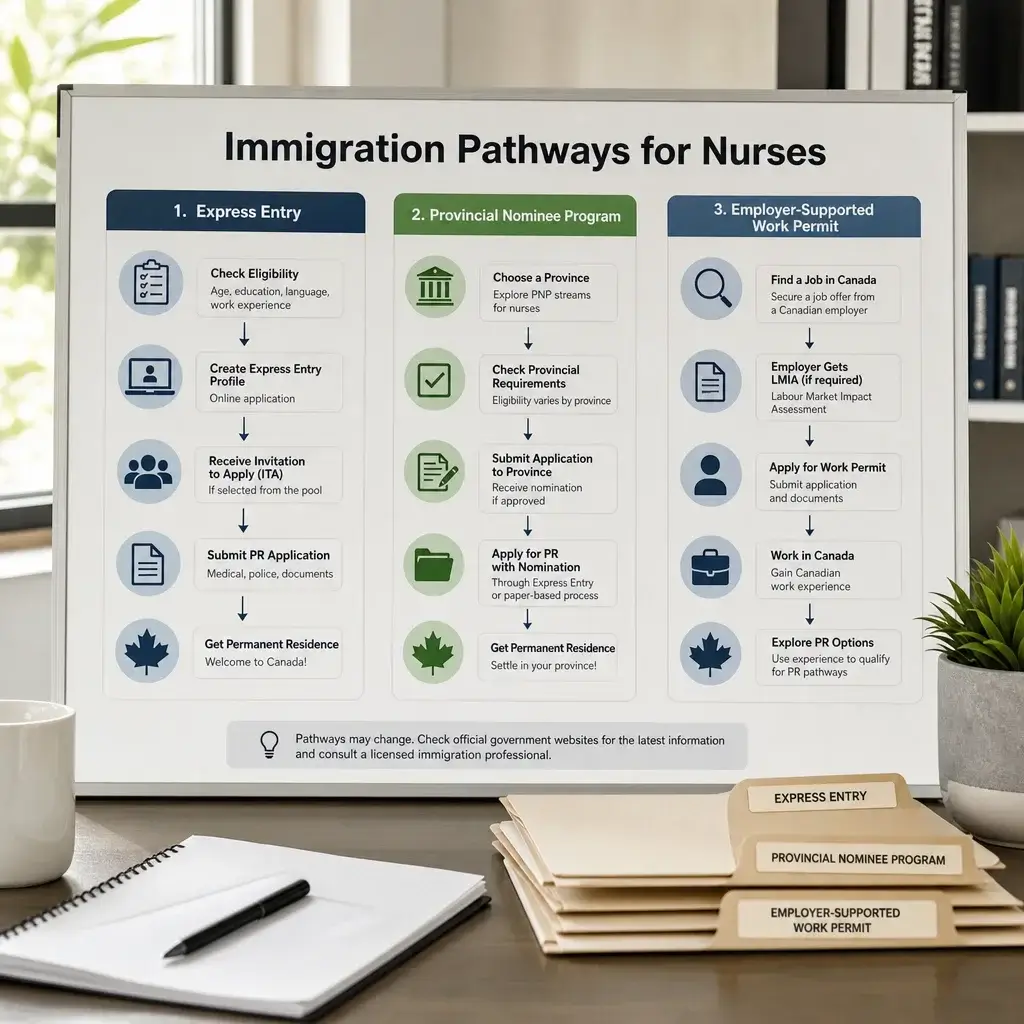
Most nurse immigration Canada files fall into three buckets: Express Entry, a Provincial Nominee Program, or an employer-supported work permit. Some applicants go straight for PR. Others arrive on temporary status first and apply for PR later.
Express Entry is usually the cleanest PR-first route when your profile is already strong. It can include programs such as the Federal Skilled Worker Program and, in some cases, the Canadian Experience Class. For some nurse profiles, healthcare-focused or occupation-specific selection rounds may matter, but those rules can change and should be checked on the current IRCC site.
A provincial route can beat Express Entry when your federal score is not strong enough on its own. Provinces may target healthcare workers through streams tied to labour shortages, employer support, or provincial priorities. The catch is that provincial programs change more often than people think, and what was open 3–6 months ago may not be open now.
A work permit route makes sense when an employer is ready to support you and the timing matters more than getting PR first. That can help you enter Canada sooner, build Canadian experience, and later pursue a permanent residence application. The risk is dependence on the employer, plus the fact that a work permit does not solve your nursing registration problem by itself.
Which Pathway Is Best for Your Nurse Profile?

The best pathway depends more on your profile than on your title. A registered nurse immigration strategy for an experienced RN abroad is not the same as one for an RPN in Canada, a nurse with low language scores, or a healthcare worker with a job offer.
| Profile | Usually strongest route | Backup route | Biggest obstacle |
|---|---|---|---|
| Experienced RN abroad with strong English or French | Express Entry | PNP | CRS competitiveness |
| Nurse with Canadian skilled experience | Express Entry, often stronger than abroad-only profiles | PNP | maintaining status and document timing |
| Nurse with valid employer support | Work permit-first or employer-linked PNP | Express Entry | job offer may not fit immigration rules |
| Nurse with lower language scores | PNP or work permit-first | retest and later Express Entry | language thresholds and CRS weakness |
| Nurse already in Canada but not yet licensed | work permit strategy plus registration planning | PNP if eligible | cannot work in a regulated role yet |
| Recent graduate abroad with limited work experience | study options or delayed PR planning may be more realistic | work permit if employer-supported | weak work-history profile |
| LPN or RPN-type applicant | PNP, Express Entry, or work permit depending on NOC and province | alternate province | role classification and provincial fit |
| Nurse aide, orderly, or support worker | PNP or employer-supported route may be stronger than federal PR-first | later PR after Canadian experience | occupation level and immigration fit |
If your profile is strong on paper but weak in timing, a PR-first route may still be best. If your profile is decent but your CRS is not competitive, a province or work permit route may be the more realistic move. I cannot tell you which is best without seeing your file, but this is the right way to compare options.
Can Nurses Get PR Easily in Canada?
Nurses often have a better shot than some occupations, but PR is not easy in any blanket sense. In roughly 7 to 8 cases out of 10 where the profile is genuinely strong on language, work history, and documentation, there is usually a workable path to pursue. The problem is that many people overestimate how strong their profile is before they run the numbers.
Nurse PR becomes more realistic when you have recent skilled experience, good language scores, clean employment proof, and either a competitive federal profile or a province that actively fits your occupation. It becomes harder when your language is weak, your NOC is mismatched, your work letters are thin, or your licensing status is being confused with immigration eligibility. Those are the files that stall.
No honest lawyer should promise what CRS scores will do in 2026. Draw scores move because policy, category selection, and applicant volume move. If you are asking whether a score like 470 or 500 is “good,” the better answer is this: eligibility and competitiveness are different, and you should base your plan on current IRCC draws and backup options, not predictions.
Express Entry for Nurses: Eligibility, CRS, and Documents

Express Entry for nurses is a federal online selection system, not a separate nurse-only program. You first qualify under a federal stream, then create a profile, receive a CRS score, and wait to see if you are invited based on current draws.
The basic Express Entry Canada application sequence is usually this: identify the right NOC, confirm program eligibility, take an approved language test, get an ECA if one is required for your education, create your profile, monitor draws, and submit a full PR application if you receive an Invitation to Apply. That is the backbone of registered nurse immigration through the federal system.
Eligibility is not the same as being competitive. A nurse may meet the minimum federal rules and still sit in the pool for months without an invitation. Your age, education, language level, work history, spouse factors, arranged employment, and any provincial nomination all affect your score. The official Canada Express Entry points calculator and current IRCC draw pages are the right sources to use.
After an ITA, the document package usually includes identity documents, passports, language results, education records, ECA results where required, detailed employment letters, police certificates, immigration medicals, civil status records, and proof of funds where the program requires it. In real files, the employment letters and foreign civil records are two of the most common delay points.
Official-source callout: check IRCC for current Express Entry Canada requirements, current draws, and current category-based selection rules before you file.
Do Nurses Need a Job Offer to Immigrate to Canada?
No. Many nurses can immigrate without a job offer, especially through PR pathways that do not require one. That is one of the biggest myths in immigration for nurses.
A job offer can still help in three main ways. It may strengthen some provincial streams, support an employer-specific work permit, or make settlement easier because you know where you plan to live and work. In some cases, arranged employment may also affect federal scoring, but you need to check the current rules carefully because not every offer counts the way people assume.
A job offer can also fail you if you rely on it blindly. I have reviewed cases where the offer was genuine for employment but useless for immigration, and others where the employer wanted the nurse quickly but the registration process was nowhere near complete. A job lead is helpful. It is not a substitute for a legal pathway.
If you are searching for registered nurse jobs in Canada for foreigners from abroad, focus on licensed employers, health authorities, hospitals, long-term care operators, and reputable recruiters. Do not pay for immigration promises from unlicensed agents. That is where bad files and bad losses start.
Provincial Nominee Programs for Nurses: How Provinces Differ
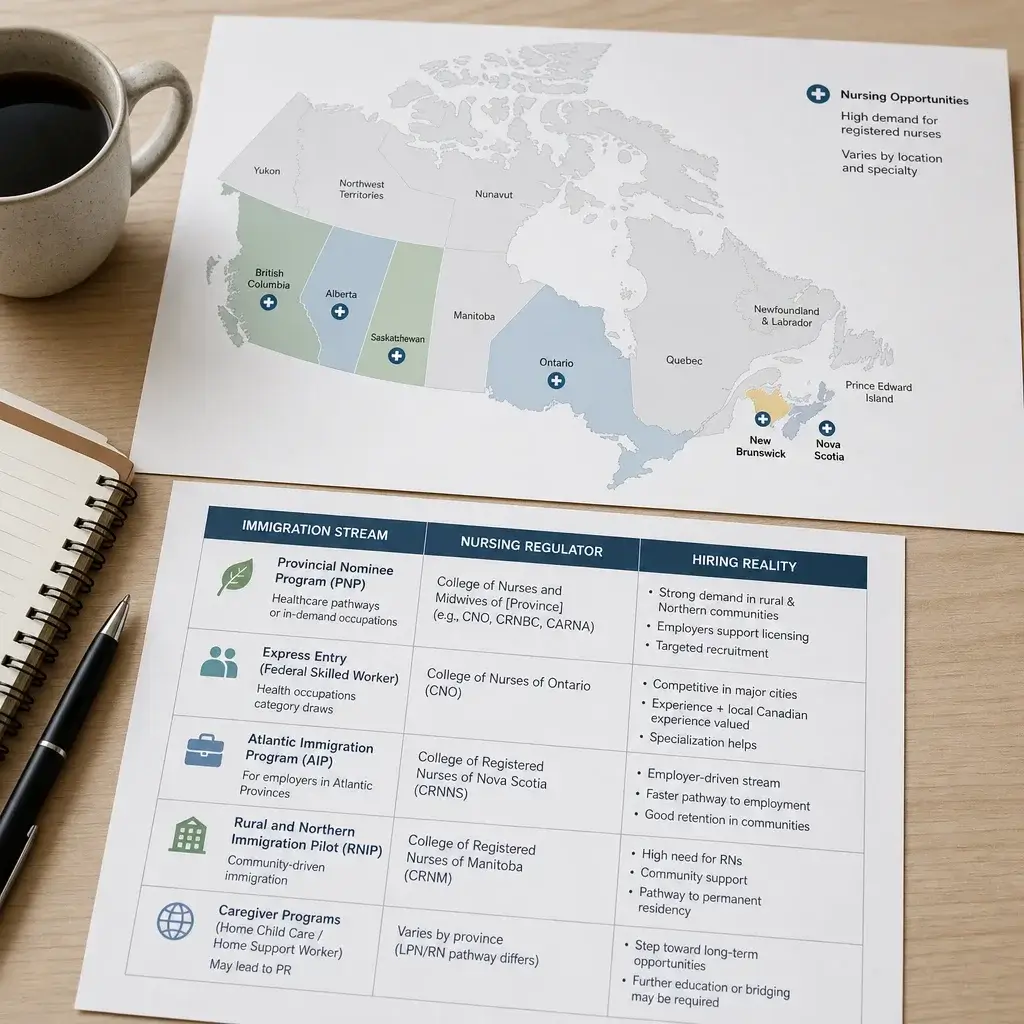
The best province is the one that matches both your immigration profile and your licensing reality. That is why broad claims about the “easiest province” usually mislead people.
Ontario is often attractive because of size, hiring volume, and the Toronto/GTA market, but Ontario is not automatically the fastest or simplest route for every nurse. You still have to check Ontario’s provincial immigration options, the College of Nurses of Ontario registration rules, and actual hiring conditions in your intended setting.
British Columbia, Alberta, Saskatchewan, Manitoba, Nova Scotia, New Brunswick, and Atlantic-focused pathways can all be good fits depending on your occupation, employer support, language level, and readiness to settle there. A province may look easier on paper but be harder in practice if the regulator requires more from your file or if the local job market is narrower than the headlines suggest.
A useful province comparison uses three lenses every time: the immigration stream, the nursing regulator, and the hiring reality. If one of those three is weak, the whole plan gets weaker.
Official-source callout: verify current PNP streams directly with the province, and verify current registration rules with that province’s nursing regulator before you commit to a province.
Licensing and Registration: What Nurses Must Do Before Working

Permanent residence does not let you practise nursing in a regulated role by itself. To work as an RN, RPN, LPN, or similar regulated nurse role, you must meet the registration requirements of the nursing regulator in the province where you intend to work.
The usual licensing sequence looks like this: choose the province, identify the regulator, complete any nursing-specific credential review, satisfy language or evidence-of-practice requirements, complete any exam or jurisprudence steps that apply, and then obtain registration before working in the regulated role. This is the part people skip when they search how to become a nurse in Canada for international nurses.
The timeline is rarely short. Licensing steps commonly run from several months to more than 1 year, depending on the province, document availability, whether extra education or remediation is required, and whether you need to repeat tests or exams. Immigration approval can arrive before licensing is finished, which is why planning the gap matters.
RN, RPN, and LPN pathways are not interchangeable. Each province sets its own registration standards, and the requirements can differ by role, practice history, education comparability, and recency of practice. If you are a psychiatric nurse or another specialized category, the province choice matters even more.
NNAS, ECA, Language Tests, and NCLEX: What Each One Is For
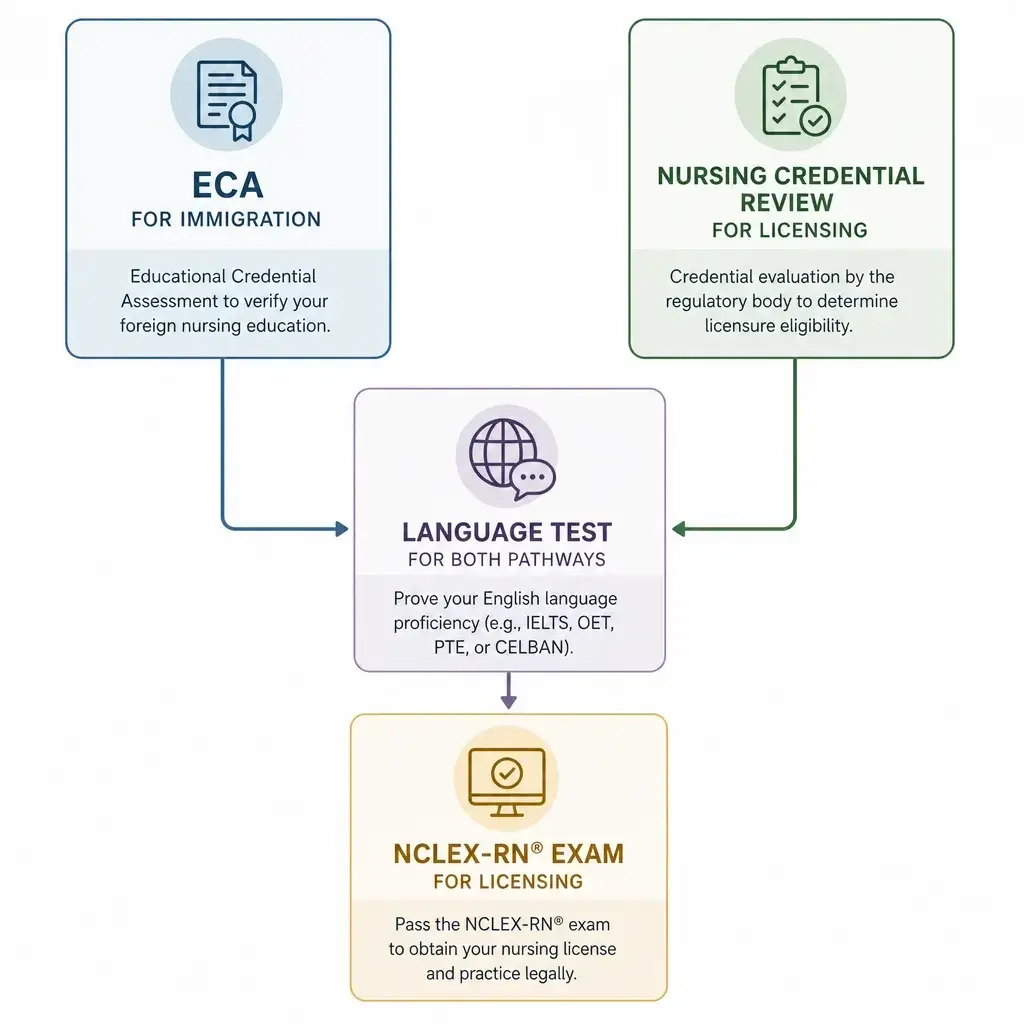
You may need both an ECA and a nursing-specific assessment because they do different jobs. This is one of the most common points of confusion in registered nurse immigration requirements.
An ECA is generally used for immigration to assess your education for federal points or eligibility. NNAS-related processes are generally used in nursing licensure to help regulators review nursing education and practice background. One supports immigration. The other supports registration. In some files you need both.
Language testing also splits into two tracks. Immigration uses approved federal language tests. A nursing regulator or employer may accept the same test, a different test, or require separate proof based on current registration rules. That is why you should never assume one language result covers every step.
Whether you must retake the NCLEX depends on the province, the regulator, your past exam history, and how your credentials are assessed. There is no single Canada-wide answer that fits every internationally educated nurse.
| Requirement | Mainly for immigration | Mainly for licensing | Who checks it |
|---|---|---|---|
| ECA | Yes | Usually no | designated immigration assessment body / IRCC process |
| NNAS or nursing credential review | No | Yes | nursing assessment body and provincial regulator |
| Language test | Yes | sometimes also yes | IRCC and sometimes regulator or employer |
| NCLEX or other exam step | No | Yes | provincial regulator |
Official-source callout: confirm current NNAS use, accepted language tests, and exam recognition with the regulator in your target province.
PR-First vs Work Permit-First for Nurses
PR-first is usually better when your score is already competitive or a provincial nomination is within reach. It gives you more long-term stability, more mobility after landing, and less dependence on one employer.
Work permit-first is often better when an employer is ready now, your move is time-sensitive, or your current CRS is too weak for a direct PR strategy. It can be a practical bridge if you expect Canadian experience to improve your future PR options.
The tradeoff is real. PR-first can take several months to more than 1 year before landing, depending on the route and current processing conditions. Work permit-first can get you to Canada sooner in some cases, but it can also leave you tied to one employer, one role, or one status problem if the longer-term PR plan is weak.
I usually tell clients to choose the route that solves the whole problem, not just the first 90 days. If you have urgent family timing, expiring test results, a low CRS, or licensing delays, get the strategy reviewed before you commit.
Step-by-Step Roadmap: From Immigration to Licensure to Employment

The safest roadmap is usually seven steps in order. First, confirm your likely immigration options. Second, identify the province that fits both your immigration profile and your nursing category. Third, start your language testing and education assessment planning. Fourth, begin the nursing regulator or NNAS-related process if your province requires it. Fifth, choose PR-first or work permit-first based on your actual profile. Sixth, gather your full document package early. Seventh, line up realistic employment options that match your current registration status.
This order matters because each stage affects the next. If you choose the wrong province first, you may repeat registration work. If you delay employment letters, your Express Entry or PNP file can stall. If you assume you can work as a nurse immediately after landing, your finances can take a hit.
A strong roadmap also leaves room for interim options. Some clients arrive with a long-term goal of RN registration but work first in a lawful, non-regulated healthcare role while they complete additional requirements. That is not ideal for everyone, but it is better than arriving with no bridge plan at all.
What If You Qualify for Immigration but Not Yet for Licensure?
That situation is common, and it does not automatically kill the plan. It means you need a two-track strategy instead of a one-track assumption.
Your lawful options may include immigrating first and completing registration later, working in a non-regulated healthcare role while you bridge the gap, pursuing further education or remediation, fixing recent-practice issues, or choosing a province where your profile is a better fit. The right option depends on your exact file and the regulator’s current rules.
What fails is magical thinking. If you are not yet eligible to work as a licensed nurse, do not build your finances, housing, or family move on the assumption that you will be practising right after arrival. In my office, this is one of the clearest planning errors I try to catch early.
If you are researching a free bridging program for internationally educated nurses in Canada, verify whether it is actually free, whether it is pre-arrival or post-arrival, and whether it helps with licensure, employment, or both. Those details change from program to program.
Costs for Nurse Immigration to Canada

Most nurses should budget several thousand dollars to well over ten thousand dollars in combined immigration, licensing, and relocation costs, depending on pathway, province, family size, and how many assessments or retests are needed. A solo applicant on a straightforward file may spend far less than a family handling both PR and licensing steps together, but this is not a cheap process.
The main cost categories are immigration filing fees, language tests, ECA fees, nursing credential review or NNAS-related fees, provincial regulator charges, exam fees, police certificates, immigration medicals, translations, courier costs, settlement funds where required, relocation, and job-search expenses. Those categories apply whether your route is Express Entry, a PNP, or a work permit strategy.
A practical planning range for pre-arrival process costs alone is often about CAD $4,000–$12,000 for one applicant before major relocation expenses, and higher when a spouse, children, repeat testing, or multiple regulatory steps are involved. I would not rely on a narrower number without seeing your file.
Legal fees can add to that, but the fair answer is qualitative unless the firm has a published pricing range. Complexity moves the number: prior refusals, family members, low-score strategy work, work permit layering, and licensing overlap all push costs up.
Timeline: How Long It Can Take a Nurse to Immigrate and Start Working
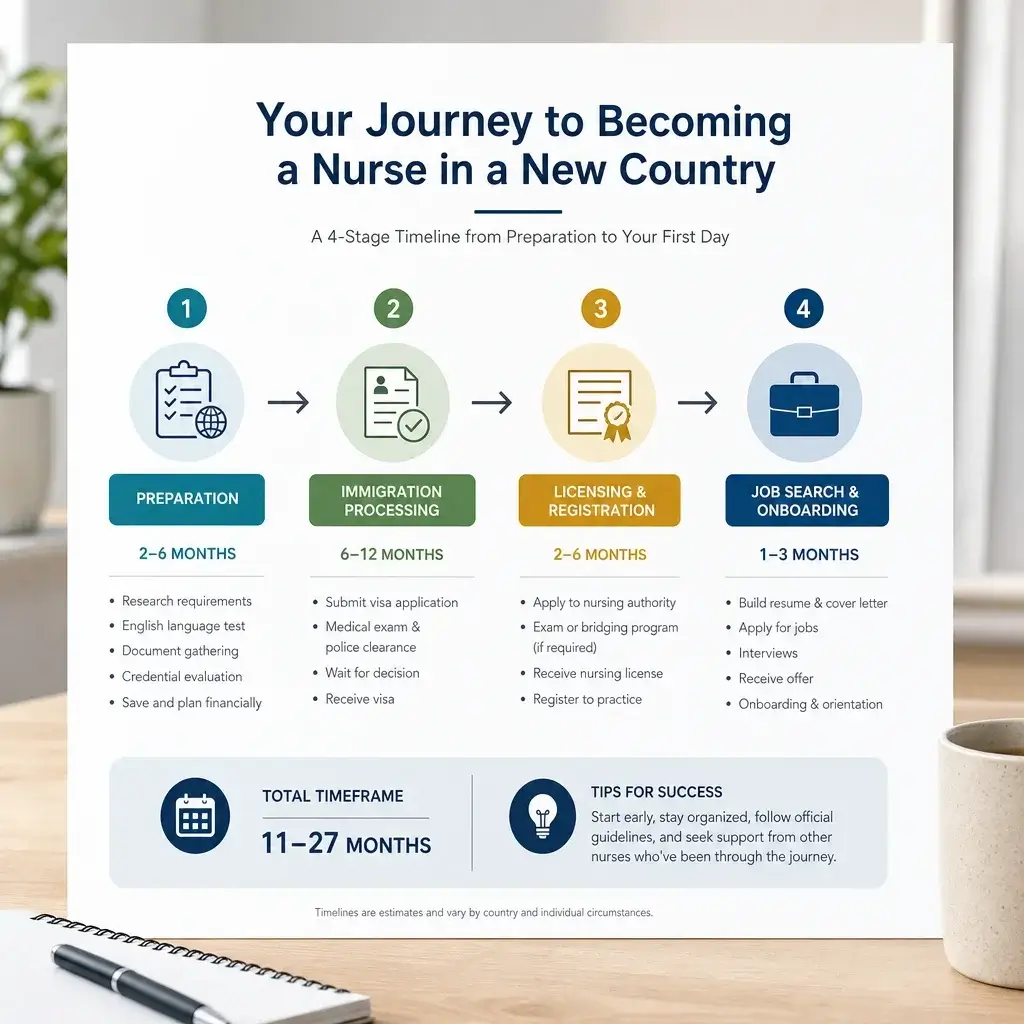
Most nurse files move in stages, and the full move-to-work timeline is usually longer than the immigration approval timeline alone. That is the honest way to look at how long it takes to immigrate to Canada as a nurse.
Preparation commonly takes about 1–6 months while you book language testing, collect civil records, request education documents, sort out employment letters, and decide on the right pathway. Some files move faster. Others drag because institutions abroad are slow or documents do not match.
Immigration processing can run from several months to more than 1 year depending on the route, current IRCC or provincial backlogs, medicals, police certificates, and whether extra review is triggered. A work permit route and a PR route also move on different clocks.
Licensing and registration often take several months to more than 1 year on their own, especially when a regulator asks for more evidence, a language retake is needed, or additional education becomes part of the picture. This is why a nurse’s actual start-work date is often later than expected.
Job search and onboarding can add another few weeks to a few months depending on your province, setting, interview timing, and whether you are applying into regulated or non-regulated roles. If your plan has no room for delay, it is probably too optimistic.
Nurse Salaries and Job Outlook in Canada
Canada continues to hire nurses, but demand and pay vary a lot by province, setting, specialization, and registration status. Licensed RN roles generally pay more than non-regulated support roles, and urban wages do not always go further once cost of living is factored in.
If you are asking how much nurses get paid in PR, the better question is how much a permanent resident nurse earns after becoming licensed in the role they trained for. PR status itself does not set your wage. Your province, union environment, shift structure, and role do.
Registered nurse jobs in Canada for foreigners do exist, but your employability improves sharply once your licensing path is clear. A province with slightly lower wage headlines may still be the better choice if registration is smoother and housing is more manageable.
For current wage data and labour outlook, use federal and provincial labour market sources instead of social media claims. Salary screenshots online are one of the least reliable parts of this research process.
Support Programs, Bridging, and Settlement Help for Internationally Educated Nurses

Support programs can help with licensure navigation, exam preparation, job readiness, settlement planning, and mentoring. They are worth checking because nursing and immigration is not just paperwork; it is also adaptation to a new professional system.
Programs described as PASS program for nurses, bridging programs, newcomer employment services, and healthcare-focused settlement supports may be available before arrival, after arrival, through a province, through an employer, or through a community organization. Availability changes, and names change, which is why you need to verify current access rules.
Use this checklist before you join a program:
- who can apply now
- whether you need PR, a work permit, or only an application in process
- whether it is pre-arrival or post-arrival
- whether it is free, subsidized, or paid
- whether it helps with licensure, employment, or both
- whether it is province-specific
I would treat any claim about a “free bridging program” carefully until you confirm the actual funding and eligibility terms. Some supports are free. Others are only partly funded. Others are free only for a narrow group.
Spouse, Children, Healthcare, and Life After PR
Many nurse applicants can include a spouse and dependent children in the immigration plan, subject to the rules of the route they use. Family inclusion can affect document volume, processing strategy, costs, settlement funds, and timelines.
A spouse may also have separate status or work options depending on the program and the stage of the process. That part needs careful planning if your family depends on two incomes or if children will move at the same time.
Public healthcare is not automatic in exactly the same way across Canada. Province, status, and timing matter. Some newcomers have immediate access in some provinces, while others may face waiting periods or practical gaps that require private coverage planning. Never assume healthcare starts the day you land everywhere in Canada.
After 5 years of PR, the key issues are usually maintaining permanent resident status through the residency obligation and, for some people, assessing whether they may later qualify to apply for citizenship. Those are separate questions. If that part matters to your family strategy, get current advice based on your travel history and status timeline.
Common Mistakes and Rejection Risks for Nurse Applicants
Most avoidable failures come from mismatch, poor proof, or bad assumptions. The biggest recurring mistakes are using the wrong NOC, assuming licensure equals immigration eligibility, assuming immigration approval equals licence readiness, filing weak work letters, letting tests expire, relying on shaky job offers, and ignoring province-specific registration rules.
Complex cases need more care. A low CRS, prior refusal, family complication, work-history gap, status issue, or inconsistent nursing documents can turn a simple file into a risky one fast. Those are the situations where self-filing can cost more later than getting the strategy right early.
Use this pre-submission checklist:
- correct occupation coding
- work letters that match duties, dates, hours, and pay
- valid language results on filing date
- education and assessment documents consistent across systems
- police and medical timing checked carefully
- province and regulator rules reviewed directly from official sources
- backup plan if licensure will lag behind immigration
2026 and TR to PR Questions: What Nurses Should and Should Not Assume
Do not build your plan around an unannounced TR to PR program. If something new opens, it will be announced by the government. Until then, it is not a strategy.
That answer covers a lot of search terms at once: Is TR to PR coming again in Canada? Will TR to PR open again in 2026? Is there any TR to PR coming? No one can responsibly promise that. The right move is to plan under pathways that exist now.
The same goes for predictions about Express Entry Canada 2026, future score drops, or which province will be easiest. Immigration policy can change quickly, and healthcare-related selection can shift with little warning. Use current IRCC and provincial information, not forecasts dressed up as facts.
Official-source callout: monitor IRCC news releases, current program pages, and official provincial immigration updates for real changes.
When to Speak With an Immigration Lawyer
Legal help matters most when the path is not obvious. That usually means low CRS, a choice between Express Entry and a province, a job offer that may or may not help, a prior refusal, family members coming with you, or a gap between your immigration eligibility and your nursing licence readiness.
What I do in these files is not magic. I compare the available pathways, check where the real pressure points are, map the document strategy, and try to stop avoidable refusals before they start. That is especially useful in registered nurse immigration cases because the file often sits at the intersection of immigration law, regulated professions, and family planning.
If you are unsure which route fits, a free assessment is a sensible next step. Bring your work history, education details, language results if you have them, family information, and the province you are targeting. A clear plan at the start usually saves money and time later.
FAQ
Can I immigrate to Canada as a nurse?
Yes. Nurses may qualify through Express Entry, PNPs, or employer-supported work permit routes. The catch is that immigration approval and nursing licensure are separate.
How can a nurse get PR in Canada?
The usual routes are Express Entry, a provincial nomination, or a work permit-first strategy that later leads to PR. The best route depends on your score, occupation, province, and employer support.
Are nurses eligible for Express Entry in Canada?
Many are. Eligibility depends on your occupation, work history, language results, education, and the current federal rules.
Do nurses need a job offer to immigrate to Canada?
No. Many nurses can apply without one. A job offer may still help in some PNP or work permit situations.
How long does it take for a nurse to immigrate to Canada?
A realistic full process can run from several months to well over 1 year once you include preparation, immigration processing, and licensing. Straight immigration approval alone is not the full answer.
Do internationally educated nurses need both an ECA and NNAS?
Sometimes yes. An ECA is generally for immigration, while NNAS or a similar nursing assessment process is generally for licensure.
Do I have to retake the NCLEX if I move to Canada?
Maybe, but not always. The answer depends on the province, regulator, and your past exam and registration history.
Which province is best for nurse immigration to Canada?
There is no universal best province. The right province is the one that fits your immigration profile, regulator requirements, and employment reality.
Can I immigrate first and get licensed later?
Yes, that is possible in some cases. But you need a plan for what you can lawfully do while licensing is still in progress.
Can my spouse and children come with me if I immigrate as a nurse?
Often yes, depending on the route. Family members affect cost, paperwork, and strategy.
Is Canada still hiring foreign nurses?
Yes, but demand is uneven across provinces and employers. Being hireable still depends on registration status and immigration status.
Is there a free bridging program for internationally educated nurses in Canada?
Some supports may be free or funded, but you need to verify current eligibility, province, and what the program actually covers.
If your file sits between strong and borderline, do one thing next: map your immigration path and your licensing path on the same page. That is where good nurse plans usually start.