

The RNIP process is closed to new applications. An old job advertisement or community recommendation cannot reopen it. The Rural and Northern Immigration Pilot ended on August 31, 2024. New applicants considering rural permanent residence need to understand the Rural Community Immigration Pilot, or RCIP.
RNIP status: what closed and what replaced it
RNIP was a community-based pathway to Canadian permanent residence. Participating communities recommended workers who met federal requirements and local economic needs. Immigration, Refugees and Citizenship Canada, or IRCC, made the final permanent residence decision.
Applications submitted before the closure can still be processed. However, an unused RNIP recommendation does not create a right to file now. A pending application and an unfiled recommendation are different situations.
RCIP builds on the rural immigration model, but it is a separate program. It requires a qualifying offer from a designated employer, a community recommendation and a federal permanent residence application. An old RNIP employer approval or recommendation does not automatically transfer.
At Sutton Law, I’m Alex Sutton. My first step is to separate historical RNIP paperwork from an available application route. We review the submission record, employer, occupation and community before preparing a strategy. That avoids building a new application around a closed program.
RNIP versus RCIP: which process applies to you
Your filing history determines whether RNIP remains relevant. Someone with a pending RNIP application needs to manage that file. Someone starting now needs a current pathway, such as RCIP, rather than archived RNIP requirements.
| Issue | Historical RNIP | RCIP |
|---|---|---|
| New applications | Closed | A current rural immigration pathway, subject to local intake |
| Employer role | Provide an eligible offer and meet community requirements | Obtain community designation and provide an eligible offer |
| Local selection | Community assessed and recommended candidates | Community assesses candidates linked to designated employers |
| Federal decision | IRCC decided permanent residence | IRCC decides permanent residence |
| Transfer between programs | No automatic transfer | Requires its own eligibility assessment and application |
| Local availability | Historical participation does not reopen RNIP | Priority occupations, allocation and intake control local access |
These programs separate local selection from federal approval. A community recommendation supports an application; it does not grant immigration status or guarantee permanent residence.
The federal RNIP program information explains the former pathway. The RCIP program information describes the separate rural pathway, including candidate and employer requirements.
The RNIP process and the current RCIP process
The historical RNIP sequence ran from an eligible job offer to community recommendation, then federal filing. RCIP adds an essential employer-designation stage before the employer can support a qualifying candidate.
RCIP process flow:
Participating community and priority occupation → employer designation → eligible job offer → candidate eligibility assessment → community recommendation application → recommendation issued → complete PR application to IRCC → federal processing → permanent residence decision.
Each stage needs its own evidence. Designation does not establish the worker’s eligibility. A signed offer does not establish qualifying experience. A recommendation does not replace police certificates, medical requirements or federal admissibility assessment.
I tell clients to resolve occupation classification before requesting recommendation. A mismatch between actual duties, work references and the offered position can undermine both local selection and federal eligibility. Copying a convenient job title into every document does not fix that mismatch.
Candidate eligibility: the federal foundation
Candidates need to satisfy both federal requirements and the community’s selection criteria. Under RCIP, the core requirements include qualifying work experience or a graduate exemption, education, language results, an eligible designated-employer offer, settlement funds where required, and genuine intent to live in the community.
Use this eligibility checklist before assembling the application:
- Employment: A qualifying offer within the participating community.
- Experience: Eligible paid work, unless a qualifying graduate exemption applies.
- Education: A qualifying Canadian credential or assessed foreign equivalent.
- Language: Approved test results meeting the offer’s TEER threshold.
- Funds: Accessible settlement money, unless the working-in-Canada exemption applies.
- Settlement: Evidence supporting a genuine plan to live locally.
- Selection: A recommendation issued through the community’s process.
Meeting the federal minimum does not secure a recommendation. Communities select within their allocation and local priorities. An eligible worker can still fall outside the occupations, sectors or intake being accepted.
Work experience and international graduate exemptions
Historical RNIP required at least 1,560 hours of eligible paid experience during the preceding three years. RCIP also uses a qualifying year of work experience within the preceding three years. Part-time work can contribute, but accumulating hours quickly does not eliminate the required period of experience.
Qualifying experience can come from Canada or abroad. Canadian work must have been authorized. Employment letters should identify dates, hours, pay and actual duties, supported by records such as pay statements, contracts and tax documents.
Self-employment does not count toward the qualifying work-experience requirement under RNIP or RCIP. Unpaid internships and volunteer work do not count either. Calling a contractor an employee will not resolve records showing a self-employed business relationship.
A qualifying graduate from a public post-secondary institution in the recommending community can receive a work-experience exemption. Under historical RNIP, one route required a full-time program lasting at least two years, graduation within 18 months before the PR application, and residence in the community for at least 16 of the preceding 24 months.
Historical RNIP also provided a route for qualifying master’s or higher graduates. They needed full-time study, graduation within the relevant 18-month period, and residence in the community throughout the program. Programs dominated by language study or distance learning, and certain return-home scholarships, were excluded.
RCIP has its own community-graduate exemption, including program, graduation and residence conditions. A Canadian diploma alone is insufficient: the institution’s location, study history and residence must fit that exemption. The exemption removes qualifying work experience, not the remaining eligibility requirements.
Education and ECA requirements
The education baseline is a Canadian secondary-school credential or higher, or a foreign credential assessed as equivalent. A foreign qualification needs an Educational Credential Assessment, or ECA, from an organization designated for immigration purposes.
An ECA must be less than five years old when the permanent residence application is submitted. A university transcript or professional licence is not a substitute. The report must establish the required Canadian educational equivalency.
A qualifying Canadian credential does not need an ECA. However, using Canadian education to satisfy the education requirement differs from claiming a community-graduate work-experience exemption. The latter also requires the relevant study and residence conditions.
Eligible job offers: what works and what fails
A qualifying offer must be genuine, full-time, non-seasonal and indeterminate. Indeterminate means no predetermined end date. Full-time means at least 30 paid hours weekly. RCIP also requires the employer to hold designation in the participating community.
The offered wage must meet the applicable Job Bank wage requirement for the occupation and location. The job must fit the program’s occupation-matching rules and the applicant’s ability to perform it. A high salary cannot repair an ineligible employer or occupation.
| Job-offer example | Assessment |
|---|---|
| A designated manufacturer offers an ongoing local position matching the candidate’s qualifying background | Potentially eligible, subject to wages, duties and community priorities |
| A tourism business offers work only during its operating season | Ineligible seasonal offer |
| A business offers a fixed-term contract ending after a project | Does not meet the indeterminate-offer requirement |
| A Toronto employer permits remote work from a participating town | Not enough: the offer must satisfy the pilot’s local employer and work-location requirements |
| An agency offers placement through another business | Temporary placement arrangements do not satisfy the qualifying employer model |
| A worker buys a business and offers themselves a position | Ownership and control restrictions require separate assessment; this is not a self-sponsorship shortcut |
These examples turn on the employment arrangement, not the occupation’s reputation. Hospitality, manufacturing or health-care work is not automatically eligible. Employer designation, priority occupation, wage, location and candidate qualifications still control.
NOC, TEER and language requirements
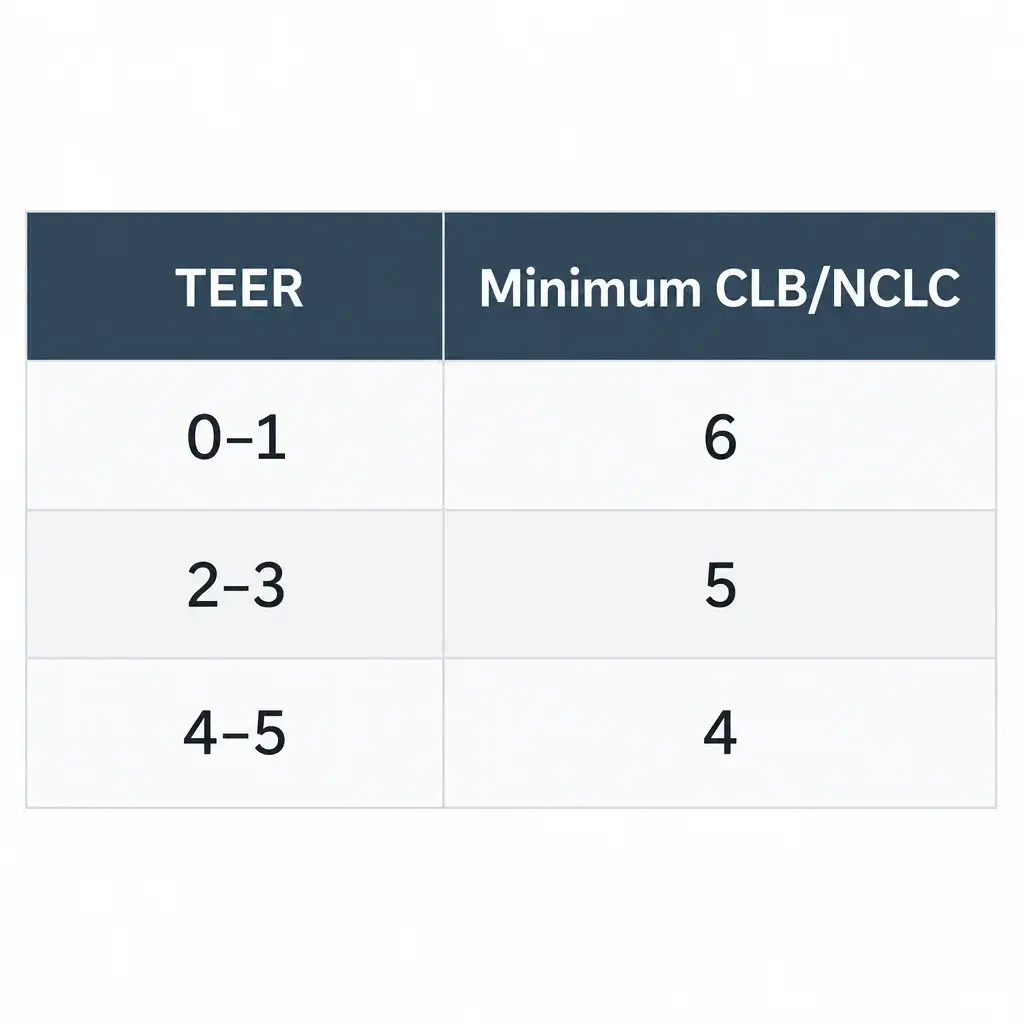
The National Occupational Classification, or NOC, classifies jobs by their duties. TEER describes the training, education, experience and responsibilities associated with an occupation. The correct classification follows the work performed, not whichever title produces a lower language requirement.
Historical RNIP and RCIP use the following minimum language levels according to the offered job’s TEER category. Applicants must meet the threshold in speaking, listening, reading and writing. CLB measures English; NCLC measures French.
| Offered job’s TEER category | Minimum CLB or NCLC in each ability |
|---|---|
| TEER 0 or 1 | 6 |
| TEER 2 or 3 | 5 |
| TEER 4 or 5 | 4 |
The categories and minimum scores above are federal language thresholds, not community selection guarantees. A community can select candidates using additional priorities even where an applicant meets the minimum.
You can avoid IELTS by taking another approved test, not by submitting no test. Approved English options include CELPIP-General and PTE Core; IELTS must be General Training. Approved French options include TEF Canada and TCF Canada. Results must be less than two years old when required for the application.
A degree taught in English does not replace the approved language-test requirement for these pilots. Nor does an overall test score cure a reading or writing result below the required level.
Settlement funds and acceptable financial evidence
Settlement funds must support the applicant and counted family members after arrival. The required amount follows the applicable program’s family-size table. Historical RNIP figures should not be reused for an RCIP application. Family size includes a spouse or partner and dependent children, including those not accompanying the applicant.
Applicants already working legally in Canada are exempt from the settlement-funds requirement under these pathways. A visitor record, study permit or unused work permit alone does not establish that someone is working legally. Employment and authorization records establish the exemption.
Bank letters and account records should show ownership, balances and access to the money. Borrowed funds and property equity do not satisfy the requirement for available settlement funds. Large recent deposits need a documented source, such as a completed asset sale.
Former RNIP communities and participating RCIP communities
The former RNIP communities are historical, not reopened application destinations. Their names still appear in older recruitment posts and search results. Participation in RCIP must be assessed separately.
| Province | Former RNIP communities |
|---|---|
| Ontario | North Bay; Sudbury; Timmins; Sault Ste. Marie; Thunder Bay |
| Manitoba | Brandon; Altona/Rhineland |
| Saskatchewan | Moose Jaw |
| Alberta | Claresholm |
| British Columbia | Vernon; West Kootenay |
These were the participating RNIP locations; the program’s closure applies across that list.
RCIP’s participating communities include the locations below. Community participation does not mean every employer, occupation or address within the surrounding region qualifies. Each program has defined boundaries and local selection priorities.
| Province | RCIP communities |
|---|---|
| Nova Scotia | Pictou County |
| Ontario | North Bay; Sudbury; Timmins; Sault Ste. Marie; Thunder Bay |
| Manitoba | Steinbach; Altona/Rhineland; Brandon |
| Saskatchewan | Moose Jaw |
| Alberta | Claresholm |
| British Columbia | West Kootenay; North Okanagan Shuswap; Peace Liard |
The locations above are RCIP participating communities, not a statement that every local intake is open. Ontario community information is published through local organizations, including North Bay, Welcome to Sault Ste. Marie and Thunder Bay Community Economic Development Commission.
Toronto employment does not become rural employment because the applicant plans to move. The qualifying employer and offered work must satisfy the participating community’s requirements. That distinction matters for GTA workers considering a relocation.
Employer designation under RCIP

Employer designation is the community’s approval for a business to participate in RCIP. It is separate from selecting an individual worker. The community assesses the business’s operations, compliance, hiring needs and ability to support newcomers.
Employers generally need an established business operating in the community, good standing under employment and occupational health and safety rules, and a genuine need for the position. RCIP also requires employer training and settlement-support commitments. Recruitment evidence and priority-sector alignment form part of the designation assessment.
An employer’s designation file should address:
- Business registration, ownership and local operating history.
- Workplace location and the proposed occupation.
- Recruitment efforts and the unmet labour need.
- Payroll, employment terms and compliance records.
- Required training and newcomer settlement arrangements.
- Community designation forms and supporting declarations.
An undesignated employer cannot support an RCIP recommendation merely by signing an offer. The business needs designation first. If designation is unavailable, the worker needs another qualifying employer or a different immigration route. An LMIA does not substitute for RCIP designation.
Finding a designated employer without buying a job
Community-published designated-employer lists and local economic-development job portals provide a focused starting point. Job Bank and direct employer applications can identify vacancies, but a job advertisement alone does not establish designation or RCIP eligibility.
Target employers whose vacancies match both your experience and the community’s priority occupations. Prepare a Canadian-style résumé, detailed employment references, language results and education records. That lets the employer assess whether the position can support a recommendation rather than simply fill a vacancy.
A designation list is not a list of guaranteed job offers. Employers still recruit and assess candidates. Payment for an offer, a recommendation or guaranteed permanent residence is a serious fraud signal; none of those purchases establishes eligibility.
Getting a community recommendation
A community recommendation confirms that the community supports the candidate under its selection process. The community assesses federal eligibility alongside local factors such as the occupation, employer, settlement readiness and intention to reside. IRCC retains the permanent residence decision.
The recommendation application typically combines the offer, employer information, candidate eligibility documents and settlement evidence. Local processes can include scoring, an interview or requests for further documents. Not every community uses the same selection method.
Strong settlement evidence explains how the move will work. Examples include realistic housing research, a family relocation plan, local work or study history, and arrangements for a spouse’s employment or children’s schooling. Existing family ties can support the plan, but they do not replace eligibility.
Weak evidence contradicts the promised move. A plan to keep living in Toronto while presenting a distant community as the permanent destination undermines intention to reside. I would address that contradiction directly, not bury it under a generic settlement letter.
Documents for candidates and employers
Candidate documents must establish identity, eligibility, admissibility and the recommended employment. The community application and federal PR application overlap, but they are separate submissions. A document accepted locally can still require additional evidence at the federal stage.
Candidate checklist:
- Passport, civil-status documents and family information.
- Canadian immigration status and work authorization, where applicable.
- Approved language-test results.
- Canadian education records or foreign credentials and ECA.
- Employer references showing dates, hours, wages and duties.
- Supporting payroll, tax and employment records.
- Signed eligible offer and community recommendation.
- Settlement-funds evidence or proof of the exemption.
- Community forms and settlement plan.
- Police certificates and required translations, with medical examinations and biometrics completed according to IRCC instructions.
Employer checklist:
- Designation approval and applicable community forms.
- Business registration and operating records.
- Detailed job description, wage and employment terms.
- Recruitment and labour-need evidence.
- Payroll and compliance information requested by the community.
- Training records and settlement-support arrangements.
Names, dates and duties must agree across the file. A reference letter describing supervisory work and an offer describing entry-level duties require a clear explanation of the occupational match. Inconsistent forms create problems even when the underlying employment is genuine.
Processing times, costs and recommendation deadlines
There is no useful single RNIP processing time for a new applicant because RNIP is closed. For a pending file, the remaining work can include eligibility review, medical assessment, criminality, security screening and additional-document requests. Those stages, not an old recruitment advertisement, determine what remains.
RCIP timing has separate stages: employer designation, local recommendation and federal PR processing. Local intake windows, allocation limits, occupation priorities and application completeness affect the first stages. Federal workload, background checks and family circumstances affect the PR stage. A recommendation is not an expedited federal approval.
A recommendation must remain valid when the complete PR application is submitted. The certificate’s expiry date controls the filing deadline. Historical RNIP recommendations could not extend the program’s final application deadline, even where a certificate showed a later expiry.
Expiry checkpoint: Match the recommendation deadline against passport validity, language results, ECA validity and missing documents. Filing an incomplete package just before expiry can result in its return, leaving no valid recommendation for resubmission.
Costs include federal application fees, language testing, an ECA where needed, medical examinations, police records and translations. Legal fees reflect the work required: employer designation, recommendation preparation, family members, prior refusals and disputed eligibility. A quoted government fee alone does not represent the full cost of the process.
A recommendation or PR application does not itself authorize employment or extend temporary status. Eligible RCIP applicants can have access to a separate employer-specific work-permit route, subject to its requirements. Work authorization and permanent residence must be managed as separate applications.
Refusals, expired recommendations and failed designation
A community refusal requires a local-process response. The reasons might involve occupation priorities, insufficient evidence, employer eligibility or settlement intent. Any available review or resubmission follows that community’s procedure; there is no universal community appeal process.
A federal refusal requires a different analysis. Reapplication addresses an evidentiary or eligibility problem; reconsideration asks IRCC to revisit its decision; judicial review asks the Federal Court to review lawfulness and fairness. These options are not interchangeable, and reconsideration does not suspend the judicial-review deadline.
An expired recommendation normally requires a valid replacement before a new PR filing can proceed. Reissuance is not automatic: allocation, employer eligibility and candidate circumstances still matter. An expired RNIP recommendation cannot support a new application under the closed pilot.
Reapplying only helps when the problem has changed. A corrected NOC assessment, stronger employment records, updated language results or a newly designated employer can address specific defects. Resubmitting the same unsupported claim usually reproduces the same weakness.
Other permanent residence routes
The fastest suitable route follows the applicant’s profile, not the program’s reputation. Express Entry uses eligibility rules and selection scores; provincial nominee programs target provincial needs; family sponsorship requires an eligible relationship and sponsor. A work permit alone does not guarantee a later PR pathway.
Indian citizenship does not make RNIP or RCIP easier or harder as an eligibility test. Education, language, qualifying experience, employment, admissibility and community selection determine the application. The same federal program requirements apply regardless of nationality.
Frequently asked questions
RNIP availability and replacement
RNIP is closed to new applications. RCIP is a separate rural pathway, not a mechanism for reviving an old RNIP recommendation. Pending RNIP applications remain distinct from new RCIP applications.
Work experience and self-employment
Historical RNIP required qualifying paid employment unless a graduate exemption applied. Self-employed work did not qualify. Overseas employment could qualify when its duties, hours and supporting records met the program requirements.
ECAs and language tests
Foreign education generally needs an immigration ECA when used to meet the education requirement. IELTS is not mandatory specifically, but an approved English or French test is required. Canadian education does not remove that language-test requirement.
Settlement funds
The required funds follow the applicable program table and family size. Applicants working legally in Canada qualify for the funds exemption. Others must show accessible, unborrowed money rather than property equity or unexplained deposits.
Recommendation meaning and processing time
A recommendation records community support; it is not PR approval. Local recommendation processing and federal PR processing are separate stages, affected by local selection capacity, document completeness and federal admissibility work.
Expired recommendations
A recommendation that expires before a complete PR filing cannot simply be attached as though it remained valid. A replacement depends on the applicable community process. The closed RNIP program does not accept a new filing based on an expired or unused recommendation.
Designated employers
Community employer lists and local job portals identify potential RCIP employers. Designation does not guarantee a vacancy or recommendation. An employer without designation must obtain it before supporting the candidate through RCIP.
Talk to Sutton Law About Your Rural Immigration Application
Contact Alex Sutton and the Sutton Law team if you need help identifying the right rural immigration route. We can assess employer designation, prepare a community recommendation package or review a refusal. We offer a free initial assessment to discuss your documents and next steps.