

Not every LMIA-exempt permit is open. Closed LMIA-exempt work permits are common in Canada, and the difference matters because it changes who can hire you, what documents you need, and whether an employer must file through the government portal.
A closed LMIA-exempt work permit is an employer-specific permit issued without a Labour Market Impact Assessment because the job fits a recognized exemption category under the International Mobility Program.
What Are Closed LMIA-Exempt Work Permits in Canada?
A closed work permit in Canada is tied to a specific employer and usually lists conditions such as the employer name, job, location, or period of authorized work. LMIA-exempt means the employer does not need to obtain an LMIA before the work permit is issued because the case falls under a recognized exemption in law, regulation, or public policy, usually under the International Mobility Program.
An LMIA-exempt work permit is not automatically open. Some LMIA-exempt permits are closed, and some are open, which is why people searching whether an LMIA exempt work permit is open or closed keep finding conflicting answers. The right way to classify it is to ask two separate questions: is it employer-specific, and is an LMIA required.
A closed LMIA-exempt permit is usually the right label when a worker has one employer, one qualifying exemption category, and an employer-side submission through the Employer Portal unless that category is itself exempt from the portal or compliance fee. Your actual eligibility depends on the exact exemption code, your status, the job offer, and the evidence filed with the application.
Closed LMIA-Exempt vs LMIA-Based Closed vs Open Work Permits
These three permit types solve different problems. A closed LMIA-exempt permit avoids the LMIA but still ties the worker to one employer; an LMIA-based closed work permit usually relies on the Temporary Foreign Worker Program; and an open work permit usually lets the worker change employers without first getting a new employer-specific permit.
| Permit type | Employer-specific | LMIA required | Usual program | Employer portal step | Typical example | Family options |
|---|---|---|---|---|---|---|
| Closed LMIA-exempt | Yes | No | International Mobility Program | Often yes | CUSMA professional, intra-company transferee, Mobilité Francophone | Depends on current spouse/dependant rules |
| LMIA-based closed work permit | Yes | Yes | Temporary Foreign Worker Program | LMIA process, not IMP offer process | Employer hires after approved LMIA | Depends on current spouse/dependant rules |
| Open work permit | No | No | Separate open permit categories | No employer-specific offer needed | Spousal open work permit, PGWP, bridging open work permit where eligible | Depends on the category itself |
The easiest practical test is this: if your permit names one employer, it is closed; if the employer had to prove labour market need through an LMIA, it is LMIA-based; if no LMIA was needed because the case fits a treaty, transfer, reciprocal, public policy, or benefit category, it may be LMIA-exempt.
If you are unsure which category fits, a file review before submission is usually cheaper than a refusal. Immigration rules and public policies can change, so this is general information, not legal advice for your situation.
Who Is Eligible for a Closed LMIA-Exempt Work Permit?
Eligibility depends on the exemption category, not one universal rule. Most applicants need a genuine job offer where the stream requires one, proof they meet the category-specific conditions, admissibility to Canada, and documents that match the role actually being offered.
Many employer-specific LMIA-exempt streams still require employer involvement. The employer often submits the offer details through the Employer Portal and may need to pay the employer compliance fee, unless the category is exempt from that step. I would not assume employer support is optional just because the permit is LMIA-exempt.
Workers who may fit closed LMIA-exempt work permits include treaty professionals, intra-company transferees, French-speaking workers outside Quebec under Mobilité Francophone, some significant benefit applicants, some reciprocal employment cases, and certain religious, charitable, academic, or public-policy cases if current rules support them. The label matters less than the evidence trail behind it.
Main Categories of Closed LMIA-Exempt Work Permits Under the International Mobility Program
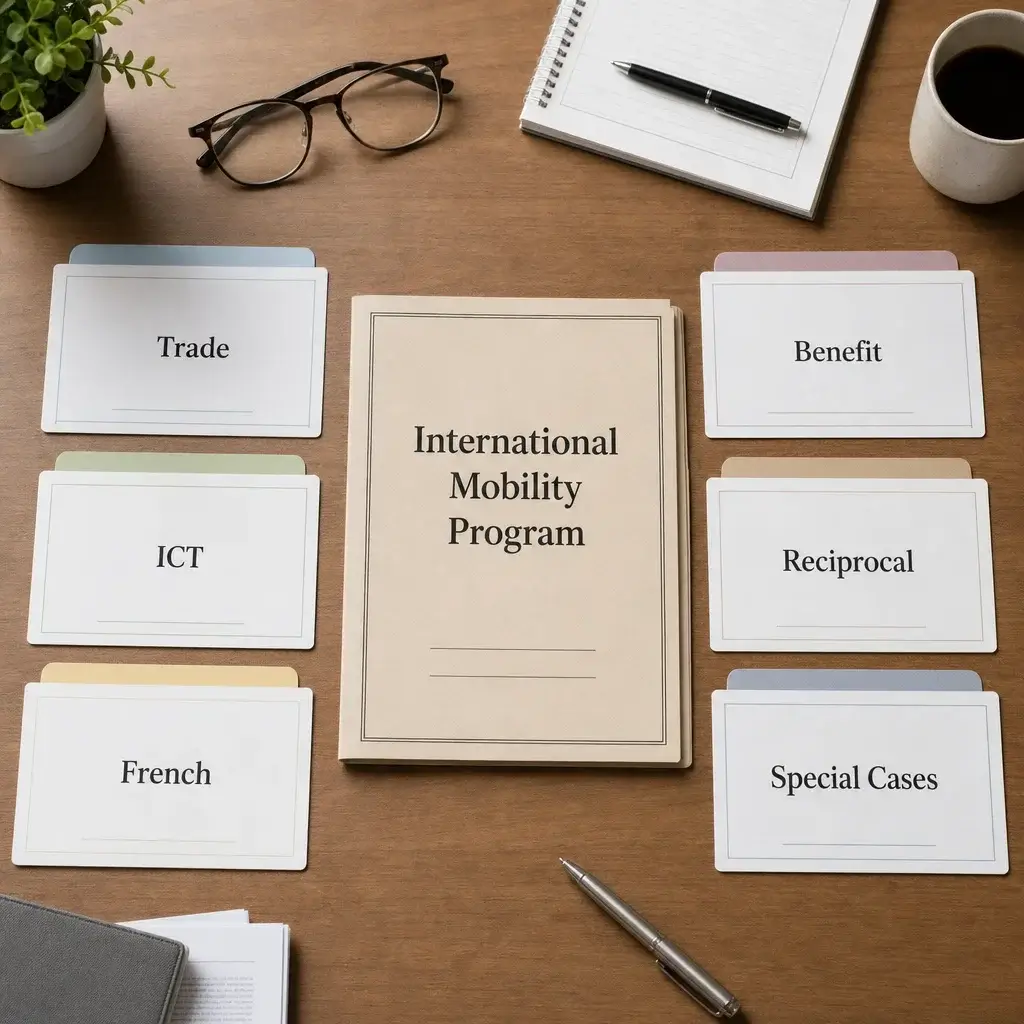
The main closed LMIA-exempt categories under the International Mobility Program include international trade agreements, intra-company transferees, Mobilité Francophone, significant benefit, reciprocal employment, and some academic, religious, charitable, or special-code cases. Not every subcategory under those umbrellas is closed, so you have to check the exact stream rather than the umbrella name alone.
| Category | Usually closed or open | Job offer needed | Common evidence | Typical issue |
|---|---|---|---|---|
| CUSMA or other trade agreement worker | Usually closed | Usually yes | Citizenship proof, job letter, category match | Role does not fit treaty class |
| Intra-company transferee work permit | Closed | Yes | Corporate relationship proof, prior employment, org chart | Weak proof of relationship or specialized knowledge |
| Mobilité Francophone | Closed | Yes | French ability evidence, job offer outside Quebec, NOC/TEER fit if required by current rules | Job or location does not meet current criteria |
| Significant benefit work permit | Often closed when tied to one employer | Often yes | Achievements, impact evidence, business rationale | Evidence is too general |
| Reciprocal employment | Often closed | Usually yes | Exchange or reciprocal program documents | Reciprocity not proven |
| Religious or charitable worker | Often closed | Usually yes | Organization documents, duties, background evidence | Role framed too broadly |
| Special code or public policy case | Depends on the code | Depends on the code | Policy-specific proof | Category assumed without current authority |
The right category is usually found by matching the legal basis of the job, the worker, and the employer relationship. There is no one-size-fits-all list, and your actual pathway depends on current IRCC instructions and the facts in your file.
How to Tell If a Specific Job May Qualify

There is no universal lmia exempt jobs list. LMIA exemption usually turns on the exemption category, treaty, employer relationship, public policy, or benefit to Canada, not just the job title.
A better method is to test six points in order: who the employer is, what country relationship or status the worker has, what the actual duties are, which NOC code and TEER level fit those duties, where the job is located, and which exemption category could legally connect those facts. That is the closest thing to decision logic in this area.
NOC and TEER still matter even when there is no single set of lmia exempt noc codes. Officers look at the real duties, not just the title printed on the offer letter, and a mismatch between the chosen NOC code and the described job is a common refusal issue. I tell people to compare duties line by line before they file.
A treaty professional under a CUSMA work permit, a manager transferred into a Canadian affiliate, a French-speaking worker hired outside Quebec, or an applicant claiming significant benefit may all be LMIA-exempt for different reasons. The same occupation title could fit one person and fail for another because the exemption is legal-category driven, not title driven.
Mobilité Francophone: Who Qualifies and Key Requirements

Mobilité Francophone is generally used for French-speaking foreign workers with job offers outside Quebec. It is typically employer-specific, which means it commonly appears as a closed LMIA-exempt work permit rather than an open permit.
The key questions are whether the job location, the worker’s French ability, and the occupational criteria meet the current IRCC rules. Those criteria can change, so I would verify the current language threshold and NOC or TEER conditions before filing rather than relying on an older summary online.
The common weak points are straightforward. Quebec job location issues, thin proof of French ability, and duties that do not match the claimed NOC code can all sink a Mobilité Francophone application even where the offer itself is real. This is one of those categories where details matter more than the label.
Intra-Company Transferees: When a Transfer Can Be LMIA-Exempt

An intra-company transferee work permit can be LMIA-exempt when the foreign business and the Canadian entity have the required qualifying relationship and the worker fits the relevant transfer criteria. This is usually an employer-specific permit, so it is commonly a closed work permit Canada employers use to move key staff into a Canadian branch, parent, subsidiary, or affiliate structure.
The usual worker profiles are executives, senior managers, or workers claiming specialized knowledge, if the current instructions still support that classification on the facts filed. Officers look closely at what the person actually does, how the companies are connected, and whether the transfer makes business sense in Canada.
The most useful evidence is practical evidence. Corporate documents, organization charts, payroll records, employment confirmation, job descriptions, and an explanation of why the Canadian entity needs that person now are more persuasive than broad statements about talent. If the corporate relationship is weak on paper, the file usually needs more detail, not less.
Significant Benefit, Entrepreneurs, and Self-Employed Applicants
A significant benefit work permit is based on evidence that the applicant’s work would create an important social, cultural, or economic benefit for Canada. It is one of the most discretionary LMIA-exempt categories, which means the evidence burden is usually heavier than people expect.
This stream is not the same as saying a business is promising or that an employer prefers one foreign worker. Officers may assess achievements, contracts, patents, awards, media coverage, investment plans, letters of support, sector need, job creation potential, and the realism of the proposed activity in Canada.
Entrepreneurs and self-employed applicants need a category-specific theory, not just a business idea. An employer-specific filing may still be closed where the work authorization is tied to a particular enterprise or role, while some self-directed cases turn on different facts entirely. I would not use significant benefit as a fallback just because an LMIA case looks weak.
Reciprocal Employment and Treaty-Based Options
Reciprocal employment LMIA-exempt work permits are based on the idea that Canadians receive similar opportunities abroad. The legal logic is different from a trade agreement case, even if both sit under the International Mobility Program.
Examples may include some exchange arrangements, performing artists, academics, or other programs where reciprocity can be shown under current instructions. The core evidence is not just the job offer but the reciprocal framework behind it.
Trade-agreement pathways such as a CUSMA work permit use a different structure. Those cases usually depend on citizenship in a treaty country, a job that fits a treaty category, and documents showing the role matches that category’s terms. If you confuse reciprocity with treaty eligibility, you can build the whole file around the wrong legal basis.
Other Possible Closed LMIA-Exempt Streams: Academics, Religious Work, Charitable Work, and Special Cases
Some academic, research, guest lecturer, visiting professor, religious worker, and charitable worker cases may qualify as LMIA-exempt depending on the exact role and the current guidance. These are not catch-all categories, and small wording differences in the job duties can matter.
Religious and charitable applications are especially fact-sensitive. Officers usually want to see the organization’s nature, the role’s duties, the applicant’s background, and why the claimed exemption code actually fits the work being proposed. Broad humanitarian language does not replace stream-specific proof.
C51 LMIA-exempt work permit questions come up in search, but the code should only be used if the current IRCC authority clearly applies to the case. If a code or public policy is temporary or narrow, assume nothing and verify it against the current source before filing.
Step-by-Step: How to Apply for a Closed LMIA-Exempt Work Permit

The process usually starts with the employer, not the worker. The employer first confirms the exemption category, prepares the offer details, and submits the offer through the Employer Portal when that step is required, then pays the employer compliance fee if the category is not exempt from that fee.
The worker then gathers identity documents, the offer of employment number where applicable, proof of qualifications, and category-specific evidence, completes the work permit application, pays the government filing fees, and submits online, from inside Canada, from outside Canada, or in limited cases at a port of entry if eligible under current rules.
Biometrics or a medical exam may also be required. Biometrics fees are charged separately from the work permit application fee, and a medical exam can be triggered by the type of work or recent residence history under current health screening rules. I cannot quote your exact process path without knowing where you are applying from and what category you are using.
A simple workflow looks like this:
- Confirm the exemption category and whether it is truly closed LMIA-exempt.
- Check whether the employer must use the Employer Portal.
- Prepare the job offer and category-specific supporting evidence.
- Submit the employer-side offer and pay the compliance fee if required.
- File the worker’s application with fees and documents.
- Complete biometrics and medicals if instructed or required.
- Respond to any request letters quickly and consistently.
Closed LMIA-Exempt Work Permit Checklist: Documents You May Need
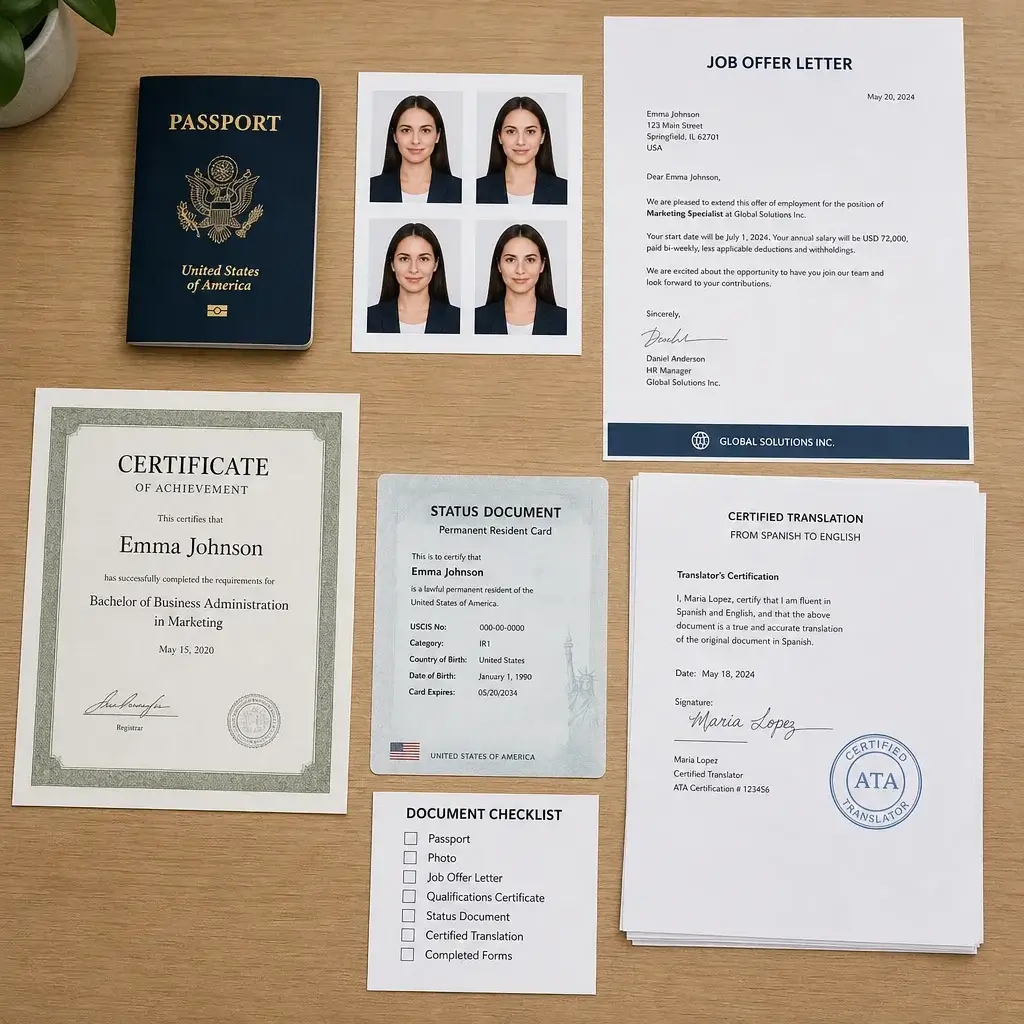
The basic LMIA exempt work permit checklist usually includes a valid passport, application forms, digital photo, job offer or offer of employment number where required, proof of qualifications, status documents for in-Canada applicants, and certified translations for any non-English or non-French documents.
Dependants add their own documents. That can include marriage or common-law proof for a spouse or partner, birth certificates for children, school records where relevant, and status records if family members are applying from inside Canada. Family options depend on the principal worker’s category and the current rules.
Category-specific evidence is where many files break down:
- Mobilité Francophone: French ability evidence, job offer outside Quebec, and documents showing the role fits current occupational criteria.
- ICT: corporate relationship proof, prior employment proof, organization chart, detailed Canadian role, and foreign role history.
- Trade agreement cases: citizenship proof, treaty-category support letter, and qualifications for the listed professional or business class.
- Significant benefit: business plan or project plan, achievements, contracts, support letters, and evidence of social, cultural, or economic impact.
- Reciprocal employment: exchange or reciprocity framework documents and employer explanation of the reciprocal basis.
Weak job letters, inconsistent duties, missing corporate proof, and unsupported exemption codes are common failure points. A checklist is not just about collecting papers; it is about making every paper prove the same theory.
Fees, Processing Times, Biometrics, and Medical Exams

Government fees usually include the work permit application fee, the biometrics fee if biometrics apply, and the employer compliance fee where the employer-side submission requires it. Exact fee totals depend on who is applying, whether family members are included, and whether a fee exemption applies, so check the current IRCC fee page before paying.
Processing times are not stable enough to treat as a fixed promise. IRCC posts processing times by application location and stream, and the real timeline can move based on filing country, biometrics completion, medical exam timing, background checks, and whether the officer needs more evidence. If timing matters, use the official processing tool on the day you file.
Medical exams are not required in every case. They can be triggered by the type of intended work, length of stay, or residence in certain countries under current screening rules. This is general information, not a legal recommendation for your file.
Restrictions, Conditions, Extensions, and Changing Employers

A closed permit restricts you to the employer and conditions written on the permit. That can include the employer name, the occupation, the location, and the authorized period of work. If the permit is employer-specific, you should not assume you can simply move to another employer and start work.
Extensions may be possible if the worker still qualifies under the same exemption or a different valid exemption and the employer completes the required steps again where applicable. A renewal with the same employer is not automatic; it is a new application or extension assessment based on current rules and current evidence.
A closed work permit does not convert into an open work permit just because you ask. An open work permit usually requires eligibility under a separate program or policy, such as a spousal category, post-graduation category, or another open-permit basis if the current rules allow it. I would compare the target category first before making any status-change plan.
If you want to change employers, the safe rule is to get the proper new authorization before starting the new job unless a current public policy or specific rule says otherwise. Never treat a new offer letter as permission to begin work.
Can Spouses or Children Get Status or Work Permits Too?

Family options depend on the principal worker’s stream, the job, the permit length, and the policies in force when the family applies. A spouse or partner may qualify for an open work permit in some situations, but not every dependant of every closed LMIA-exempt permit holder qualifies.
Children may be able to apply for visitor status or study authorization depending on age, school plans, and the family’s immigration status in Canada. The best approach is to map the whole family file together rather than treating the principal permit as the only application.
Because these rules change, I would not rely on a blanket statement that every spouse gets an open work permit. Check the current requirements tied to the principal worker’s category and status before filing.
If Your Application Is Refused: Reapply, Reconsideration, or Judicial Review?
The next step depends on the refusal reasons, your status timeline, and whether stronger evidence or a different category exists. A refusal does not always mean the worker was ineligible in principle; sometimes it means the evidence, code choice, or document set did not prove the case the officer needed to see.
A practical first move is usually to get the refusal reasons in full and consider GCMS notes, then compare the officer’s concerns against the legal category actually used. Reapplying can make sense where the record can be fixed, while reconsideration is more limited and fact-specific.
Judicial review may be worth discussing when the refusal appears unreasonable or legally flawed, but deadlines are strict and should be checked immediately based on where the decision was made. If status is expiring or a start date is at risk, urgency matters.
If you need a personalized review of the job offer, exemption category, employer steps, or family options, Sutton Law offers free assessments for workers and employers. This is educational information only, and any next step should be based on the facts of your file.
Employer Guidance: Hiring or Retaining Workers Without an LMIA
Canadian employers can sometimes hire or retain foreign workers without an LMIA if the role fits an LMIA-exempt pathway under the International Mobility Program. The key difference is that the employer is not proving labour shortage through the Temporary Foreign Worker Program; the employer is proving category eligibility under an exemption stream.
Employer compliance still matters. The offer details, wages, duties, and working conditions should match what is submitted, and employers using employer-specific IMP permits should keep records and be prepared for compliance review under the current rules. Accuracy at the start is cheaper than fixing inconsistencies later.
This comes up a lot when an employer wants to retain a worker whose current status is expiring. The answer is not to search for a generic lmia exempt jobs list but to ask whether a treaty class, transfer, Francophone stream, reciprocal basis, or another valid category applies to that actual worker and that actual role.
Common Mistakes and How to Strengthen a Closed LMIA-Exempt Work Permit Application
The biggest mistakes are choosing the wrong exemption code, using a vague job description, mismatching the NOC code to the duties, assuming family members qualify automatically, and filing an ICT or significant benefit case without enough underlying proof. These are preventable errors.
Strong applications line up every document with one legal theory. The job letter, the corporate documents, the applicant’s résumé, the treaty or category evidence, and the forms should all point to the same exemption and the same actual job. If one document tells a different story, the file gets harder to approve.
General information online can help you understand the structure, but it cannot tell you whether your facts fit a specific exemption. For urgent filings, refusals, employer compliance issues, or category uncertainty, get individual advice on the file before you submit.
FAQ
Is an LMIA-exempt work permit always a closed work permit?
No. Some LMIA-exempt permits are closed and some are open. The test is whether the permit is employer-specific and whether the exemption removes the LMIA requirement.
Who is eligible for a closed LMIA-exempt work permit in Canada?
Eligibility depends on the category. Common pathways include treaty workers, intra-company transferees, Mobilité Francophone applicants, reciprocal employment cases, and some significant benefit, religious, charitable, or academic streams where current rules apply.
Do I need a job offer for an LMIA-exempt closed work permit?
Usually yes. Most closed LMIA-exempt permits are employer-specific, so a real job offer and employer-side steps are often central to the application.
How much does an LMIA-exempt work permit cost?
Government costs can include the work permit fee, biometrics fee, and sometimes the employer compliance fee. Check the current IRCC fee schedule because totals change by applicant type and family composition.
How long does an LMIA exempt work permit take?
It depends on where and how you apply, plus biometrics, medicals, and complexity. Use IRCC’s posted processing times for your filing location rather than any fixed estimate in an article.
Can I extend a closed LMIA-exempt work permit?
Sometimes. You usually need to show that you still qualify under the same or another valid exemption and complete any required employer-side steps again.
Can I change employers on a closed LMIA-exempt work permit?
Not just by accepting a new offer. In most cases you need a new employer-specific authorization before starting with the new employer.
Can my spouse get an open work permit if I have a closed LMIA-exempt permit?
Possibly, but not automatically. Spouse eligibility depends on the principal worker’s category, occupation, permit details, and the current rules in force when the family applies.
What is the difference between LMIA-exempt and LMIA-based work permits?
LMIA-based permits rely on an approved Labour Market Impact Assessment. LMIA-exempt permits do not, because the case fits a recognized exemption under law, regulation, treaty, or public policy.
Can I convert a closed work permit to an open work permit?
Not directly. You usually need to qualify under a separate open work permit category or policy.