

Check IRCC’s processing-times tool for the current citizenship processing time. At IRCC’s October 9, 2026 update, the estimate for a citizenship grant was about 12 months, with about 322,700 people waiting. IRCC’s service standard for a citizenship grant application is also 12 months. For citizenship grants IRCC publishes a forward-looking estimate: how long a new application is likely to take, given the queue ahead of it. It is a benchmark, not your personal deadline.
IRCC counts processing time from the day it receives your complete application. Your acknowledgement of receipt (AOR) records that date, so use it as the start of your own count.
If your application is overdue, build a dated record, ask what remains outstanding and consider legal advice if the delay remains unexplained.
Citizenship backlog in numbers
Citizenship looks comparatively healthy in IRCC’s published figures, but that does not mean every application moves promptly.
| Official reporting snapshot | Citizenship figure | What it tells you |
|---|---|---|
| May 28, 2026 committee binder, referring to Q1-2026 data | 260,800 applications in inventory; 77% within service standards | Most were within standard, but not all |
| August 31, 2026 | 327,125 citizenship grant applications not yet finalized | This is an inventory count, not an overdue-file count |
The committee binder does not identify an exact snapshot date. The later monthly inventory page uses different reporting language, so these figures should not be treated as a direct measure of backlog growth.
IRCC’s service-standard goal is also 80%. Neither that goal nor a national inventory figure answers whether your delay is reasonable. For broader context, see our IRCC processing-delay guide.
The 7 stages of a citizenship application
Use this map to organise your citizenship application status enquiries. The “stall” column suggests questions, not findings about your file; do not assume that the IRCC citizenship tracker explains why something has stopped.
| Stage | Tracker/status information to check | Possible stall to investigate | Your move |
|---|---|---|---|
| 1. Application received/AOR | Receipt confirmation and application number | Is receipt confirmed? | Save the application, submission proof and AOR |
| 2. In-process review/eligibility | Any review status or document request | Is something outstanding from you? | Compare messages with what you submitted |
| 3. Test/interview, if applicable | Invitation and completion information | Was attendance or completion recorded? | Keep invitations and completion evidence |
| 4. Background/security | Wording about checks in progress | What check remains, and is anything required from you? | Request a specific explanation |
| 5. Decision | Decision-related status or correspondence | Has a decision actually been made? | Ask IRCC to distinguish review from decision |
| 6. Oath invitation | Any ceremony invitation or scheduling message | Is the file awaiting scheduling or another assessment? | Ask which, without assuming approval |
| 7. Oath | Ceremony instructions and completion correspondence | Is any instruction or follow-up unresolved? | Keep the instructions and your responses |
There are no verified stage-by-stage durations in this guide. A forum post about someone else’s test-to-oath interval cannot establish the deadline for your application.
“Background check in progress” for months: what it means
That status is not a detailed explanation of the work remaining. Avoid inferring a security concern from the wording alone.
Practitioner summaries of Federal Court decisions report that bare assertions of ongoing security screening have been rejected as insufficient justification for prolonged delay. Those summaries also describe cases where particular screening complexities justified a longer wait.
The useful question is therefore not simply whether screening is ongoing. It is whether IRCC can explain the delay with evidence specific to your circumstances.
Ask when the outstanding check began, whether IRCC needs anything from you and what explanation it can provide. Save the answer, including any reply that gives no file-specific information.
Stuck after the test or interview?
Completing a test or interview does not, by itself, establish that every other assessment is finished. Your enquiry should distinguish a file awaiting further review from one awaiting an oath invitation.
In a web form, identify:
- Your application number and AOR date.
- Your test or interview date and completion evidence.
- The tracker’s exact wording and the date it last changed.
- Any unanswered request or document submission.
Then ask: “Is any assessment or document outstanding? Has a decision been made? Is my application awaiting ceremony scheduling, or does another issue remain?”
Keep the request factual. “Everyone else has received an oath invitation” is less useful than a clear chronology showing what happened to your application.
Your escalation steps
These steps build evidence. They are not a promise that each enquiry will move the file.
-
Send a focused web form. IRCC allows enquiries when an application is over normal processing time. It expressly says another web form will not speed processing. Save the acknowledgement; do not treat it as a substantive answer.
-
Ask your MP’s office for a case enquiry. Provide your timeline, application details and previous correspondence. IRCC’s Ministerial Centre for Members of Parliament and Senators lists enquiry service standards of one business day for critical cases, two for urgent or complex cases, up to five for time-sensitive cases and up to ten for routine cases. These are liaison standards, not citizenship decision deadlines.
-
Request your GCMS notes and personal records. A Privacy Act request for your own information is free and available to individuals worldwide. Ask for relevant officer notes, activity records and history. See our GCMS notes guide.
-
Consider a lawyer’s demand letter. A proper assessment addresses the outstanding duty, your compliance, the explanation given and a reasonable opportunity to act. It should not simply announce that the posted time has expired.
-
Assess mandamus. If the delay remains unjustified, discuss a Federal Court application with a writ of mandamus lawyer.
For a fuller enquiry sequence, see our web form and MP escalation guide.
Mandamus for citizenship: how it differs
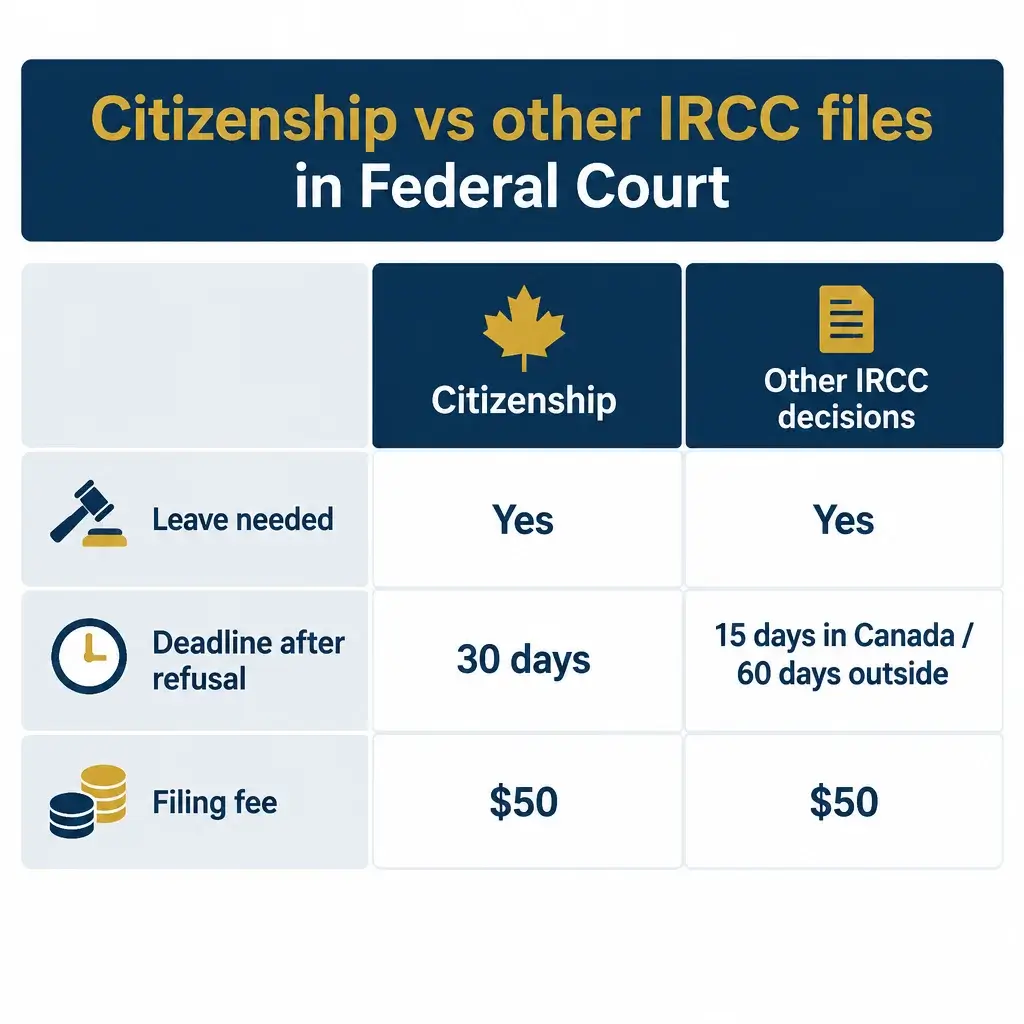
Citizenship has its own judicial-review provision. Under section 22.1 of the Citizenship Act, judicial review requires the Court’s permission, called leave.
If your citizenship application has been refused, the application for leave must be filed and served within 30 days of notification. Do not substitute the IRPA deadlines of 15 or 60 days. Nor should you read the citizenship refusal deadline as requiring a delay case exactly 30 days after the posted processing time expires.
What makes a delay case arguable?
The Court’s restatement of the mandamus requirements includes a public duty owed to you and a clear right to its performance. A prior demand and a reasonable opportunity to comply matter.
Practitioner summaries describe the unreasonable-delay assessment as asking whether the process has taken too long for its nature, whether you caused the delay and whether the authority has provided satisfactory justification.
“Twice the posted time” is a practitioner rule of thumb, not the legal test, as illustrated by published practitioner guidance. It is neither a required waiting period nor an automatic entitlement.
Mandamus forces a decision, not an approval.
What have reported citizenship cases shown?
A practitioner account reports that Habibi v Canada, 2025 FC 1675, involved a 36-month citizenship delay and resulted in mandamus with costs. The same account describes Jahazi v Canada, 2024 FC 2072, involving approximately ten years of delay and costs awarded for special reasons.
Those outcomes are not universal waiting thresholds. Separately, practitioner summaries of Tousi, 2025 FC 671, and Majidi, 2025 FC 680, report that “significant prejudice” is not a separate requirement. Evidence of the delay’s impact is still worth preserving.
What does it cost, and how long does it take?
The court filing fee is $50 under rule 23. That is not the lawyer’s fee. Request a written quote explaining the demand-letter stage, court representation, taxes and disbursements.
Under rule 22, costs are normally neither awarded nor payable unless the Court finds special reasons. The reported citizenship cases above illustrate exceptions, not a promise of reimbursement.
There is no official mandamus resolution-time figure. The Court’s August 12, 2026 special order currently adds 90 days to the usual 30-day applicant’s-record deadline, giving 120 days in total. That filing allowance is not a prediction of when your application will be resolved.
Build your delay log
A useful log separates events, sources and proof. Record exact dates where possible, and identify estimates rather than presenting them as certain.
| Date | Event | Source | Proof to keep |
|---|---|---|---|
| [Date] | Application submitted/AOR received | Submission system or IRCC email | Application copy, receipt, AOR |
| [Date] | Test, interview or tracker change | Invitation or tracker | Email and dated screenshot |
| [Date] | Enquiry sent or answer received | Web form or MP correspondence | Submission, acknowledgement, reply |
| [Date] | Specific effect of delay | Employer, travel or family records | Supporting document and explanation |
Copy this table into a document or spreadsheet and add a row every time something happens on your file.
Keep these documents together:
- Your application, supporting documents, AOR and payment receipt.
- Every IRCC request, your response and submission proof.
- Test/interview correspondence, tracker screenshots and GCMS records.
- Web forms, MP enquiries, demand letters and answers.
Document citizenship-specific effects with dates: an actual job offer requiring citizenship, travel affected by not having a Canadian passport, a missed family event or inability to vote in a particular election. Explain the connection honestly. Do not describe a hypothetical opportunity as something already lost.
What to do this week
- ☐ Check the current posted time and save a dated copy.
- ☐ Gather your AOR, correspondence and tracker screenshots.
- ☐ Confirm whether anything remains unanswered on your side.
- ☐ Send one focused enquiry if your file is overdue.
- ☐ Request your personal records and consider an MP enquiry.
- ☐ Start the delay log and collect evidence of actual consequences.
- ☐ If refused, obtain advice promptly about the 30-day citizenship deadline.
- ☐ Ask for a legal assessment if the delay remains unexplained.
Related guides
- The Canadian citizenship process, step by step
- Background check for citizenship in Canada
- IRCC tracker and GCMS notes
Frequently asked questions
How long after the citizenship test do you get the oath?
There is no verified fixed test-to-oath interval in this guide. Ask whether your test result is recorded, whether other assessments remain and whether your application is awaiting a decision or ceremony scheduling. Those distinctions are more useful than another applicant’s timeline.
Can I travel while my citizenship application is in process?
Yes, but plan around three rules. Physical presence (1,095 days in the five years before you apply) is counted up to the date you sign your application, so later trips do not change it. You must stay a permanent resident and be able to attend your test, interview and oath when invited; missing them without a good reason can stop your application. And to board a flight back to Canada you need a valid PR card or a permanent resident travel document (PRTD).
How much does citizenship cost?
On IRCC’s fee list the fee for an adult (18 and over) is $653: the processing fee plus the $123 right of citizenship fee. The fee for a minor is $100.
Citizenship application fees are separate from court filing fees and any legal fees for a delay case.
Can I file mandamus for citizenship myself?
Yes. CBA commentary explains that Federal Courts Rules, rule 119 permits an individual to act personally or through a lawyer. Self-representation still requires a proper leave application, evidence, records, service and compliance with deadlines. Immigration consultants cannot represent you in Federal Court.
Will mandamus make IRCC refuse me?
A mandamus application asks for action, not a particular merits outcome. The Court does not decide whether you qualify for citizenship through that delay remedy. Discuss any unresolved eligibility concerns before seeking an order requiring IRCC to decide.
Your file is past the posted time and nothing is moving? Sutton Law reviews your timeline and GCMS notes and tells you in writing whether a mandamus application is realistic now, later, or not at all.
Discuss your citizenship delay with Sutton Law. Immigration lawyer Alex Sutton serves clients across Canada and abroad, with consultations by video or at our Richmond Hill office (Greater Toronto Area), in English, Russian or Ukrainian.
This article is general information, not legal advice. Last reviewed: November 2026.