

For immigration judicial review, you generally have 15 days for a matter arising in Canada or 60 days for one arising outside Canada, counted from notification or awareness of the decision under section 72 of the Immigration and Refugee Protection Act. A reconsideration request does not pause that deadline. If you received a procedural fairness letter instead of a refusal, respond by the letter’s deadline before choosing a post-refusal remedy.
First 48 hours after a refusal
Your first task is to preserve your options, not immediately submit another application.
- Save the complete refusal package. Download the letter, attachments, portal messages and any officer decision notes. Keep evidence of when you received or accessed the decision.
- Find the actual reasons. Separate the officer’s concerns from your assumptions about why the application failed.
- Record the deadline immediately. Note the decision date and notification date separately. Get advice about whether the matter arose inside or outside Canada.
- Compare the reasons with your submitted application. Identify documents the officer may have overlooked, factual mistakes and genuine gaps before reapplying.
IRCC confirms a proactive officer-decision-notes initiative for select temporary-resident applicants. Practitioners report that, since July 2025, notes accompany most study permit, work permit, visitor visa and visitor-extension refusals, although coverage is not universal.
For a PGWP refusal, study permit refusal or visitor visa refusal, check those attachments first. If fuller records are needed, see our GCMS notes guide. Do not wait for GCMS notes before protecting a court deadline.
The deadline that catches people
Reconsideration and judicial review run on separate tracks. Asking IRCC to reopen your file does not suspend the original judicial-review clock.
For an immigration judicial review, a judge may extend time “for special reasons” under section 72. An extension is not automatic, and IRCC cannot grant it for you.
| Matter | Deadline to start the court challenge | Starting point |
|---|---|---|
| Immigration matter arising in Canada | 15 days | Notification or awareness |
| Immigration matter arising outside Canada | 60 days | Notification or awareness |
| Citizenship matter | 30 days to file and serve | Notification |
| Family-class sponsorship refusal with a possible IAD appeal | Confirm the applicable appeal deadline immediately | Check the refusal and appeal instructions |
Citizenship has its own rule: section 22.1 of the Citizenship Act requires leave and sets the 30-day filing-and-service period.
Your physical location when you opened the refusal does not, by itself, establish where the matter arose. Have that classification checked rather than choosing the longer period yourself.
Reconsideration requests: when they work and when they do not
A reconsideration request asks IRCC to reopen a decision it has already made. There is no statutory right to reconsideration.
IRCC’s instructions, citing Canada (MCI) v Kurukkal, 2010 FCA 230, recognise officer discretion to reconsider. They describe reconsideration as appropriate in exceptional cases; simply disagreeing with the result is not enough.
A focused request is more useful than a long account of how disappointing the refusal feels. Consider it where you can identify a clear factual error or show that a relevant document was already submitted but apparently overlooked.
What to include
Organise your request around:
- Identification: your name, application number, UCI and refusal date.
- The precise error: identify the relevant statement in the reasons.
- The evidence: point to the document and where it appeared in your original submission.
- Why it matters: explain how the error affects the refusal reasoning.
- The request: ask clearly for reconsideration and reopening.
Distinguish material already before the officer from genuinely new evidence. If your circumstances have changed, a fresh application may be more appropriate than arguing that the original decision was wrong.
Keep submission records and acknowledgements. An acknowledgement is not confirmation that IRCC has reopened the file. Protect the judicial-review option in parallel if you may need it.
For a step-by-step guide to writing the request itself, see our IRCC reconsideration request guide.
Judicial review in Federal Court
Judicial review challenges the decision or the process used to reach it. Under section 72, it begins with an application for leave, meaning the Court’s permission to proceed.
The government fee to file an immigration leave application is $50, under the Federal Courts Citizenship, Immigration and Refugee Protection Rules. That is not the total cost of legal representation. Lawyer fees vary; request a written scope explaining which stages are included.
A successful review usually means the refusal is set aside and the application returns for redetermination, generally by a different officer. It does not mean the Court grants your visa or permit.
How long does judicial review take?
If leave is granted, section 74 places the hearing between 30 and 90 days after leave. That is not the total time from filing to resolution.
As of November 2026, a Federal Court special order provides a 90-day extension for the applicant’s record, giving 120 days total. This record-preparation period does not extend the initial deadline to challenge your refusal.
Ask counsel to explain the filing deadline, record deadline and expected stages separately.
Reapplying: when a stronger application beats litigation
Reapplying may fit better when the refusal identifies a genuine evidentiary gap that you can now address. Your task is to explain what has changed and provide evidence responsive to the officer’s reasons.
Before submitting again, ask:
- Can I address each refusal concern with reliable documents?
- Is the problem missing evidence, or an apparent error in assessing evidence already submitted?
- Does the refusal raise an allegation requiring legal advice rather than another application?
Do not assume another application preserves your right to challenge the original refusal. Decide whether to protect that right before its deadline expires.
Sponsorship refusals and the IAD
Some family-class sponsorship refusals can be appealed to the Immigration Appeal Division, or IAD. Section 63 of the Immigration and Refugee Protection Act identifies the appeal categories, which also include certain removal-order and overseas residency-obligation decisions.
The IAD is not a general appeal body for every IRCC refusal. It is also different from the Immigration Division, which handles admissibility hearings and detention reviews.
If you receive a sponsorship refusal, check appeal eligibility and the applicable deadline immediately. Section 72 requires available statutory appeal rights to be exhausted before judicial review. Do not automatically apply the temporary-resident refusal route.
Options compared
| Option | Who should consider it? | Deadline or timing | Cost considerations | Possible result |
|---|---|---|---|---|
| Reconsideration | You can identify a clear officer error or overlooked evidence | Act promptly; it does not pause court deadlines | Legal fees vary | IRCC may reopen and reconsider |
| Federal Court judicial review | You want to challenge the decision or decision-making process | Usually 15 or 60 days for immigration; 30 for citizenship | $50 immigration leave filing fee; legal fees vary | Refusal may be set aside and returned for redetermination |
| New application | You can materially strengthen the evidence or address changed circumstances | Check requirements for your application | Confirm current application fees and any legal fees | A new decision on the new application |
| IAD appeal | You have an eligible sponsorship refusal or another qualifying decision | Confirm the applicable appeal deadline | Confirm applicable fees and representation scope | Relief depends on the appeal category |
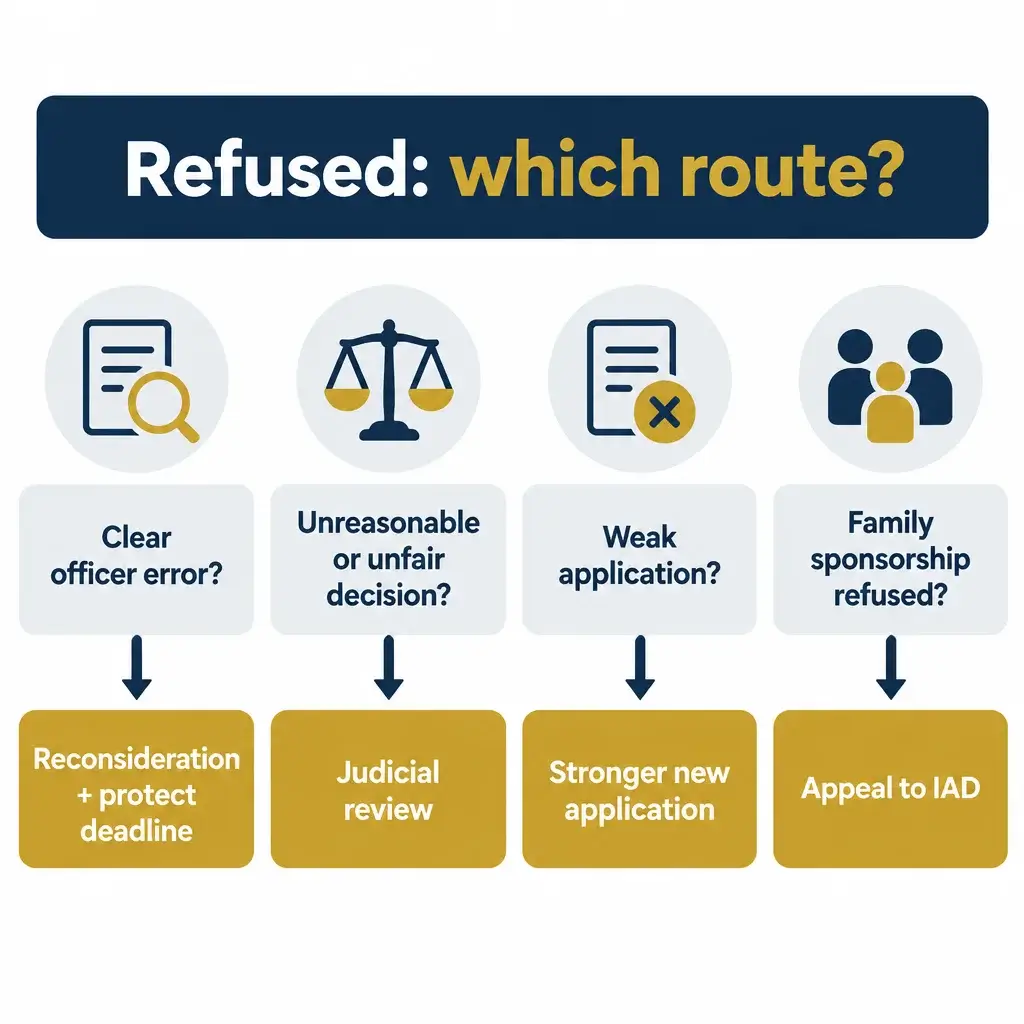
Refusal decision tree
What did IRCC send?
│
├─ Procedural fairness letter, no final refusal
│  └─ Respond to each concern by the letter's deadline
│
├─ Final refusal
│  ├─ Citizenship → check the 30-day court deadline
│  ├─ Family sponsorship → check IAD appeal eligibility first
│  └─ Temporary residence or other PR matter
│     ├─ Clear error → assess reconsideration
│     ├─ Challenge to decision/process → assess judicial review
│     └─ Stronger evidence available → assess reapplying
│
└─ No decision, only delay
   └─ Assess follow-up steps and possible mandamus
Refusal deadline counter
Loading…
Procedural fairness letters: what they mean and how to respond
A procedural fairness letter tells you about concerns before a final decision and gives you an opportunity to answer them. It is not itself a refusal.
IRCC’s procedural fairness instructions require a meaningful and reasonable opportunity to respond, but do not set one fixed response period. Practitioners commonly report 30-day deadlines; your letter may give a different period.
Read the actual deadline and submission instructions. Do not substitute a deadline you found online.
Build your response concern by concern
Use the same structure for every issue:
- Concern: identify exactly what the officer questions.
- Evidence: attach the records that address it and label them clearly.
- Explanation: connect those records to your answer, including any discrepancy.
- Conclusion: explain why the concern should be resolved.
A short cover letter with an indexed evidence package can make your response easier to follow. Answer every concern, not only the one you find easiest to explain.
Check consistency against your original forms and supporting documents. Avoid speculation, unsupported accusations and explanations that create new contradictions.
If you cannot obtain essential evidence before the deadline, seek advice promptly about requesting more time. Do not assume an extension has been granted.
Misrepresentation letters need particular care
Under section 40 of the Immigration and Refugee Protection Act, misrepresentation includes misrepresenting or withholding material facts that induce, or could induce, an error. A finding can bring five years of inadmissibility.
If your letter mentions misrepresentation, authenticity or withheld information, get legal advice promptly. Identify precisely what was submitted, by whom, and what reliable evidence explains the concern.
Do not guess at an explanation or submit a replacement document without addressing the original issue.
Silence instead of refusal? That is a mandamus question
If IRCC has not decided your application, reconsideration is not the relevant remedy because there is no refusal to reopen.
Start by checking IRCC’s processing-times tool and organising your timeline. Our IRCC follow-up guide explains steps to document before escalating.
A mandamus application may be worth assessing where delay remains unresolved. Mandamus forces a decision, not an approval.
Some practitioners use twice the posted processing time as a screening rule of thumb. It is not the legal test, and crossing that point does not automatically establish a case.
What to do this week
- ☐ Save your refusal or fairness letter and every attachment.
- ☐ Record the notification date and actual response deadline.
- ☐ Read officer notes before choosing a remedy.
- ☐ Match every concern to evidence in your submitted file.
- ☐ Obtain advice promptly for misrepresentation concerns.
- ☐ Decide whether a court filing is needed while reconsideration is pending.
- ☐ Request a written legal-fee scope, including later stages.
- ☐ Keep copies and proof of every submission.
Frequently asked questions
Can you appeal a Canada visa refusal?
Not every refusal carries an IAD appeal right. For many temporary-resident refusals, the relevant court route is an application for leave and judicial review, rather than an IAD appeal.
How long does an IRCC reconsideration take?
IRCC’s reconsideration guidance does not publish a standard processing time. Do not wait for a response if doing so risks missing your judicial-review deadline.
Can I send a reconsideration request by web form?
Follow any submission instructions in your refusal letter. If you use the IRCC web form, identify the refusal, explain the requested correction and retain the acknowledgement. It does not confirm reopening or extend court time.
What happens if I do not answer a procedural fairness letter?
You lose the opportunity to address the stated concerns before IRCC decides on the available record. Do not treat silence as agreement to an extension.
Does a PFL mean refusal is coming?
Not necessarily. It identifies concerns and gives you an opportunity to respond. Focus on a complete, evidence-based answer rather than trying to predict the outcome.
Should I reapply or go to Federal Court?
Compare the refusal reasons with the original evidence. A genuine gap may favour reapplying; an apparent decision-making error may justify assessing judicial review. Protect the deadline while making that choice.
Related guides
- IRCC reconsideration request after refusal: full guide
- Appeals for refused spousal sponsorship applications
- IRCC tracker and GCMS notes
Get your letter and deadline reviewed
Refused or holding a procedural fairness letter? Send us the letter today — the deadline is short.
Your file is past the posted time and nothing is moving? Sutton Law reviews your timeline and GCMS notes and tells you in writing whether a mandamus application is realistic now, later, or not at all. Consultations are by video or at our Richmond Hill office (Greater Toronto Area), in English, Russian or Ukrainian.
Discuss your options with a writ of mandamus lawyer.
This article is general information, not legal advice. Last reviewed: November 2026.