

The IRCC contact number is 1-888-242-2100, toll-free within Canada only, with automated service available 24/7. If your application is past normal processing time, use the IRCC webform to request an update. Neither channel is an express lane: IRCC says agents cannot normally speed up processing.
Start with a documented enquiry, then consider an MP enquiry, GCMS notes, a service complaint or legal action, depending on what remains unresolved. Keep one timeline rather than starting over with every contact.
IRCC contact options at a glance
| Channel | When to use it | What it can do | What it cannot do | Official response standard |
|---|---|---|---|---|
| Web form | Your application is over normal processing time | Submit an enquiry and create a written record | Guarantee faster processing | No published response-time standard |
| Phone | You are in Canada and want a status check | Provide available status information | Give agents extra file details or ordinary queue-jumping powers | Automated service is available 24/7; that is not an agent-response standard |
| MP office | You want a parliamentary case enquiry | Ask IRCC through its parliamentary liaison channel | Promise an immigration decision by the enquiry deadline | Critical: 1 business day; urgent/complex: 2; time-sensitive: up to 5; routine: up to 10 |
| GCMS/ATIP request | You need records rather than another status message | Obtain information recorded on your file | Require IRCC to finalize the application | Statutory access deadlines apply, with permitted extensions |
| Client feedback form | You want to report a service failure | Submit a complaint, compliment or suggestion | Compel an immigration decision | No published response-time standard |
| Demand letter | Earlier enquiries have not resolved a potentially unreasonable delay | Make a formal demand and document notice | Guarantee action by your chosen date | No universal response deadline |
| Federal Court mandamus | The delay may justify a court remedy | Seek an order requiring a decision | Secure approval of the underlying application | Court procedure applies, not a fixed resolution promise |
How to fill in the IRCC web form
Before writing, check IRCC’s processing-times tool. Save the result and the date you checked it. Posted times are estimates, not a promise that every application will finish within that period.
Submit a focused enquiry
- Open the official web form. Use the IRCC link above rather than a paid intermediary.
- Choose the enquiry route matching your application. Where offered, select the option concerning an application over normal processing time. Do not treat the wording below as a guaranteed copy of the current form’s labels.
- Identify the file. Have your application number, unique client identifier (UCI) and acknowledgement of receipt (AOR) date ready.
- Explain the delay briefly. State when you applied, how long you have waited and what the processing-times tool showed on a specific date.
- Ask a precise question and save your submission. Request the current status and confirmation of any outstanding requirement.
IRCC provides an automatic acknowledgement. That confirms receipt of the enquiry, not that an officer has reviewed or advanced your application.
Web form message template
Subject: Application over normal processing time — [application number]
Applicant: [full name]
UCI: [UCI]
Application number and type: [details]
Application submitted: [date]
AOR received: [date]My application has been pending for [number] months. On [date checked], IRCC’s processing-times tool showed [time displayed] for my application category.
I responded to IRCC’s requests on [dates]. [Identify anything still outstanding, if applicable.]
Please confirm the current status of my application and whether any document, information or action is required from me.
My previous enquiry was submitted on [date], and the response was [brief summary, if applicable].
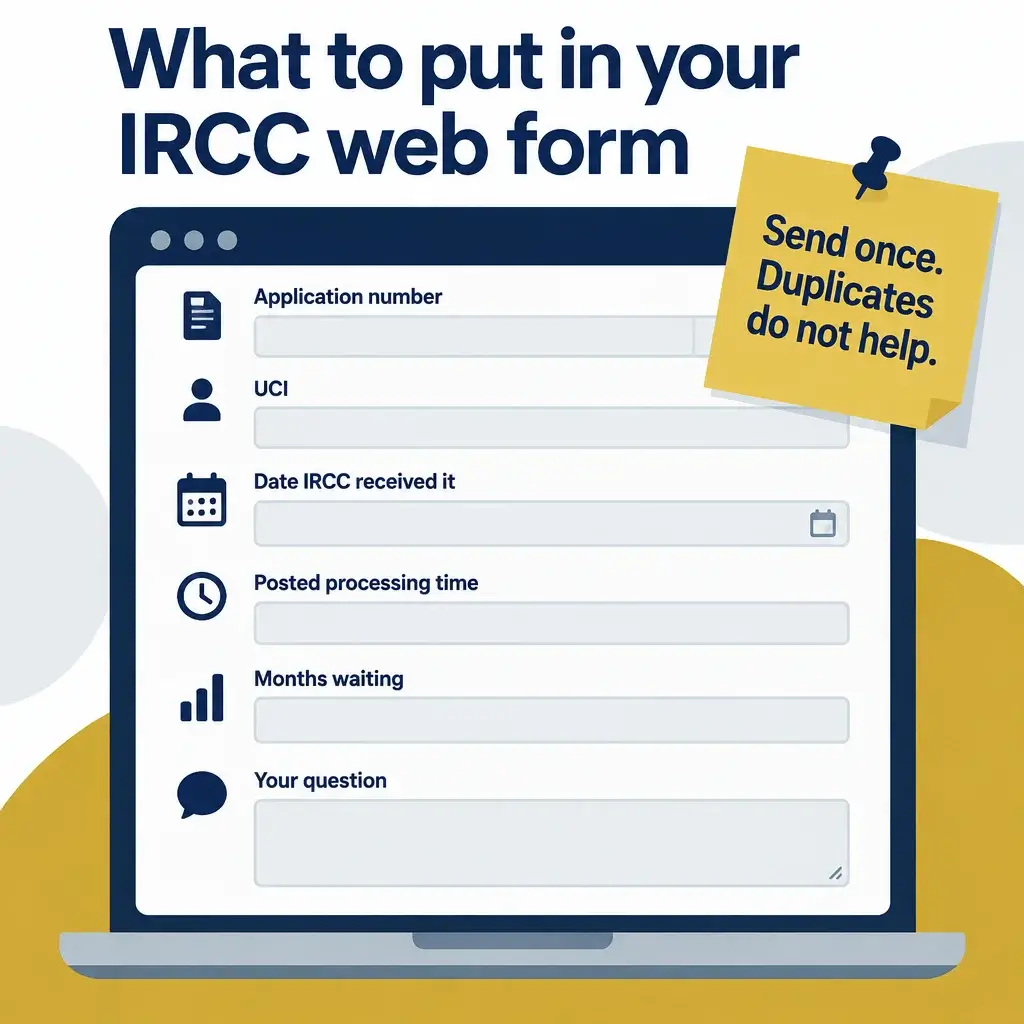
Keep the message factual. IRCC expressly says that submitting another web form will not speed things up. A further message should identify a useful update or unresolved question, rather than repeat the same text.
Calling IRCC: what the agents can and cannot do
The IRCC phone number is useful for checking available status information, but understand its limits before calling. IRCC says agents:
- “don’t have more details than what’s available online”; and
- “can’t speed up your application’s processing time,” unless you are already eligible for urgent processing.
The automated service operates around the clock. That does not mean live agents are available 24/7.
Have your identifiers and a short list of questions ready. Afterwards, record the date, information provided and any action requested. A call log helps preserve your chronology even when the answer is simply that processing continues.
If you are outside Canada, use the web form rather than relying on the Canada-only telephone line.
Getting your MP involved
Your MP’s constituency office can open a case enquiry with IRCC’s Ministerial Centre for Members of Parliament and Senators. Ask the office about its intake process and sign the consent it requires.
Provide a compact package:
- application number, UCI and key dates;
- your processing-time comparison;
- previous enquiries and replies;
- any outstanding IRCC request; and
- documents supporting genuine urgency.
The service standards in the table concern IRCC’s response to the parliamentary enquiry, not completion of your application. A routine enquiry standard of up to 10 business days does not mean a decision is due within 10 business days.
An MP enquiry is an established channel, but not a promise of preferential processing. Ask the MP’s office to share the substance of IRCC’s reply so you can update your timeline.
Complaints: IRCC feedback form versus ATIP complaints
These are different processes. Choose the one matching the problem.
A service complaint about IRCC
The official IRCC client feedback form accepts complaints, compliments and suggestions. It provides an acknowledgement if you supply an email address, but IRCC publishes no response-time standard.
Describe the service failure, relevant dates and the response you are requesting. Use a status enquiry to ask what is happening with your file; use a complaint to explain what went wrong with the service you received.
There is no independent IRCC ombudsperson to whom you can escalate the application. IRCC’s committee materials discuss the proposed creation of such an office, not an existing complaint route.
A complaint about access to your records
For GCMS notes, the ordinary statutory response period is 30 days, subject to permitted extensions under the Access to Information Act or Privacy Act. These deadlines concern disclosure of records, not the immigration decision.
If the records request is late or refused:
- Access to Information Act: complaints go to the Information Commissioner under section 30. The complaint deadline is generally 60 days from the refusal, notice or awareness of the grounds.
- Privacy Act: complaints go to the Privacy Commissioner under section 29, not the Information Commissioner.
The demand letter: last step before court
A demand letter is more than another request for an update. It formally asks IRCC to perform its duty and documents that it had an opportunity to respond before court proceedings.
The prior-demand requirement forms part of the Apotex mandamus framework, as reflected in the Federal Court’s 2026 discussion of the test. It includes a prior demand, a reasonable time to comply and an express or implied refusal. A letter alone does not establish that the full legal test is met.
What the letter should contain
This is an elements list, not a complete legal template:
- Who is making the demand: applicant and representative details.
- Which file: application type, application number and UCI.
- Chronology: submission, AOR, requests, responses and follow-ups.
- Processing-time comparison: the category, displayed estimate and date checked.
- Compliance: evidence that you answered IRCC’s requests, with any gaps explained.
- Consequences: documented effects on work, family or other circumstances.
- A clear demand and reasonable deadline: tailored to the file.
- Notice of intended proceedings: that you may seek mandamus if the delay remains unresolved.
The lawyer sends the letter to IRCC and keeps proof of delivery. The Department of Justice becomes involved only once a court application is filed. Practitioner accounts describe action after some demand letters, but there is no official resolution-time figure or guaranteed response.
Ask for a written quote distinguishing demand-letter work from any later court representation.
The full escalation ladder
Use the ladder as an evidence tracker, not a requirement to wait indefinitely at every rung. A lawyer can assess whether further enquiries are useful or court action is already worth considering.
Loading…
What the court stage involves
An immigration mandamus proceeding under IRPA requires leave, meaning the Court’s permission to proceed, under section 72. Mandamus forces a decision, not an approval.
The filing fee is $50, separate from legal fees and other expenses. Under the August 12, 2026 special order, mandamus applicants currently have up to 120 days to file their applicant’s record. That is a document-filing period, not a promised decision date.
For the broader assessment, see our IRCC delay and mandamus guide or speak with a writ of mandamus lawyer.
Common mistakes
- Sending duplicate web forms. Repetition does not create priority.
- Paying for a supposed “expedite” connection. Ask what lawful service is being offered; do not rely on an outcome guarantee.
- Treating “twice the posted time” as law. Some practitioners use it as a screening rule of thumb, not the legal test or an automatic entitlement.
- Using an unlicensed court-document service. Practitioners warn about this practice. Under Federal Courts Rules, rule 119, an individual acts personally or through a lawyer, not an immigration consultant.
- Losing the evidence trail. Save submissions, acknowledgements, replies, notes and delivery records.
- Continuing the delay ladder after refusal. A refusal raises different remedies and court deadlines. Get advice promptly rather than waiting for another status reply.
What to do this week
- ☐ Check the current processing-time estimate and save a dated copy.
- ☐ Build a one-page application chronology.
- ☐ Confirm whether any IRCC request remains unanswered.
- ☐ Send a focused web form enquiry if appropriate.
- ☐ Gather past correspondence before contacting your MP.
- ☐ Consider GCMS notes if status replies explain little.
- ☐ Ask for a legal assessment and written fee quote if the delay remains unexplained.
Immigration lawyer Alex Sutton serves clients across Canada and abroad, with consultations by video or at our Richmond Hill office (Greater Toronto Area), in English, Russian or Ukrainian.
Related guides
- IRCC processing times explained
- IRCC tracker and GCMS notes
- IRCC refusal or procedural fairness letter
FAQ
Can I call IRCC from outside Canada?
The published toll-free line is for calls within Canada only. Use the official web form from outside Canada.
How long does an IRCC web form reply take?
IRCC publishes no response-time standard. The automatic acknowledgement is not a substantive answer, and another submission will not speed processing.
Can my MP speed up my application?
An MP’s office can make an enquiry through IRCC’s parliamentary channel. Its response standards are not deadlines for deciding your application.
What is a demand letter to IRCC?
It is a formal request for action that sets out the file history, explains the delay and gives IRCC a reasonable opportunity to respond before potential mandamus proceedings.
Do I need a lawyer to send a demand letter?
Not necessarily. The important question is whether the demand is legally adequate. A lawyer can assess that issue and whether court proceedings would be realistic.
Does complaining hurt my application?
IRCC provides an official complaint channel, but that does not support a guarantee about an individual file’s outcome. Keep your complaint factual and continue answering application-related requests.
Your file is past the posted time and nothing is moving? Sutton Law reviews your timeline and GCMS notes and tells you in writing whether a mandamus application is realistic now, later, or not at all.
This article is general information, not legal advice. Last reviewed: November 2026.