
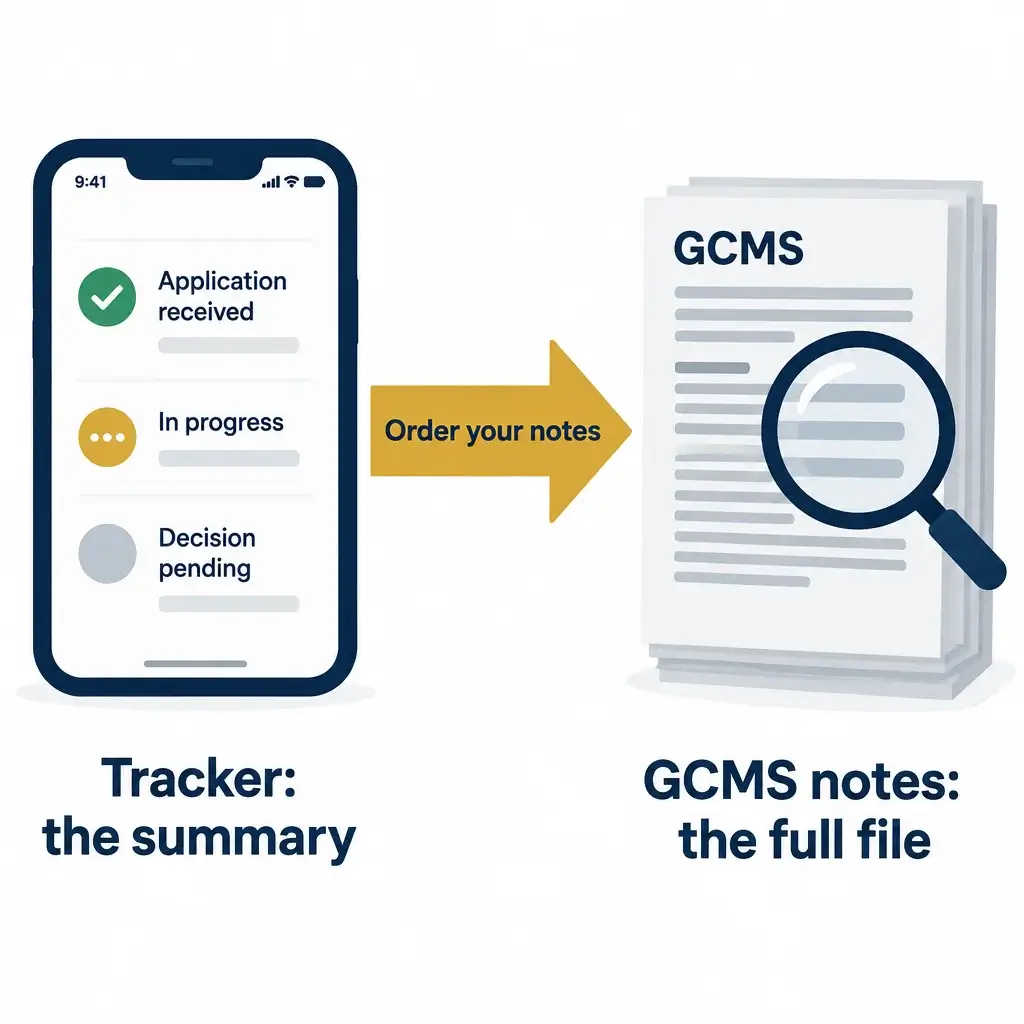
The IRCC tracker gives you a status summary; GCMS notes can show more of the record behind it. If your application seems stuck, compare the tracker with your correspondence and request your records rather than guessing from an unchanged status.
A notes package is not necessarily the complete file, either. A 2026 Privacy Commissioner finding identified missing GCMS history in IRCC disclosures. Below, you will find how to request fuller records, read them for delay evidence and decide when legal advice may help.
IRCC tracker statuses explained
Use these descriptions to frame questions about your IRCC application status. A label alone does not establish when substantive work happened or why a stage remains unfinished.
| Status or stage | Plain-language reading | What it does not tell you | When to investigate |
|---|---|---|---|
| Submitted | Your application is shown as submitted. | Whether every required item has been accepted or assessed. | You cannot reconcile it with your submission records or correspondence. |
| In progress | The application or stage is not shown as finished. | Whether someone is actively reviewing it today. | The file is past the posted time without a clear explanation. |
| Eligibility | A status relating to whether you meet program requirements. | The reasoning, concerns or outstanding review behind the label. | You need to understand what remains unresolved. |
| Background check | A status relating to background assessment. | Referral dates, work completed or the reason for a prolonged check. | A long delay is explained only by this broad label. |
| Medical | A status relating to the medical requirement. | Whether other requirements are complete. | It conflicts with a medical-related request or correspondence. |
| Biometrics | A status relating to biometrics. | Whether the application is otherwise ready for decision. | You cannot reconcile it with your biometrics records. |
| Decision | A decision is shown. | The full reasons or what you must do next. | You have a refusal or cannot locate the decision correspondence. |
Check IRCC’s processing-times tool, but do not treat its estimate as an individual deadline.
The “twice the posted time” benchmark is a practitioner rule of thumb, not the legal test for unreasonable delay. Your application’s history matters more than a multiplier.
Crowd trackers: useful comparisons, not your evidence
Crowd trackers, including myimmitracker-type services, can help you compare timelines people report. Treat those comparisons as questions to investigate, not proof that your application must follow the same schedule.
For a possible court case, focus on your own records: submission dates, requests, responses, correspondence and disclosed notes. Another person’s reported approval date does not explain what happened in your file. Our guide to IRCC delays discusses the broader assessment.
What GCMS notes are and why they matter
GCMS notes are records from IRCC’s case-management system. They can help you examine the history behind a tracker label rather than relying on the label alone.
The practical question is not simply whether a stage says in progress. It is what the disclosed record shows happened, when it happened and what remains outstanding.
Do not assume every blank field means no work occurred. Distinguish between an unexplained gap in the material you received and proof that nothing happened.
How to get GCMS notes: Privacy Act vs ATIP
“ATIP” refers to access to information and privacy. The important choice is which law you use.
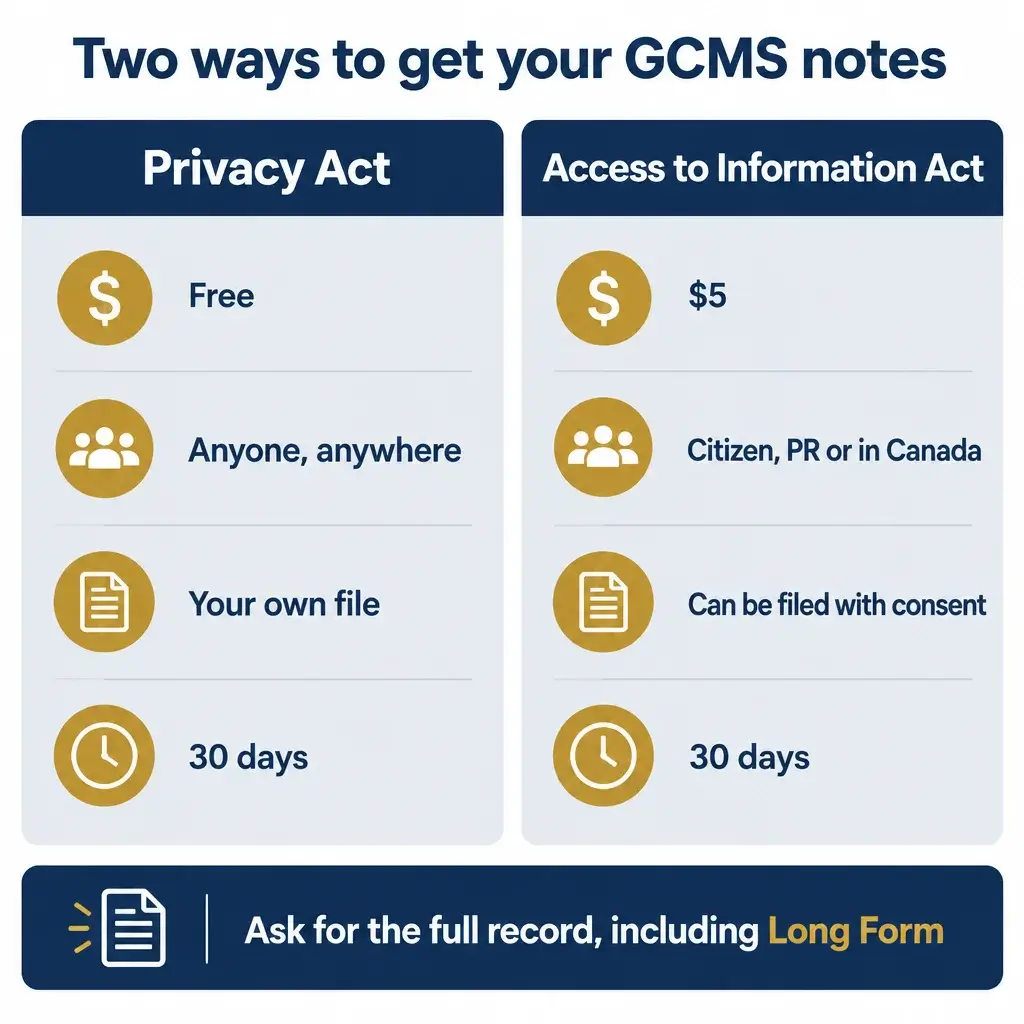
Since July 13, 2022, individuals anywhere in the world can request their own personal information under the Privacy Act. You do not have to be in Canada to use that route.
| Question | Privacy Act | Access to Information Act |
|---|---|---|
| Who can request? | Anyone, inside or outside Canada, requesting their own personal information. | Canadian citizens, permanent residents, or individuals or corporations currently in Canada. |
| Government fee | Free. | $5. |
| Representative route | The direct route described here is for your own information. | An eligible representative can request another person’s information with consent. |
| Consent | Request your own information directly. | IMM 5744 is required from each person over 18 whose information a third party requests. |
| Initial legal response period | 30 days. | 30 days. |
| Extensions | Up to 30 additional days; longer extensions are permitted for translation or an alternative format. | A reasonable period for specified reasons, including volume, consultations or third-party notice. Extensions exceeding 30 days must be reported to the Information Commissioner. |
These are statutory periods, not guaranteed delivery dates. IRCC reported that, in fiscal 2024–25, 80.7% of Access to Information Act requests and 87% of Privacy Act requests were completed within legislated timelines. Those figures do not predict your request’s completion date.
Privacy Act or ATIP? Three-question chooser
| Your answers | Practical route | Cost and paperwork | Initial legal period |
|---|---|---|---|
| Own information: yes; eligible requester: yes; representative: no | Privacy Act is the free direct option. | No government fee; online request. | 30 days, subject to extensions above. |
| Own information: yes; eligible requester: no; representative: no | Privacy Act, directly from abroad. | No government fee; online request. | 30 days, subject to extensions above. |
| Own information: yes; representative: yes | An eligible representative can use the Access to Information Act. | $5; IMM 5744 consent. | 30 days, subject to extensions above. |
| Other people’s information: included; eligible requester: yes | Access to Information Act, with required consent. | $5; IMM 5744 for each person over 18 concerned. | 30 days, subject to extensions above. |
| Other people’s information: included; eligible requester: no | Use an eligible requester or representative. | $5; required IMM 5744 consents. | 30 days, subject to extensions above. |
Loading…
Ask for the Long Form: the 2026 Privacy Commissioner finding
In a March 26, 2026 finding, the Privacy Commissioner found a complaint against IRCC well-founded and not resolved. IRCC’s ATIP office retrieved the GCMS Short Form rather than the Long Form and History section, which contained personal information the requester was entitled to access.
That finding matters if you are trying to reconstruct a delay. A summary may leave out the history you need to examine.
Explicitly request the full GCMS record, including the Long Form and History section. When the response arrives, check whether those components are actually included rather than assuming the package is complete.
Refused? You may already have the notes
Before making a GCMS notes request, open every attachment accompanying your refusal. IRCC’s reporting confirms an initiative to release officer decision notes proactively to selected temporary-resident applicants.
Practitioners report that, from July 29, 2025, this covers most study permit, work permit, visitor visa and visitor record or extension refusals, but not electronic travel authorizations or temporary resident permits. Notes may be redacted.
You may not need ATIP simply to obtain the final officer’s reasons, although those reasons are not necessarily the full history. See our officer refusal notes guide.
Do not wait for records before checking a refusal deadline. Under IRPA section 72, judicial-review filing periods are 15 days for a matter arising in Canada and 60 days for one arising outside Canada, measured from notification or awareness.
Step-by-step: requesting your notes
-
Choose the legal route. Use the comparison above. For your own personal information, being outside Canada does not prevent a direct Privacy Act request.
-
Prepare identifying information. Have your application correspondence available so you can identify the correct file accurately.
-
Use the official portal. Submit through the ATIP Online Request service, selecting IRCC and the appropriate Act.
-
Include consent where required. For a third-party Access to Information Act request, use IMM 5744. Do not assume an informal authorization replaces the prescribed consent.
-
Describe the records clearly. Adapt this suggested wording to your request:
Please provide the full GCMS record relating to my application [application number], including the Long Form, the complete History section, officer notes and records of processing activity from [date] to the date of retrieval. Please do not limit the response to the Short Form.
- Save the submission and track the deadline. Keep the acknowledgement, request number, payment receipt if applicable, and any extension notice together.
The suggested wording identifies what you want; it does not guarantee an unredacted response.
Reading your notes for delay evidence
Read your notes alongside a dated timeline. Separate what the records establish from what remains unknown.
GCMS gap checklist
Look for these five things:
- Last substantive activity: Identify the most recent entry showing an assessment or processing step.
- Long gaps: Mark periods without disclosed substantive entries, while checking whether history is missing.
- Requests already answered: Match IRCC’s requests against your response dates and delivery records.
- Screening referrals: Record any disclosed referral dates and subsequent entries without guessing at undisclosed activity.
- Decision-readiness remarks: Flag entries suggesting assessments are complete or a decision remains outstanding.
Practitioner summaries of Conille describe three questions for unreasonable delay: whether the process has taken longer than its nature requires, whether you or your counsel caused the delay, and whether the responsible authority has provided a satisfactory justification.
GCMS records can help address those questions, but gaps alone do not establish every requirement for relief. Mandamus forces a decision, not an approval.
If your timeline raises concerns, a writ of mandamus lawyer can assess the records and missing explanations. Ask for a written scope and fee quote before retaining counsel; the government notes-request fee is not a legal-representation fee. Our guide to next steps for a stalled file provides further context.
If IRCC misses the 30-day deadline
First check for an extension notice and calculate the applicable deadline. A missed legal deadline is a deemed refusal under the Access to Information Act or the Privacy Act.
The complaint route depends on the law used:
- Access to Information Act: Complain to the Information Commissioner. Section 31 requires filing within 60 days of the refusal or notice, or becoming aware of the grounds. Unreasonable extensions can also be challenged.
- Privacy Act: Complain to the Privacy Commissioner under section 29, not the Information Commissioner.
Keep this separate from the immigration delay: a records-access complaint concerns access to records, not a decision on your application.
What to do this week
- ☐ Save your tracker status and relevant correspondence.
- ☐ Check IRCC’s processing-times tool.
- ☐ Build a timeline of submissions, requests and responses.
- ☐ Check refusal attachments before ordering duplicate reasons.
- ☐ Request your full GCMS record, including Long Form and History.
- ☐ Calendar the access-request deadline and any refusal-related court deadline.
- ☐ If appropriate, send a focused IRCC web-form enquiry. IRCC says repeated web forms will not speed processing.
- ☐ Seek legal advice if the records leave a prolonged delay unexplained.
Related guides
- Canadian immigration application status
- IRCC processing times explained
- IRCC web form and escalation guide
FAQ
Are GCMS notes free?
A Privacy Act request for your own personal information is free. An Access to Information Act request carries a $5 government fee. A private ordering service may charge separately.
Can I get GCMS notes from outside Canada?
Yes. Individuals anywhere can request their own personal information under the Privacy Act. Access to Information Act requester eligibility is narrower, so choose the route carefully.
How long do GCMS notes take?
Both laws start with a 30-day response period, but lawful extensions and late responses occur. Neither the statutory period nor past performance guarantees when your particular package will arrive.
Why do I need GCMS notes?
The tracker shows only a short status. GCMS notes show what officers have actually recorded on your file: which checks are open, what was requested and when someone last worked on it. That tells you whether to keep waiting, fix a gap or prepare a mandamus application. You can file the request yourself, and the Privacy Act route is free. A lawyer adds value by reading the notes and assessing your legal options.
Will ordering notes slow my application?
Requests go to IRCC’s ATIP office. The sources reviewed for this article provide no evidence that requesting notes slows an application. Requesting records should not be confused with asking IRCC to expedite a decision.
What if my notes are heavily redacted?
Review the explanation accompanying the release and identify what is missing. Consider the applicable commissioner complaint process if you question the withholding. Redactions are not, by themselves, proof of wrongdoing or unreasonable immigration delay.
Your file is past the posted time and nothing is moving? Sutton Law reviews your timeline and GCMS notes and tells you in writing whether a mandamus application is realistic now, later, or not at all.
Discuss a mandamus application with Sutton Law. Immigration lawyer Alex Sutton offers consultations by video or at our Richmond Hill office (Greater Toronto Area), in English, Russian or Ukrainian, for clients across Canada and abroad.
This article is general information, not legal advice. Last reviewed: November 2026.