

Check your application category in IRCC’s processing-times tool, but treat the result as an estimate, not a deadline. Historical IRCC processing times show how long it took to process 80% of comparable applications; some programs use forward-looking estimates instead. If your file is past the posted time, start documenting the delay and following up rather than assuming either that something is wrong or that nothing can be done.
How IRCC calculates processing times
For historical estimates, the posted number is a rear-view mirror. IRCC calculates how long it took to process 80% of applications over the previous six months for permanent residence or eight to 16 weeks for temporary residence.
That number does not tell you how long the remaining 20% waited. Being outside the estimate matters, but it does not automatically establish an unreasonable delay.
For some programs, IRCC instead provides a forward-looking estimate: how long it expects an application received today to take. Read the explanation attached to your result before applying it to an older file.
IRCC updates permanent residence estimates monthly and temporary residence estimates weekly. It also cautions that estimates do not account for sharp increases in applications or urgent shifts in priorities.
The backlog in numbers (2026)
A posted processing estimate and a service standard are different measures. IRCC’s stated goal is to process 80% of applications within service standards; applications waiting beyond those standards form its backlog.
The May 28, 2026 committee material, referring to Q1-2026 data without an exact snapshot date, reported:
| Measure | Applications |
|---|---|
| Total inventory | 2,092,700 |
| Within service standards | 1,151,300 |
| In backlog | 941,400, approximately 45% |
Do not present that 45% as the current backlog rate. The newer monthly inventory page, with data as of August 31, 2026, reports “applications not yet finalized” instead:
| Category | Not yet finalized | Waiting for space under yearly targets |
|---|---|---|
| Temporary residence | 365,425 | — |
| Economic permanent residence | 256,555 | 22% |
| Family permanent residence | 167,170 | 42% |
| Protection permanent residence | 291,615 | 43% |
| Citizenship grant | 327,125 | — |
| Proof of citizenship | 135,965 | — |
These are different measures, not directly comparable snapshots. “Not yet finalized” does not mean every application listed is overdue, and national totals do not explain your individual file.
PR, work permit, study permit, citizenship: where each number lives
There is no single permanent residence processing time or work permit processing time that applies to everyone. Select the exact application category and answer the tool’s questions.
For your delay log, record the application-received date identified in your acknowledgement of receipt (AOR). Do not assume that the date the AOR email arrived is the date IRCC received your application; verify the relevant clock instructions before calculating.
| Application | Where to look | Clock information to check | Important note |
|---|---|---|---|
| Permanent residence | IRCC tool, exact PR stream | Receipt date in AOR; confirm stream-specific instructions | Do not substitute another PR stream’s estimate |
| Work permit | IRCC tool, applicable work permit category | Recorded receipt date; confirm tool instructions | Select the category matching your application |
| Study permit | IRCC tool, applicable study permit category | Recorded receipt date; confirm tool instructions | Save the result you used |
| Citizenship grant | IRCC tool, citizenship grant | Receipt information in AOR; confirm tool instructions | See our citizenship-delay guide |
| PR card | IRCC tool, applicable PR card category | Check the tool’s instructions for the clock start | Do not use the PR application estimate |
Save a dated screenshot of the result. Your comparison should identify both how long you have waited and which posted estimate you used.
Calculate your overdue ratio
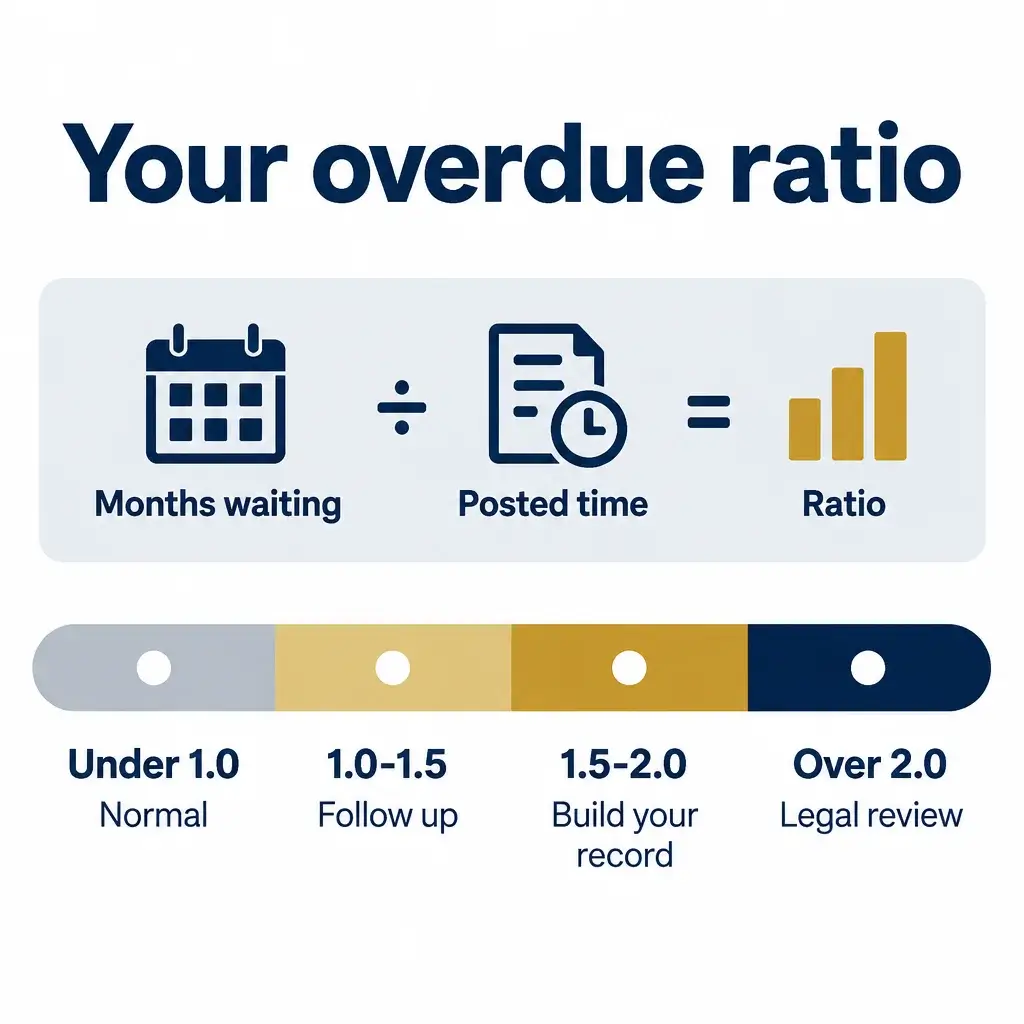
Your overdue ratio is a simple way to organise your next steps:
Overdue ratio = months waiting ÷ current posted processing time in months
For a hypothetical example, suppose you have waited 22 months and the estimate you check is 10 months. Your ratio is 22 ÷ 10 = 2.2; these are illustrative numbers, not a current program estimate.
The zones below are practical triage guidance. Practitioners describe roughly twice the posted time for PR or citizenship, or roughly one year for most temporary applications, as assessment points, not legal thresholds.
| Ratio or waiting period | Zone | Suggested next step |
|---|---|---|
| Below 1.0 | Green: within the estimate | Monitor your account and answer requests |
| 1.0 to below 1.5 | Yellow: follow up | Send one focused web form |
| 1.5 to approximately 2.0 | Amber: build the record | Request GCMS notes and organise a delay log |
| Above approximately 2.0 for PR or citizenship | Red: seek an assessment | Ask whether mandamus is realistic |
| Around 12 months for most temporary applications | Assessment flag | Seek advice based on the application’s circumstances |
These zones are a practitioner rule of thumb, not the legal test. A green result does not resolve every concern, and a red result does not establish that a court application will succeed.
IRCC Overdue Ratio Calculator
Loading…
Why your file may be taking longer
Start by identifying what is actually outstanding, rather than relying on another applicant’s timeline. Ask:
- Do the available records identify security or background screening?
- Is eligibility still under review?
- Has IRCC requested documents, and can you prove you supplied them?
- Is there an outstanding medical request or an issue involving expired medical results?
- Does IRCC’s explanation identify something specific to your file, or only general volumes?
Treat these as questions to investigate, not a diagnosis. Your account history, correspondence and GCMS notes can help you frame a more precise enquiry.
Screening and backlog explanations need scrutiny
Practitioner summaries of Federal Court decisions report that a bare assertion that security screening remains ongoing is not necessarily a satisfactory explanation for prolonged delay. The details and evidence supporting the explanation matter.
The same commentary describes decisions rejecting pandemic or backlog explanations without evidence of their specific impact on the application. That does not mean every screening delay is unreasonable; it means the explanation needs to be assessed against your particular timeline.
What does not speed things up
Duplicate web forms
IRCC says submitting another web form will not speed things up. One clear enquiry, with proof of submission, is more useful to your record than repeated identical messages.
IRCC publishes no web form response-time standard. An automatic acknowledgement confirms receipt, not that an officer has reviewed or advanced your file.
Repeated calls
According to IRCC’s Client Support Centre guidance, agents do not have more details than are available online. They cannot speed up processing unless you are already eligible for urgent processing.
Calling is therefore not a substitute for documenting the delay. Keep any useful information you receive, but do not mistake repeated calls for an escalation process.
Paid “expedite” promises and court-paper agents
Before paying someone who promises faster processing, ask which published urgent-processing provision they say applies. Do not treat payment as proof that a faster route exists.
CBA commentary on Federal Court representation explains that individuals act for themselves or through a lawyer; immigration consultants cannot represent clients in Federal Court. It also reports concerns about unlicensed agents drafting mandamus filings for supposedly self-represented applicants.
What to do this week
Work through this checklist in order. The aim is a reliable record, not a larger pile of enquiries.
- ☐ Check your dates. Locate your AOR and record the application-received date, application number and category.
- ☐ Check the current estimate. Save a dated screenshot from IRCC’s tool and calculate your overdue ratio.
- ☐ Audit outstanding requests. Match each IRCC request with your response and proof of delivery.
- ☐ Send one focused web form if you are past the posted time. State your receipt date, category and relevant history, then ask what remains outstanding. Use our web form escalation guide.
- ☐ Request your GCMS notes. Follow our GCMS notes and tracker guide to investigate the record rather than guessing.
- ☐ Start a delay log. Record each request, response, enquiry and explanation, with supporting documents.
For your own personal information, IRCC accepts Privacy Act requests from individuals inside or outside Canada without a fee. Do not assume an overseas applicant must pay a third party simply to qualify to request their own information.
When a delay becomes legally “unreasonable”
Going past the posted estimate is a reason to investigate, not an automatic entitlement to a court order. Practitioner summaries of Conille describe three questions for assessing unreasonable delay:
- Has the process taken longer than its nature reasonably requires?
- Did you or your representative avoid causing the delay?
- Has the responsible authority failed to provide a satisfactory justification?
The assessment also involves the broader mandamus requirements, including a duty owed to you and a prior demand for action. The Federal Court has restated these foundational requirements.
A lawyer should examine the application history, your responses and IRCC’s explanations, not just multiply the posted estimate. Mandamus forces a decision, not an approval.
What does court action cost, and how long does it take?
For immigration matters under IRPA, proceedings begin with an application for leave, meaning the Court’s permission to proceed. Citizenship judicial review also requires leave.
The Registry filing fee is $50. That is not the lawyer’s fee: ask for a written quote explaining the stages covered, taxes, disbursements and what happens if the matter resolves early.
There is no official overall mandamus resolution timeline. Under the August 12, 2026 special order, applicants currently have a 120-day total period to perfect their record; that is a filing deadline, not an expected resolution time.
For IRPA proceedings, the hearing follows 30 to 90 days after leave is granted. Those procedural periods do not support a promise that IRCC will decide within a particular number of weeks.
If your record shows sustained delay without a meaningful explanation, consider a mandamus application assessment.
Frequently asked questions
How much time does PR take in 2026?
It depends on your PR program; check IRCC’s processing-times tool for the applicable category. Locate the receipt date in your AOR and follow the tool’s clock instructions when comparing your wait.
Why is IRCC taking so long for my PR application?
You need your file’s records to distinguish an outstanding request, review or screening issue from a general explanation about volumes. GCMS notes and a focused enquiry can help identify what remains unresolved.
Does IRCC process applications in order?
The posted estimate does not establish a strict queue order or tell you when your individual application will be decided. Another person receiving a decision first does not, by itself, establish unreasonable delay.
Can I pay to speed up processing?
Do not rely on a paid “expedite” promise without identifying an applicable urgent-processing route. Paying for legal assistance is different from buying priority or a guaranteed outcome.
Is twice the processing time enough for mandamus?
Not automatically: twice the posted time is a practitioner assessment guideline, not the legal test. The nature of the process, responsibility for the delay and IRCC’s justification still matter.
Does a web form reset my place in the queue?
IRCC’s cited web form guidance does not say that an enquiry resets your place. It permits enquiries after normal processing time and warns that duplicate submissions will not speed processing.
Related guides
- Canada PR processing time by program
- Canadian immigration application status
- Citizenship processing time and delays
Get a clear assessment of your delay
Alex Sutton, immigration lawyer at Sutton Law Professional Corporation, serves clients across Canada and abroad, with consultations by video or at our Richmond Hill office (Greater Toronto Area), in English, Russian or Ukrainian.
Your file is past the posted time and nothing is moving? Sutton Law reviews your timeline and GCMS notes and tells you in writing whether a mandamus application is realistic now, later, or not at all.
Speak with a writ of mandamus lawyer.
This article is general information, not legal advice. Last reviewed: November 2026.