

A marriage certificate is not a complete sponsorship application. This family sponsorship checklist covers what comes next: eligibility, forms, relationship evidence, financial records and a file IRCC can actually assess.
Family Sponsorship Checklist: Start With the Right File
Family sponsorship combines a sponsor’s application with a relative’s permanent residence application. Immigration, Refugees and Citizenship Canada, or IRCC, assesses the sponsor, the relationship and the applicant’s admissibility. This guide focuses on spouses, partners and dependent children, with separate notes for other relatives.
I’m Alex Sutton, and my approach at Sutton Law starts with eligibility and evidence, not forms. We compare civil records, immigration history and the relationship timeline before preparing the submission. A polished application cannot repair an unexplained contradiction between those records.
Use this master pre-filing checklist to build the file:
- Identify the eligible relationship category.
- Assess the sponsor’s status, residence and sponsorship history.
- Choose the appropriate inland or Family Class route.
- Select the relationship-specific and country-specific document instructions.
- Gather sponsor, applicant and dependent child records separately.
- Build a dated relationship and address history.
- Prepare financial records and a realistic support plan.
- Plan police certificates, medical examinations and biometrics.
- Resolve missing documents, translations and name differences.
- Prepare required forms, signatures and payment receipts.
- Organize uploads and save the complete submitted package.
The applicable checklist controls what belongs in the application; a generic online list does not replace it. Older searches for a “CIC sponsorship application” refer to the department now called IRCC, not a separate immigration program.
Eligibility: Who Can Sponsor and Who Qualifies
Sponsors generally must be at least 18 and be Canadian citizens, permanent residents, or persons registered under the Canadian Indian Act. Permanent residents must live in Canada to sponsor. Canadian citizens abroad can sponsor a spouse, partner or qualifying dependent child if they demonstrate plans to return when the sponsored person becomes a permanent resident.
| Sponsor eligibility checklist | Sponsored person eligibility checklist |
|---|---|
| Document qualifying Canadian status and residence. | Document an eligible family relationship. |
| Assess previous undertakings and sponsorship restrictions. | Disclose immigration history, refusals and family members. |
| Identify social assistance, bankruptcy, criminal or removal issues. | Meet applicable criminal, security and medical requirements. |
| Show the ability to meet the financial undertaking. | Provide civil records and relationship evidence. |
Social assistance other than disability assistance, an undischarged bankruptcy, a removal order, certain convictions, or default on support obligations can prevent sponsorship. The exact bar matters. Receiving disability assistance is not the same as receiving other social assistance.
Previous sponsorships can also restrict a new application. A person sponsored as a spouse or partner generally cannot sponsor another spouse or partner until five years after becoming a permanent resident. A sponsor also remains responsible for an earlier spouse’s undertaking during its applicable period.
Eligible family categories include spouses and partners, dependent children, parents and grandparents, and narrowly defined other relatives. Parent and grandparent sponsorship has a separate intake and financial framework. Siblings, cousins and adult children do not qualify simply because they are close family.
Choose the Relationship Category Before Gathering Proof
The correct spousal application checklist follows the relationship facts, not convenience. Marriage, common-law partnership and conjugal partnership have different evidence requirements. A “visa sponsorship application” for a spouse usually means an application for permanent residence, not a visitor visa or a work permit.
| Category | Eligibility foundation | Evidence to prioritize |
|---|---|---|
| Married spouse | A legally valid marriage recognized for Canadian immigration purposes. | Marriage certificate, records ending prior marriages, shared life and relationship history. |
| Common-law partner | At least 12 consecutive months of cohabitation in a marriage-like relationship; brief temporary absences can be compatible with continuing cohabitation. | Address records spanning the qualifying period, shared expenses and evidence of a combined household. |
| Conjugal partner | A partner outside Canada in a conjugal relationship lasting at least one year, with significant barriers preventing marriage or cohabitation. | Relationship history plus concrete evidence of the barriers. |
Conjugal sponsorship is not a shortcut for couples who prefer not to marry or live together. Immigration, legal, social or other serious barriers must explain why the couple could not establish marriage or common-law status. Work schedules and personal preference alone do not establish that case.
A marriage certificate establishes a legal event, not the entire sponsorship case. IRCC also assesses whether the relationship is genuine and whether it was entered into primarily to obtain immigration status. Foreign, proxy and remotely performed marriages require particular attention to legal recognition and immigration exclusions.
Inland and Outland Sponsorship Compared
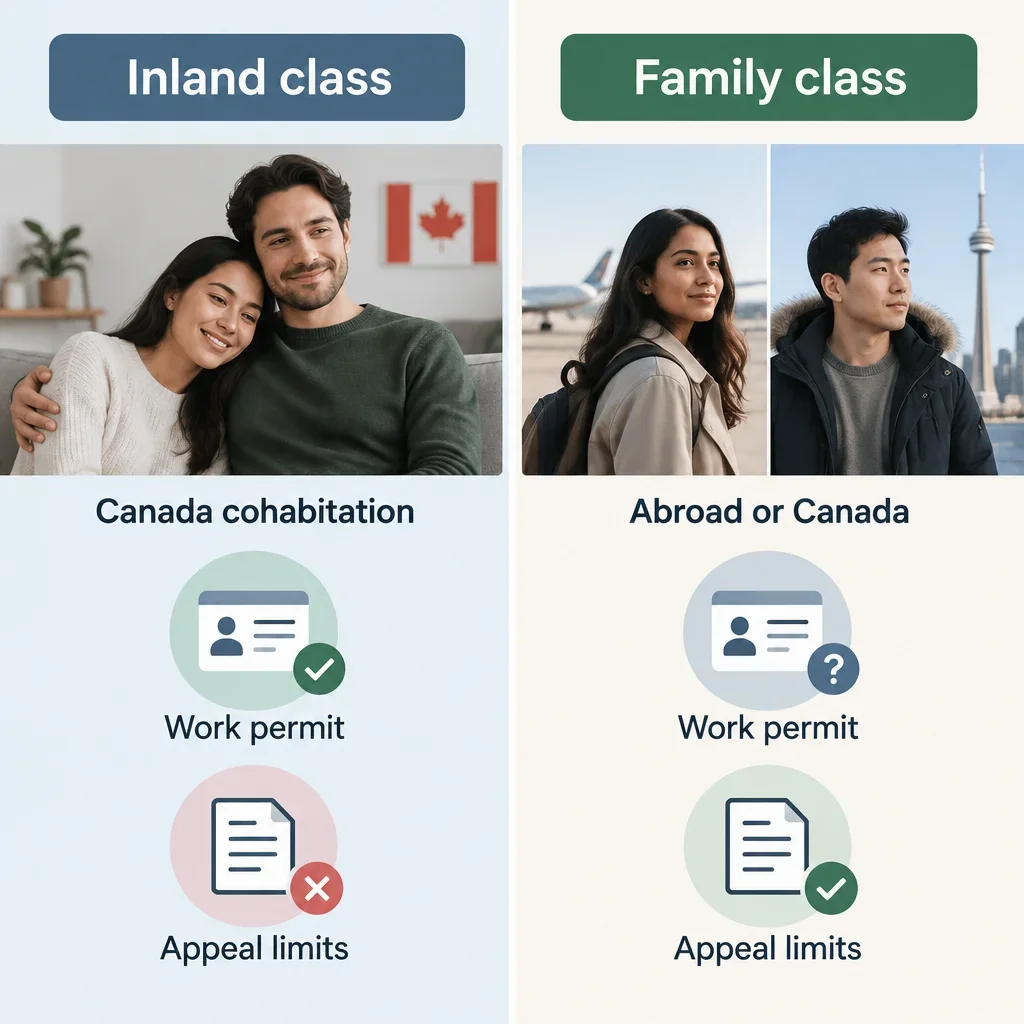
“Inland” usually means the Spouse or Common-Law Partner in Canada Class. “Outland” usually means the Family Class, which includes conjugal partners and can also accommodate applicants physically inside Canada. Physical location alone does not decide the route.
| Issue | Inland class | Family Class, often called outland |
|---|---|---|
| Living arrangements | Spouses or common-law partners must live together in Canada. | The applicant can live abroad; eligible applicants in Canada can also use this route. |
| Travel | Inability to return can undermine the required cohabitation in Canada. | Better suited to applicants whose circumstances require living abroad. |
| Work permit | An eligible applicant living with the sponsor in Canada can pursue a separate open work permit. | Certain eligible applicants living with their sponsor in Canada can also pursue an open work permit. |
| Appeal position | Refusals do not carry the same sponsorship appeal right to the Immigration Appeal Division. | Sponsors generally have an Immigration Appeal Division appeal route, subject to statutory limits. |
| Main practical concern | Canadian status, cohabitation and re-entry risks. | Overseas documents, separation, travel and visa-office processing. |
Submitting permanent residence paperwork does not itself extend temporary resident status or authorize work. Applicants in Canada need a separate status plan. Certain out-of-status spouses and partners can qualify under public policies, but those policies do not automatically resolve every inadmissibility problem.
Sponsor-Side Document Checklist
The sponsor’s documents establish identity, eligibility and the ability to meet the undertaking. Keep these records separate from the principal applicant’s civil documents so the file clearly shows who supplies each item.
- Canadian passport, citizenship certificate, birth certificate or permanent resident status evidence, as applicable.
- Proof of residence, such as a lease, utilities or government correspondence.
- Return-to-Canada evidence for an eligible citizen sponsoring from abroad.
- Employment letter, pay records and tax documents required by the applicable checklist.
- Details of previous sponsorships and existing undertakings.
- Records addressing relevant support arrears, convictions or other eligibility concerns.
- The sponsor’s required forms and declarations.
Self-employed sponsors should connect tax records with current business activity. Contracts, invoices, business bank records and an explanation of net income help show available resources. Students and unemployed sponsors should document savings, housing arrangements and their actual support plan rather than invent employment income.
Variable income needs an explanation, not selective bank statements. A CRA Notice of Assessment shows assessed tax information; current employment records explain what has changed since that tax year. Those records serve different purposes and should tell a consistent financial story.
Principal Applicant Document Checklist
The principal applicant is the person applying for permanent residence. Their records establish identity, family composition, immigration history and admissibility. A complete spousal PR application checklist normally includes the following categories, subject to the applicable instructions.
- Passport and required identity pages.
- Birth certificate and national identity documents, where required.
- Marriage certificate or evidence supporting the partner category.
- Divorce judgments, annulment records or former spouse’s death certificate.
- Legal name-change records and explanations for alternate spellings.
- Canadian immigration status documents, if living in Canada.
- Address, employment, education and personal history.
- Previous refusals, removals and other requested immigration history.
- Required police certificates.
- Immigration photographs meeting the application specifications.
- Translations and required accompanying documents.
- Medical and biometrics documents when instructed.
Country-specific requirements can add civil records, identity documents or special police-certificate procedures. They can be tied to nationality, residence or where documents were issued. A document checklist for spousal sponsorship outside Canada must therefore account for the applicant’s actual countries, not just the sponsor’s Canadian address.
Personal history must agree across forms and supporting records. List unemployment, study, travel and caregiving periods where requested. An unexplained gap can trigger questions even when the underlying activity was entirely lawful.
Dependent Children: Declare Them and Document Them
Declare all children as required, including children who will not immigrate with the applicant. Non-accompanying family members generally still require examination unless an exception applies. Failing to declare or have a family member examined can block later sponsorship.
A dependent child is generally under 22 and not married or in a common-law relationship. Older children can qualify under specific dependency rules involving a physical or mental condition and financial dependence beginning before age 22.
- Birth certificate identifying parents.
- Passport and identity records.
- Adoption orders, where applicable; guardianship alone does not establish adoption.
- Custody orders and parenting agreements.
- Required consent from a non-accompanying parent, including IMM 5604 where applicable.
- Medical examination arrangements.
- Dependency evidence where an exception is claimed.
- Explanations for different surnames, missing parents or unavailable consent.
A custody order does not always resolve international relocation consent. The order’s wording, decision-making rights and the child’s proposed move matter. For families managing Ontario parenting arrangements alongside immigration, those records must support the same relocation plan.
Forms: What They Do and Who Completes Them
The forms depend on the relationship category and application instructions. Some information is entered digitally in the permanent residence portal; other forms are uploaded. The table explains their roles, not a requirement to submit every form listed.
| Form | Purpose and who completes it | Applicability and common mistake |
|---|---|---|
| IMM 1344, Application to Sponsor, Sponsorship Agreement and Undertaking | Sponsor and principal applicant complete their applicable sections and signatures. | Records the sponsorship commitment. Missing a required signature can make the package incomplete. |
| IMM 5532, Relationship Information and Sponsorship Evaluation | Sponsor and principal applicant provide relationship and sponsor information. | Used for spouse and partner cases. Dates must match the relationship evidence. |
| IMM 5533, Document Checklist: Spouse | Used to assemble a married-spouse application. | Not a universal checklist for every partner category. |
| IMM 5589 / IMM 5629, Partner checklists | Common-law partner checklist / conjugal partner checklist. | Select the checklist matching the claimed relationship. |
| IMM 0008, Generic Application Form for Canada | Principal applicant supplies application and family details. | Omitting a dependent creates more than a clerical problem. |
| IMM 5669, Schedule A: Background/Declaration | Applicant and other required family members provide background histories. | Personal history must account for the periods requested. |
| IMM 5406, Additional Family Information | Applicant and required family members disclose family relationships. | Non-accompanying relatives still belong where the form requests them. |
| IMM 5409, Statutory Declaration of Common-Law Union | Common-law partners, where applicable under the instructions. | A declaration does not replace cohabitation evidence. |
| IMM 5562, Supplementary Information: Your Travels | Applicant and applicable family members, when required. | Travel details must reconcile with passports and address history. |
| IMM 5476, Use of a Representative | Person appointing, changing or cancelling a representative. | Relevant when someone represents the applicant or sponsor. |
| IMM 5475, Authority to Release Personal Information to a Designated Individual | Person authorizing information release. | Allows information access; it does not appoint an immigration representative. |
Follow each form’s signature and validation instructions individually. A typed name, portal declaration and uploaded signature are not interchangeable in every context. Save the completed versions so later responses remain consistent with the original submission.
Relationship Evidence: Strong Proof Versus Weak Proof

Strong evidence shows how the relationship developed and how the couple shares a life. Joint residence, financial ties, visits, communications and family involvement answer different parts of that story. A large upload of photographs cannot replace missing proof of cohabitation.
| Evidence bundle | Stronger presentation | Weak presentation |
|---|---|---|
| Married relationship | Marriage record linked to visits, shared responsibilities and continuing contact. | Ceremony photographs with little evidence before or after the wedding. |
| Common-law relationship | Lease, bills, bank records and government mail spanning the qualifying cohabitation period. | A joint lease signed recently, with no records showing actual shared residence. |
| Long-distance relationship | Travel records, dated visits, communication samples and an explanation of separation. | Undated chat screenshots with unexplained gaps. |
| Conjugal relationship | Evidence of commitment plus records establishing barriers to marriage or cohabitation. | A statement that living together was inconvenient. |
For common-law proof, map evidence month by month across the required 12-month period. A lease anchors the address; utility records and government mail support continued residence. If one partner’s name is absent from the lease, explain the arrangement and supply independent records.
For a separated married couple, connect the wedding record to the ongoing relationship. Organize travel bookings, selected communications, financial support and future household plans chronologically. Label photographs with dates, locations and the people shown rather than making the officer guess.
Follow any checklist limits on photographs or communication samples. Select representative evidence across the relationship rather than dumping entire message histories. Explain address discrepancies, interrupted visits and periods without ordinary records directly.
Income Rules and the Sponsorship Undertaking
There is no universal minimum income amount for every family sponsorship application. Most spouse, partner and dependent-child cases outside Quebec do not have a fixed minimum income threshold. Exceptions include certain cases involving dependants who have dependent children of their own. Parent and grandparent sponsorship follows different income rules.
The undertaking is a binding promise to provide basic needs and repay recoverable social assistance paid during the undertaking period. Government application fees do not satisfy that obligation. Sponsors need a credible plan for housing, food and other covered needs.
Outside Quebec, a spouse or partner undertaking lasts three years from the sponsored person becoming a permanent resident. Separation, divorce, unemployment or the sponsored person obtaining citizenship does not end it. Undertakings for children and other relatives have different durations, so the spouse period should not be copied across categories.
An unemployed sponsor is not automatically disqualified from sponsoring a spouse. Savings, housing, household support and the applicant’s circumstances can help explain the support plan. Social assistance restrictions and other eligibility bars remain separate questions.
Fees, Medical Examinations, Biometrics and Police Certificates
Budget separately for government fees, document expenses and optional legal representation. Government charges can include sponsorship processing, principal applicant processing, the Right of Permanent Residence Fee, dependent applicant fees and biometrics where applicable. The family composition and applicable exemptions determine the payment categories.
Third-party expenses include panel-physician examinations, police certificates, translation, document replacement and delivery. Legal fees reflect the work involved: preparing a straightforward application differs from addressing custody problems, inadmissibility or a previous refusal. An itemized scope separates preparation work from later responses or litigation.
For spousal sponsorship, police-certificate instructions generally cover countries other than Canada where an adult applicant lived for at least six consecutive months since age 18. Country procedures can require an IRCC request before a certificate is issued. Document that procedure rather than substituting an unrelated background check.
Biometrics capture fingerprints and a photograph; they do not replace police certificates. A medical examination must be completed through an IRCC panel physician, not simply the applicant’s regular doctor. Follow the application’s instructions for when to complete each step and retain the resulting records.
Organize and Submit the Online Application
Family sponsorship permanent residence applications generally use IRCC’s Permanent Residence Portal, with alternative arrangements available for applicants who need accommodation. The principal applicant and sponsor have different declarations and responsibilities even though the application is assembled together.
Use the portal’s designated upload fields first. Where a field needs a combined document, arrange related records in a readable bundle with an index. A practical assembly map is:
| Bundle | Suggested contents | Example filename |
|---|---|---|
| Sponsor | Status, residence, employment and financial records | Sponsor_Status_Residence.pdf |
| Applicant | Passport, birth record and civil-status documents | Applicant_Identity_CivilRecords.pdf |
| Children | Separate identity, custody and consent records for each child | Child_Name_Custody_Consent.pdf |
| Relationship | Timeline, shared residence, finances, visits and communications | Relationship_Cohabitation.pdf |
| Explanations | Issue-specific letters and supporting records | Explanation_NameDifference.pdf |
| Payment | Applicable government payment receipt | Payment_Receipt.pdf |
Upload translations together with the corresponding source documents and required supporting certifications. Keep scans legible, correctly oriented and free of password restrictions. A merged file should preserve document labels, not turn the evidence into an unsearchable pile.
A missing upload slot does not make a required document optional. Use the applicable additional-document field and identify its contents clearly. Save the submission confirmation, payment receipt and exact submitted files; screenshots alone do not preserve the full application.
Missing Documents, Translations and Name Differences
A letter of explanation does not automatically replace a mandatory document. If a record is unavailable, document the attempts to obtain it, the issuing authority’s response and the alternative evidence supplied. The applicable instructions determine whether an explanation or substitute can be accepted.
Documents outside English or French generally require a translation and the accompanying records specified by IRCC. A translator’s affidavit is generally required when the translator is not a Canadian certified translator. Applicants and their family members cannot translate their own application documents. Notarization is not a universal requirement for every copy.
Name discrepancies need a documentary bridge. Link the passport name to birth, marriage and previous immigration records using legal name-change documents, marriage records or an explanation of transliteration. Disclose former names and aliases where requested rather than silently standardizing the forms.
An effective explanation letter identifies the issue, gives the relevant dates, lists supporting exhibits and explains what remains unavailable. For relationship gaps, prior refusals or unusual finances, answer the specific discrepancy. Repeating that the application is genuine does not resolve conflicting addresses or missing records.
After Submission: The Process Checklist
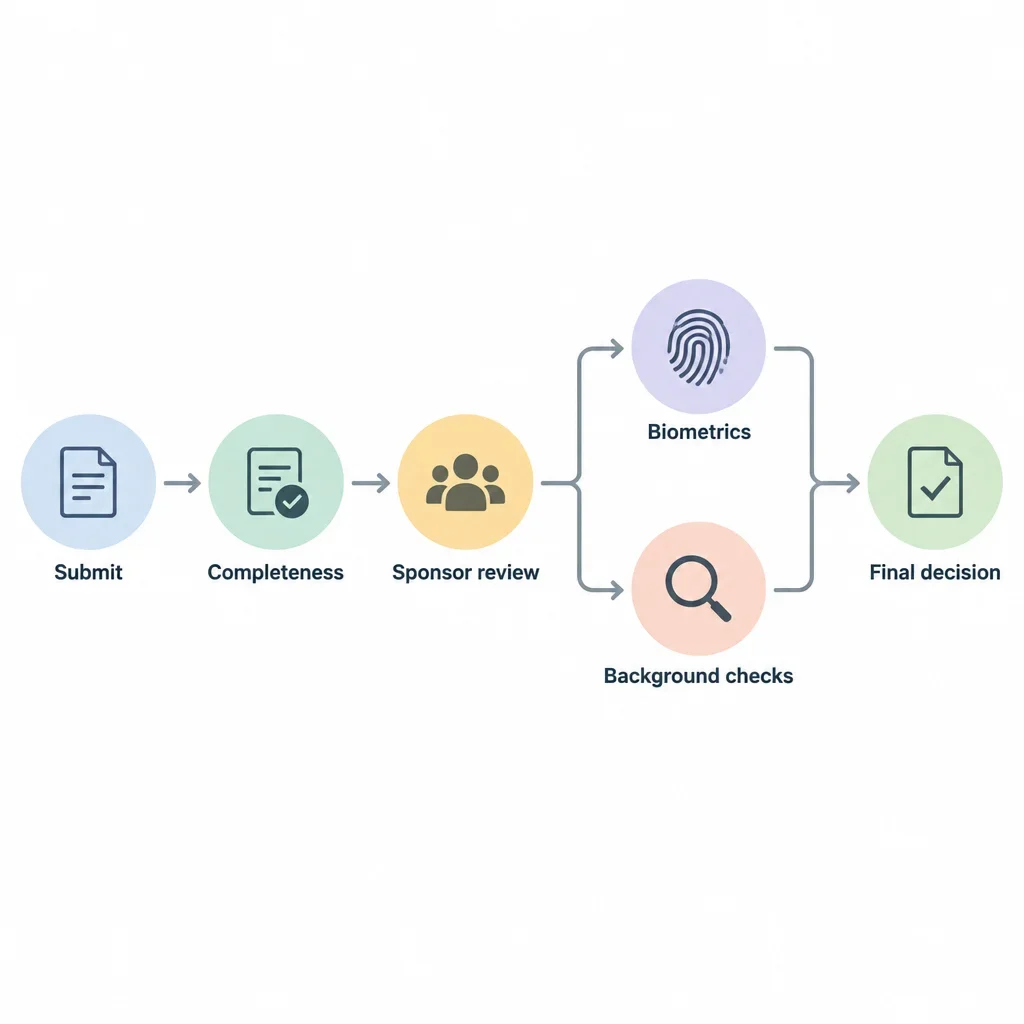
Submission begins processing; it does not mean IRCC has accepted the application as complete or approved the relationship. The usual stages include the following, although requests can overlap:
- Completeness review and acknowledgment of receipt, known as AOR.
- Sponsor eligibility assessment.
- Biometrics, medical or police-document requests, where required.
- Relationship and applicant eligibility assessment.
- Background and admissibility checks.
- Additional documents, an interview or a procedural fairness letter, where needed.
- Final decision and permanent residence confirmation instructions.
A Confirmation of Permanent Residence, or COPR, records approval details, but applicants must complete the applicable finalization process. Applicants abroad may receive travel-document instructions; applicants in Canada may complete virtual confirmation. A permanent resident card is a separate document.
Processing length is driven by the application class, destination province, responsible office, background checks, interview needs and document requests. An inland spouse file and a parent sponsorship file do not share one reliable timeline. AOR, work-permit processing and permanent residence approval are also separate milestones.
Read each request for its specific deadline and required response method. Report relevant changes such as a new address, birth, separation or changed family composition. A birth during processing affects the application even when the family does not plan immediate travel for the child.
Returns, Delays and Refusals Are Different
An incomplete application can be returned without a full eligibility decision. A document request means IRCC needs more information; a refusal means the application has received a negative decision. Those outcomes require different responses.
| Problem | Why it causes trouble | Prevention |
|---|---|---|
| Missing form or signature | Required application components are absent. | Audit every applicable checklist item and declaration. |
| Conflicting dates | Forms and evidence tell different histories. | Reconcile addresses, employment, travel and relationship dates. |
| Unsupported common-law claim | Shared residence is not established for the qualifying period. | Build a continuous cohabitation record. |
| Weak relationship evidence | Legal marriage alone does not establish a genuine relationship. | Show the relationship before and after the ceremony. |
| Missing child disclosures | Family composition and examination requirements are affected. | Declare children and address accompanying status clearly. |
| Incorrect payment or poor translations | Required processing components are missing or unusable. | Match payment categories and translation requirements to the file. |
| Undisclosed refusals or criminal history | Credibility and admissibility concerns arise. | Disclose the history and provide the relevant records. |
A returned application requires a corrected, complete resubmission under the applicable instructions. Do not simply resend the same package with the missing page attached. A return does not preserve temporary status, authorize work or guarantee that the original submission date remains effective.
Refusals can involve relationship findings, sponsor ineligibility, inadmissibility or misrepresentation. An appeal, reconsideration request, judicial review or new application serves a different purpose. The decision reasons, application class and available deadline determine the appropriate response.
Quebec: Separate Federal and Provincial Steps
Quebec sponsorship involves federal immigration processing and a provincial undertaking process through the Ministère de l’Immigration, de la Francisation et de l’Intégration, or MIFI. A package prepared for an Ontario sponsor should not be copied unchanged for someone settling in Quebec.
Federal checklist
- Submit the applicable federal sponsorship and permanent residence application.
- Include identity, civil-status and relationship evidence.
- Complete federal medical, security and criminal requirements.
- Follow federal instructions for the Quebec undertaking stage.
Quebec checklist
- Prepare the applicable MIFI undertaking application.
- Address the provincial financial assessment where required.
- Obtain the required Quebec selection documentation.
- Account for category-specific intake restrictions and provincial requirements.
Quebec’s undertaking rules and intake restrictions require their own assessment. Federal eligibility does not remove a provincial intake barrier, and provincial selection does not replace federal admissibility processing.
Frequently Asked Questions
What the complete checklist includes
A complete family sponsorship checklist covers eligibility, the correct relationship category, sponsor records, applicant records, children, forms, relationship proof, finances, admissibility documents, translations and payment. The final list must also incorporate country-specific instructions and the application’s online declarations.
Permanent residents sponsoring family
Canadian permanent residents can sponsor eligible relatives while residing in Canada. They cannot use the citizen-abroad exception to sponsor while living overseas. A valid PR card alone does not establish that the sponsor meets the residence requirement.
Open work permits during sponsorship
An eligible spouse or partner living in Canada with the sponsor can apply separately for an open work permit under the applicable sponsorship measures. Acknowledgment of receipt and temporary resident status requirements normally matter, with specific exceptions under the relevant measures. Filing the PR application alone does not permit employment.
A spouse’s visitor visa or work permit
A spouse does not receive a visitor visa or work permit automatically through marriage. Temporary entry, work authorization and permanent residence are separate applications with separate eligibility requirements. A pending sponsorship file does not remove the need to maintain lawful temporary status where required.
The supposed four types of sponsorship
There is no single legal rule limiting Canadian family sponsorship to four types. Public summaries commonly group spouses and partners, dependent children, parents and grandparents, and certain other relatives. The actual category and relationship rules determine eligibility, not the number of headings in a summary.
Files that need more than a standard checklist
Previous refusals, criminal records, status problems, missing civil records and cross-border custody issues require a strategy beyond document collection. A procedural fairness letter also requires a response to the officer’s actual concerns, supported by evidence. Adding more photographs will not resolve an inadmissibility allegation or an unexplained omission.
Talk to Sutton Law About Your Sponsorship File
Contact Alex Sutton and the Sutton Law team if you have questions about sponsoring your spouse, partner or child. We can organize your application, assess relationship evidence and address missing documents or a previous refusal. We offer a free initial assessment to identify the issues and practical next steps.